I'm not obsessive nutrition compulsive.
Latest Post

AOI Japanese Restaurant Review @The Emporium Mall
AOI is one of the finest Japanese restaurants in Thailand. It prides itself in authentic recipes & extravagant presentations (website here).
We were meeting w/ a family friend who is also Japanese, so this place was a fitting choice. Many of the restaurant’s customers were Japanese so this place is Japanese approved 😉
The orders that came first were vegetable-based (mine, of course):

(rough names)
Grilled Eggplant in Miso Paste
I kind of changed up the menu names for better sounding… (80% of the English menu names @restaurants in non-English speaking countries make the dishes sound incredibly unappetizing).
I think the eggplant was actually baked.
TASTE – Very good. Although the eggplant wasn’t crispy, they were cooked all the way through & without being mushy. The flavoring was also on point – saltiness of miso & sweetness of sugar. The downside for me would be excessive amounts of oil which the eggplant was drenched in. There was probably more than 2 tbsp of oil in that eggplant bowl (which is not too bad) but unncessary.
What interests me is the fact that the Japanese & Chinese tend to use lots of oil in their eggplant dishes i.e. this Japanese grilled eggplant dish, Chinese stir-fried eggplant w/ pools of chili oil, etc. meanwhile, in Thai cuisine we have dishes like spicy grilled eggplant salad where the eggplant are 100% fat free. Could the oil be used to unlock the beta-carotene & other fat-soluble nutrients in the eggplant? The hot-fire cooking is understandable as a way to get rid of toxins in this Nightshade plant.
But overall, it was so tasty I ate the entire eggplant bowl (that was meant for decoration) in front of my dad’s respectable friend.


NUTRITION – Eggplant has never been hailed as a ‘nutritional powerhouse’. It’s a plant of the Nightshade family that is not so rich in nutrients (per serve) but contain some antioxidants like Nasunin. What eggplants are rich in, however, is fibre. Because of its carb content, it is also more caloric-dense than other vegetables. Eggplant also have certain amounts of toxin, they are an allergen & even contain trace amounts of nicotine. That said, consuming eggplant every now & then should not do any harm. Just don’t get addicted to it! Perhaps this is why in Italian & Indian cuisine, eggplant are often pickled & consumed in small amounts?
The eggplant also comes w/ lots of vegetable oil & a bit of sweet & salty miso paste. Miso is Japanese fermented soybean paste. Miso may contain beneficial probiotics & vitamin-B 12. However, miso is simply used in a small amount as a condiment here, so its nutritional benefit is negligible. This dish is, however, abundant in vegetable oil, which is harmful to your health in large amounts (click here for a simple explanation).
In conclusion, this dish is moderate in calories (max. 150 calories per serve). However, it contained a lot of unhealthy vegetable oil. It contain small amounts of vitamin C, B-6, magnesium & iron. It will also contain at least 20% of your daily intake of fibre (per serve). Although this is a vegetable dish, it should still be consumed in small amounts. This is something I definitely need to practice next time.
Grilled Salmon Salad
TASTE – The salad was just your typical lettuce w/ a bit of purple cabbage & tomatoes. The grilled salmon slices were very well-cooked. Slightly seared on each side leaving the middle raw. They also topped the salad w/ fried salmon skin which I thought were not very crispy & a bit chewy & oily. The salad dressing was very good though (Japanese sesame dressing). Over all, I felt the dish was a bit of a rip off since it was quite expensive by Thai standard & there were not that many salmon pieces nor was the dish very tasty either.
NUTRITION – Salmon is healthful in many ways. It contain plenty of vitamin Bs, good Omega-3 fatty acids & is a great source of protein (100 g = 20 g protein or 40% daily recommendation). Lettuce contain mainly vitamin A, purple cabbage & tomatoes will provide small amounts of vitamin C. 1 serving of this salad w/ dressing (1/2) will provide ~200 calories or less, ~10 g protein, ~50% daily value for vitamin A, ~10% daily value for vitamin C, (this is difficult to say) >600 mg of Omega 3. It is doubtful the sesame salad dressing provide any nutrients other than fat, sugar & flavor.
– – – – – – – – – – – – – – – – – – – – – – – – – – – – – – – – – – – – – – – – – – – – – – – – – – – – –
Here’s the definite star of that dinner:

Wagyu Beef Steak
Undoubtedly, the taste must be great. Why? Because this 6 piece Wagyu dish was so so so so so so so so so so so so expensive. The most expensive Wagyu I’ve ever eaten.
TASTE – Not to say this dish was not tasty, it was not worth the ridiculous price tag. One bite of this beef & it’s a juice explosion in your mouth (okay, this is a bit exaggerated. But the pieces were very fatty). The beef was a bit rough on the edges but moist in the center. There was absolutely 0 beefy smell. I also tried the side veggies (potato & asparagus). They tasted incredible. High-class veggies right there (just kidding). Actually, the potato was very special in which I couldn’t even tell it was potato in the first bite. It was very well-cooked & its texture delicate. Slightly sweet w/ no flouriness.
NUTRITION – In fact, Wagyu beef do not contain that many more calories than normal beef. Its meat may contain more fat content, but often they also contain less protein. In addition, Wagyu beef is prepared in the most natural manner to preserve all its flavors. This means they are often grilled without oil or other additives. Wagyu cattle are also raised in much better conditions. They are often raised in the open, not in a crowded manner & fed high-quality feeds. Wagyu beef contains a high amount of monounsaturated fat, oleic acids & iron. They also contain protein & very little cholesterol. The Wagyu steak is served w/ sour ponzu sauce, chopped chili & scallion. 1 serving of this Wagyu steak (3 pieces) w/ veggies & sauce will provide ~250+ calories, 20 g protein, small amounts of carbs, vitamins A, B, C, some minerals (including iron from the beef) & healthy fats.

– – – – – – – – – – – – – – – – – – – – – – – – – – – – – – – – – – – – – – – – – – – – – – – – – – – – –

Buri Fish Stew w/ Ginger
TASTE – The stew is very flavorful. The fish portion used was the fin, which was fatty & very tasty. Its fattiness was balanced w/ crispy asparagus & fresh ginger.
NUTRITION – Buri or the Yellowtail Amberjack is not an oily fish. It is high in protein & nutrients like Bs, D, E & minerals like phosphorus & potassium. The piece of fish used in this dish, however, is quite fatty (for making stew). Nevertheless, the fatty part contain monounsaturated fatty acids. The soup has also been stewed w/ radish, which is rich in fibre, cancer-fighting compounds & other antioxidants.
– – – – – – – – – – – – – – – – – – – – – – – – – – – – – – – – – – – – – – – – – – – – – – – – – – – – –
Other than the dishes pictured above, we also ordered cold soba noodles, which I had forgotten to taken photos of… The soba were expectedly high-quality & flavorful. Soba has been consumed for centuries by the Japanese as a healthy carb alternative. Soba noodles are made from buckwheat & contain plenty of amino acids, minerals & are low in calories. Read more about soba here. There were also Japanese green tea (highly recommended) & Singh Beer, which you can read about their nutritional value here & here.
This restaurant may be $$$$, but it also serves up healthy & authentic Japanese cuisine. If you are looking for top-grade atmosphere, quality & flavor, this is the place.
Map here:
– Izzy.
Featured Posts

This is pretty shocking! C’ mon people, there are so many better, healthier, and more delicious alternative drinks out there! i.e. http://talesofakitchen.com/desserts/mint-cacao-frosty-smoothie/ or this https://www.relayfoods.com/recipes/FGRX6
So, I wanted to shed some light on the origin of Sriracha sauce & how they were eaten before now where they go into everything from Subway (Sriracha mayo) to donuts (Sriracha icing??)
This BuzzFeed post also represent myself and many other Thais’ shock when they first come face-to-face w/ the Sriracha sensation in the US (and also Europe). We are definitely proud that almost everyone of all walks of life can now say the Thai word “ศรีราชา” (Sriracha – See-ra-sha) although many still pronounce it wrong… On the other hand, some Thais are also frustrated that a Vietnamese businessman (Huy Fong Foods) has received full credit over the popularization of the traditionally Thai hot sauce (angry Thai article about Huy Fong’s Sriracha: http://www.matichon.co.th/news_detail.php?newsid=1362897723).
This claim is debatable as David Tran never patented the sauce nor exerted it was Vietnamese or his own. In fact, he even named the hot sauce in honor of the recipe he had adapted. So, should Thais be angry or happy?
Here is an interesting(?) documentary about the origin of Sriracha…: http://www.theatlantic.com/video/index/374917/the-origin-of-sriracha/
Click on the BuzzFeed screenshots below for 23 Traditional Ways To Eat Sriracha:


(As an extra) while writing about Sriracha, I remembered this Tiger Zoo I had visited multiple times as a child. It shared the name of the world-famous sauce:

Sriracha Tiger Zoo in Pattaya
Credit: http://www.stangtravel.com/13646944/pattaya-sriracha-tiger-zoo
To Thai Tourism Industry: if you really want to ride the Sriracha wave, how about do a “Sriracha Tour in Thailand”? I can guarantee plenty of destinations for the itinerary & bands of hardcore Sriracha followers.
– Izzy

Preface: So, we went on a 3 Day & 2 Nights Boston trip with the purpose of visiting some colleges in the area. It was just my brother & I. And since we are both foodies, we had the freedom to explore all sorts of food destinations in the city (most of them nutritious, of course!)
Our first destination was:

Quincy Market, otherwise known as Faneuil Hall Marketplace (www.city-data.com)
Quincy Market (unofficial name) or Faneuil Hall Marketplace.
The marketplace is centralized around the Quincy Market building (Roman-style temple), and the nearby Faneuil Hall. The interior of the building contains all sorts of food stores which line either sides and create a hallway down the middle. I must also mention that the main dining area has a super epic-looking dome interior.

Quincy Market contained 2 dining areas on 1st & 2nd floors – located right in the centre of the building.
Great architecture – what about the food?
The restaurants all looked very creative & enticing: both the store designs & food appearance. For example, the over-the-top name signs w/ fun illustrations, display shelves stocked full of delicious-looking desserts (http://fratellispastry.com/home/), sizzling pizza bagels (http://bagelvilleonline.com), or juicy bacon-wrapped scallops (http://www.faneuilhallmarketplace.com/restaurant/fisherman-s-net/9895/36713).
However, out of all of them what we wanted to try the most were Boston oysters. Since the oyster bar inside Quincy was selling 6 for ~$16, we decided to head out the building to find a better deal.
Then, we came upon this seemingly popular oyster-specialized restaurant/bar Salty Dog.

They also had nice interior seatings
$14.50 for 6? It’s a deal!

Irish barman meticulously serving up our oysters
The sauce, lemon juice, and taste of the oysters themselves, combined was phenomenal
So, these oysters were delicious. Despite being dead, they still tasted very fresh (zero fishy smell/taste). Although I believe we should at least put not eating any animal alive before freshness!
TASTE – As having mentioned; super fresh, 0% fishiness. Most importantly, the taste was also good – slightly sweet, with a bit of sea-salty (and real salt) tinge to it. Their seasoning combination (fresh mustard + tomato sauce + lemon juice *even better w/ Tobasco) tasted so great w/ the fresh oysters. The pinch of salt the bartender adds on just before also really makes the dish.
NUTRITION – Despite popular myths, oysters are not a high-cholesterol food. It has just about as much cholesterol as other seafood. In fact, oysters are low in fat and calories. 6 medium-sized oysters are only worth ~49 calories*. This serving size also contains 4.4 g of protein! (This is almost 3/4 amount of protein in 1 serving of mozzarella cheese (28 g), with a little over 1/2 the calories of the cheese. This means oysters > cheese = > protein = < calories.) Oysters also contain a whole lot of vital nutrients: it tops the list for high zinc, iron, vitamin B-12 foods, and also contains respectable amounts of magnesium per serving. Personally though, I am actually glad that oysters are considered expensive for many. Rich foods like these are meant to be eaten in meagre amounts; some side effects include bacterial poisoning (raw), allergic reaction, heavy metal poisoning. Oysters are healthy, but the best way is to eat them is the way you can afford (4 stars because the possible dangerous side effects – even pregnant women and children are supposed to avoid them!)
*Note 1: Also, keep in mind that farmed oysters have less cholesterol & calories, and may be even better for the environment than consuming wild ones. The calorie value referenced above is for farmed oysters.
And as for the Salty Dog Seafood Grille & Bar’s overall review? The barmen were all very friendly & attentive to our needs. The other waiters were average. The rest of the diners seemed to enjoy the atmosphere and service (including kids!) But because they forgot our salad order and ran out of romaine lettuce, I have to give them:
– – – – – – – – – – – – – – – – – – – – – – – – – – – – – – – – – – – – – –
Because the clam chowder in bread bowl looked so tasty, we also had to order one (this was within the Quincy Market hall). This time from Boston and Maine Fish Company.

Gigantic bread bowl – the width ~ my 2 fists put together
They basically won my brother over w/ their overflowing gigantic bread bowl.

Mussels pieces
TASTE – The chowder was a bit too starchy and flavor a bit too light. I’ve had better chowder w/ stronger seafood taste. Although they did include lots of small chunks inside. The bread was soft & fluffy on the inside and crispy on the outside. The entire dish was ~60% bread, but overall it is worth $7. (For affordability + filling-ness)
NUTRITION – It’s difficult to predict the precise caloric value of the bread bowl chowder, but from averaging results from different sources + looking at the bread itself, it seems the bread bowl could be somewhere between 600-650 calories. It will not contain much nutrients aside (iron, vitamin B-6, magnesium) lots of carb, >3 g of fibre, and >15 g of protein. The clam chowder on the other hand, may contain even less protein (per serving) than the bread bowl. Most of the calories will come from carb & fat. 1 cup of generic New England-style clam chowder = 201 calories ~7 g protein ~21 g carb (~as much carbs as 1 chewy granola bar) and 0 g fibre. It will contain small amounts of minerals like calcium, magnesium, iron & trace amounts of vitamin A & C from plant ingredients like starch or potatoes. In total, this entire clam chowder bread bowl is probably ~800-850 calories (If you eat this entire bread bowl, 2 stars, since it is so full of empty calories)
Clam is usually a super mineral + vitamin dense food** (rivaling oysters, but w/ more calories + protein), but only tiny pieces are put in the chowder, therefore do not result in any significant health benefits.
**Note 2: clams are an excellent source of vitamin B-12, iron, and protein. Along w/ oysters they are a much better alternative to red meat in terms of nutrition & environmental effects. Most shellfish are high in bioavailable minerals like heme iron (the body doesn’t need to extensively convert, unlike non-heme iron found in i.e. soy products) & essential amino acids.
– – – – – – – – – – – – – – – – – – – – – – – – – – – – – – – – – – – – – –
I wanted some veggies so went to Mmmac n’ Cheese – Green Organic Salads. Unfortunately was met with an incredibly overpriced wilted salad that said ~$5.50 on the board but came out nearly $7. The cashier was very unfriendly, some of the veggies were 1/2 rotten, the ingredients were uninteresting (not even red onions in there!), and the dressing could only be used for 1/2 of the salad. Ultimately, the salad should have costed $2 at most.

Just look at the pruny cherry tomato! It’s worse on the other side…
TASTE – Very basic balsamic vinaigrette. The veggies that were not rotten tasted fine.
NUTRITION – I would just look at the nutrition of shredded lettuce since they put in so little of other veggies. ~150% of vitamin A and traces of vitamin C & Bs at ~30 calories at most. Including balsamic vinaigrette = ~130 calories in total (for being low fat + calories)
Since there was only vitamin A in the salad, I would consider this a nutritional & monetary rip-off.
– – – – – – – – – – – – – – – – – – – – – – – – – – – – – – – – – – – – – –
Then, we went ahead and bought dessert. A seemingly healthy one – toffee apple. But in fact, the toffee apple was 1/2 candy 1/2 fruit (http://www.faneuilhallmarketplace.com/restaurant/berry-twist/2137044613/2138824520). I didn’t realize these were different from toffee apples lightly covered in syrup…

We bought this for $8! Won’t you believe it!?
TASTE – To be honest, the toffee apples in red syrup I’ve had back in NZ (@town fairs) tasted much better (not too sweet) than this candy + caramel combination. The caramel was too sticky + the taste was gummy. Candies + nuts used were just cheap kiddie sweets. BUT the granny smith apple was very tasty + faintly sweet, hence it’s a
NUTRITION – The bulk of the vitamins & minerals comes from the apple. Although Granny Smith apples have not shown to be the most nutritious variety out there (Pendragon apples); they still contain respectable amounts of vitamins C, Potassium, fibre, and some antioxidants. As for the candy sides of it: m&m minis, chopped peanuts, sprinkles, and at least 1/2 cup of caramel all probably equate to at least 200 calories. Including the apples that would be ~300 calories.
– – – – – – – – – – – – – – – – – – – – – – – – – – – – – – – – – – – – – –
So, the Quincy Market food experience was pretty mixed. The most of it was great: pretty surroundings, friendly + lively atmosphere, and the food was mostly pretty good. As for nutrition, they had plenty of healthful options & lots of veggies. It is only up to you to choose good health or overindulgence.
Here is a map of the market:
Later, we went on an after-dinner stroll towards the Waterfront @Northern Ave

View of Boston’s waterfront (near Liberty Wharf)
Then, went to mess about @this place:

 Harvard Club of Boston
Don’t try this at home.
And walked towards Freedom Trail…

Old State House
Strolling around Downtown Boston on a not-cold night – what a beautiful conclusion for our 1st night in this historic city!
Stay in tuned for Boston Trip Day 2!
– Izzy

I just realized I have not shared my BuzzFeed posts with my WordPress readers! I have only started writing on BuzzFeed and hence the posts may not look as professional as some of the food buzzes you may have read on their website. Nevertheless, I have added my own style to the post and included lots of nutritional reviews and healthy eating suggestions.
For those of you who don’t know what BuzzFeed is, it’s one of the hottest internet news website right now (kind of like Huffington Post). It’s based in the States.
Here are my posts:
(Click on the screenshots for the link)


Please tell me what you think (in the comment below or on BuzzFeed).
– Izzy 🙂


So, this morning I had the chance to go to Atticus for breakfast. My brother and I were meeting with his friend, and this chic bookstore/cafe was the way to do it.
The exterior with wide window view and swaggering slogan; bright and unique interior with thousands of books lining the walls, and an island-style kitchen etc., were definitely impressive. But will the taste be the same? And most importantly, the nutritional value.
That morning, the cafe was packed. This could be due to: 1. it was the day after Yale College commencement, hence many relatives were still in the area 2. the food there is really delicious.
We were given bar seating (which I like a lot because it forces you to sit up straight during a meal)

Bar seating
We did not order “big” breakfasts aka bacon w/ scrambled eggs w/ bread, etc. Instead, we opted for croissants & muffin (which are still not the healthiest breakfast).
Here are our orders:
My brother’s

Amelie croissant (w/ coconut, almond, butter, and cream filling). Can you spot the melted butter filling?

almond, raisin, coconut, butter, cream, etc.
Amelie croissant (w/ coconut, almond, butter, and cream filling) $2.85
Taste – the pastry definitely had a buttery taste to it, however, it was not flaky nor fluffy as it was not heated up when served. This also brought down the tasty factor of the filling which contained all sorts of texture like raisins, desiccated coconut, and a bit of almond pieces (?). The cream nor butter wasn’t smooth nor warm, hence making the filling taste more like icing (frosting). The flavor was mostly coconut, and its sweetness just right. This pastry had potentials but because of the dry and coldness, I can only give it 3 stars
Nutritional value – A typical almond croissant w/ filling (the closest to this creation) is ~560 calories. Most croissants are half fat (butter/vegetable fat) half carb (white flour). Butter has very little nutrient apart from vitamin A & D. Most of what you will get from the pastry would be a bit of protein, iron, vitamin B-6, and magnesium from the flour. The filling contained too little raisins and desiccated coconut to amount to any real value. The almonds and cream may contribute a bit of calcium.
Nevertheless, there is more cost than profit here in terms of imbalance between calories consumed and nutritional value.
If you do not have time to make breakfast, instant oatmeal may be a better alternative with more vitamin Bs, iron, fibre, and less carbohydrate, (but also) less protein, per serving. Here is the catch though: Each serving of instant oatmeal is 1/5 the calories of one serving of croissant.
So, if you can fit it in your stomach, you can have 5 packs of instant oatmeal (choose different flavors too!) for breakfast, for the same amount of calories as one croissant, but 5 times the nutrients.
(nutritional value stars) 2.5 stars
My brother’s friend’s selection

Ham and cheese croissant

Lots of ham & cheese inside
Ham and Cheese croissant $2.85
Taste – Definitely tastier than the Amelie croissant. The cheese tasted real and not overdone, the ham was also not dry nor salty. The pastry was once again on point. This is ham & cheese croissant done in a classy way. 3.5 stars
Nutritional value – This croissant do a bit better than the previous ‘dessert croissant’ as the filling contains less fat and more protein. A typical ham & cheese croissant contains ~350 calories. Most of the calories will come from the pastry, which means it will contain similar nutrients as before, such as some protein, iron, vitamin B-6, and magnesium. Some nutritional value will come from ham & cheese. These include a small amount of lean protein, vitamin Bs, vitamin Ds (rich in animal products) and some calcium. Nutrition rating 3 stars
Why such low rating? This is because although the croissant is not too high in calories (calorie ~a typical breakfast food), it still contains high amounts of fat from both the butter and cheese, which if consumed in high amounts and over time can cumulate inside the body as LDL (bad) cholesterol.
For a quick, high-protein, and delicious breakfast opt for one egg omelette w/ cheese, ham (1 slice each), tomatoes, and frozen veggies for ~250 calories. You can have this with whole wheat toast for ~100 calories more (total of ~350 calories) – same amount as the ham & cheese croissant but w/ more variety & nutrients. These include: all sorts of vitamins and minerals from the egg, calcium from cheese, and a boost of vitamin A and C, and definitely fibre (that the croissant lacks) from the vegetables. With wholewheat bread, this will add a small amount of protein as well.
The amount of fat in this omelette will total to around 14 g comparing to 18 g in the croissant, of which half of the fat will be healthy fats/Omega 3 found in egg yolks.
My choice

Good ol’ bran muffin

Dense with bran and raisins
Bran muffin (the seemingly healthy muffin) $2.5
Taste – Lots of spice flavors coming through (ginger, clove, cinnamon – I suspect allspice was used), branny texture (you can smell the oat bran in one bite), and raisins. Despite the bran, the muffin was still soft. The topping was the most delicious part – it was a mix of brown sugar and rolled oats. Not too sweet neither. 3.5 stars. Why such low rating? Because bran muffins are not very tasty in the beginning.
Nutritional value – I had presumed this bran & fruit-filled muffin that looked the most wholesome out of all three, would be the healthiest. I am not entirely correct. A typical innocent-looking (large sized) bran muffin is ~375 calories – more than a cheesy ham & cheese croissant! I’m not entirely surprised. Muffins require more flour to hold shape as it is not a yeast product (compared to croissants), and also a large amount of oil/butter/egg to give it moisture and shape. A bran muffin may contain less fat than a croissant, but it certainly will contain at least double the amount of carbohydrate. However, since a main component is bran, the muffin will at least contain a lot more of certain vitamins & minerals than the refined flour croissant. These include iron and magnesium. These mineral amounts may be even higher than those of instant oatmeal (1 serving). However, oatmeal (1 serving) are also 1/3 of the calories of muffins, and contain (although not in as high conc.) more variety of minerals & vitamins. 3 stars (because why refined sugar for breakfast?)
A quick and healthier option would be raisin bran cereal w/ a dairy alternative i.e. soybean milk. Your typical raisin bran cereal (not the super sweet, “crunch” kind) may not be that nutrient rich, containing trace amounts of iron or calcium unless it has been fortified. This is simply because bran is not a super nutritious food (it’s mostly fibre) in the first place. Cereal fortified with so much vitamins & minerals you can replace them as supplements, simply reveal that the cereal is so processed and junky they must pump all those nutrients back in. Soybean milk is a much better alternative to regular milk as it contains almost all the same vitamins & minerals i.e. vitamin D, Bs (besides calcium), no cholesterol, good fats (that may help lower LDL levels) and lots of fibre (which milk doesn’t contain). All in all, this breakfast would amount to ~310 calories, which means you can also supplement the cereal with a side of 1 navel orange (69 calories) OR 1 boiled egg (78 calories) OR 1 medium banana (~100 calories) for ~379-410 calories, which is roughly about 375 calories (muffin). If you choose these kinds of healthy sides, you will definitely get a much more variety of foods, textures, flavors, and greater volume and nutrients, for about the same calories as a bran muffin. Also, better for your blood sugar & waistline!

Across from out bar seats
I liked the welcoming atmosphere of the store. They also had delicious-looking selections of artisan bread, which (if you sat at the bar) you can see being sliced up for you right from the loaf.
Speaking of which, Atticus is also known for super tasty breakfast menus (which they often serve up with their artisan breads) that “taste like the comfort of home”, and great service (aside from not heating up pastry that time). Also, of course, the scone (which there was only one left by the time we arrived at 9 am!)
Here are some interesting-looking cakes.

All sorts of delicious-looking cakes

Coconut cream cake
I also spotted a coconut cream cake in the display.
Coconut Cream cake
This type of cake is increasing in popularity in Thailand, and also increasing the waistline of Thai people. For those of you who like to believe: since this cake contains coconut (and in Thai variety, also coconut meat), it must be healthier than other cakes (or is it just me who thinks this?) That is wrong.
I have experimented a lot with healthy cake recipes which was a mammoth task. So different kinds of cake simply mean varying ratios of fat : flour : sugar.
Although coconut oil has gained plenty of attention the past few years for being an elixir of great health and forever youth (just kidding), this doesn’t make sugary coconut cream any better!
Nutritional value (not on this particular cake, but judging from past experience and typical ingredients) – Most coconut cream cakes will be based on white cake recipes which are basically plenty of delicious sugar, flour, butter/oil & eggs. Just from the cake base, you will get quite a bit of protein (about the same as eating an egg) & LOTS OF fat (saturated & cholesterol) & carb (including sugars). When the coconut cream filling, icing, and desiccated coconut are added, there will be an addition of trace amounts of protein, minerals i.e. magnesium, calcium, iron, ‘animal vitamins’ aka A, D, Bs, fibre (from the coconut), and definitely MORE cholesterol and saturated fat, well above 100% recommended daily intake (although the ones from coconut is considered medium-chain and not as bad). This means if you don’t want the fat to start piling up, your diet for the rest of the day (after eating this cake) should be plain salad. 2 stars

Snickers made into dessert? Wasn’t it already?
Snickers bar bar – I’m sure you baking experts out there would know the deal with ‘desserts into desserts’ or ‘snacks into desserts’ desserts. What you are doing is no other than doubling the caloric value of those desserts by combining them into one i.e. Snickers salad (3/4 of a snickers + cream cheese + whipped cream per serve), Reese’s pie (all sorts of cream, reese’s cups, oreos, etc.), and definitely cake pops (cake made into more cake…) Nutritional rating… (without having tasted it) 2

Can you spot the lone chocolate scone?
Danish & croissants – seemingly wholesome breakfasts. European breakfast staple. Classic continental breakfasts must-have. I have talked about the unhealthiness of croissants already; in fact, danish pastries are no better. They contain the same basic ingredients: flour, sugar, butter/fat; but danish pastry recipes actually tend to contain more carb, sugar, and also eggs, which most croissants don’t have, and hence taste sweeter + denser. Danish pastries also always comes with sugary fillings and/or glazes and/or powdered sugar. They tend to come at about ~350 calories with no significant source of nutrients, similar small amounts of protein, but more calories than plain croissants of similar size (although this comparison is before the croissant is smeared with jam & butter). But what about the fruits/cheese fillings, do they add any value? The fruit preserves are pretty much pure sugar, ‘fruits’ that has gone through so much processing, heat & baking, that all that remains is simply desiccated fibre pieces. The cheese used is cream cheese, which should be called more like dairy fat than cheese. Nutrition rating 2.5

Chocolate Pecan Flourless cookies
Finally, a healthy dessert? These kinds of flour-less desserts tend to be lower in calories than their flour-containing counterparts. Without the recipe, it is very difficult to make any nutritional evaluation since there is so much variety in cookie recipes, let alone flour-less ones. Nevertheless, there is a trend with flour-less desserts in which they would either:
1. Contain LOTS of powdered sugar & egg whites (like macaroons)
2. Contain LOTS of fats & eggs
So, although less caloric dense, they will still contain very little nutrients but lots of unhealthy fats & sugar.
Overall, our breakfast orders have an average taste rating of 3.3 stars, and average nutritional rating of 2.8 stars. The atmosphere was great, waiters/waitresses were friendly. They had both unhealthy and healthy options for breakfast and other meals. Health & taste-wise, I would not recommend the dessert pastries nor the $1.5 coffee unless you are not a fan of coffee and just want a hot beverage. Not bad!
– Izzy

Preface: I did not keep a food diary during this time, hence the list of foods are only off my memory and may be inaccurate. Also, very important, the food I ate is not the most ideal post-fast food. This post is simply to provide you with a personal account on the effects of breaking a 6 day water fast.
I suggest you read my personal recordings of a 6-day water fast & post-fast Day 1 prior to this post.
– – – – – – – – – – – – – – – – – – – – – – – – – – – – – – – – – – –
The day after post-fast Day 1, I was not feeling as lethargic as the last few days of the fast, but pretty hungry. Since I woke up late, only brunch (breakfast & lunch) was on the menu for me. Afterwards, an afternoon snack and dinner.
Post fast Day 2
Brunch – cabbage soup + naval orange
Afternoon snack – large tomato (about 5*5 inches)
Dinner – naval orange
Reactions: Post-fast foods are supposed to be mostly liquid/blended, however, I only had a limited range of food in my fridge. To make up for this I chewed all my foods very slowly and thoroughly so my digestive systems don’t have to work as much.
The cabbage soup was my first cooked food. I drank the warm soup first slowly, then chewed the cabbage very thoroughly. The soup and cabbage didn’t upset my stomach.

Boiled cabbage in water.
I was still hungry so I had a naval orange – once again, I ate it very slowly.
I only ate when I was hungry. The hunger cues seem to suggest the digestive system was now ready to process more food.
By early evening, I became hungry again, so I ate a large tomato (raw). For dinner, I ate another naval orange since it was the only raw food left to eat and why not have a high-vitamin C food to replenish my nutrient storage?
Post fast Day 3
I woke up not feeling as hungry as the day before (must be because of the larger amount of food consumed on Day 2 comparing to Day 1, and the digestive system still warming-up). Since I also woke up late, I did not have breakfast but had lunch with company.
Brunch – a very small portion of soup (bone broth) with tomato, potato, and tofu + one small piece of pork + a small portion of vermicelli noodles and veggies + mostly raw carrot slices w/ soybean paste (in total: <400)
Dinner – Cooked vegetables & bone broth.
Reactions: I made a few mistakes on Day 3. First of all, I believed that my digestive system would be working full-swing by this time, which was incorrect. Although I didn’t feel any stomach pain, I had a minor diarrhea after brunch.
Secondly, I had eaten either too much or not the right foods (@brunch time) for my condition. This is because I did not feel hungry (signs of indigestion) at all even 5 hours after the very light meal that I had at noon.
– – – – – – – – – – – – – – – – – – – – – – – – – – – – – – – – – – –
Here are websites with better guidelines on post-fast meals:
http://healthyeating.sfgate.com/eat-after-short-water-fast-12064.html
http://www.livestrong.com/article/301457-foods-to-eat-after-breaking-a-fast/
http://www.healthpromoting.com/water-fasting
http://www.allaboutfasting.com/breaking-a-fast.html
And here is a useful quote from TrueNorth Health Center webpage:
Ending the Fast
When participants decide to end their fast, they are encouraged to gradually reintroduce food into their diet. This re-feeding process reinforces good dietary habits and typically requires a period of no less than one-half the length of the fast.
from: http://www.healthpromoting.com/water-fasting
Obviously, I did not follow this guideline thoroughly.
My summary of post-fast guidelines:
– The recovery period (when you are not eating normal meals) should last 1/2 of your fasting period. In the case of a 6 day fast – 3 days.
– Try to consume mostly liquid/blended foods on your first few days of the recovery. Raw fruit/vegetable juice are the best choices, followed by fat-free nutrient-dense broths.
– Eat mostly raw fruits/vegetables during the recovery period. The main idea is to re-energize the body, in a nutritious and quick way. Fruits/vegetables are easily digested and high in vitamins & minerals.
– Avoid foods that are not easily digestible during the recovery period, i.e. protein, fatty foods, etc.
My own tips:
– Take it slow = eat and drink very little at a time, and very slowly.
– Consume only when hungry = in order to avoid overwhelming the stomach with food, and bloating.
– Consume bland foods (at least for 1/2 of your recovery days) = I believe the consumption of salty condiments may have played a role in giving me diarrhea.
I believe the goal is to take as slow as you can in building up to normal meals. Don’t worry about nutrient-deficiency (in the case of short-fasters (1-6 days). Remember that many fasters have survived many more days without even taking in any nutrients. The breaking of a fast is possibly more dangerous than during the fast itself as adverse reactions can happen quicker. Refer to my previous post for examples. So, it is important to strictly follow the guidelines (I am personally lucky to have good enough health to not have serious side effects other than bloating and minor diarrhea).
It is also very important that if you feel very depleted and sick during the recovery period, to contact medical personnels immediately. You may have a medical condition not suitable for fasting i.e. anemia or diabetes OR low electrolyte levels from the fast, that would require medical attention.
– Izzy.

Preface: So, two days ago was my first day of “recovery” from the 6-day water fast that ended one day before that. Let me first start with a short explanation of what a “water fast” is, and what got me into doing it?

What is a water fast? It is basically a type of short-term fast (although I have read a blogger who had water fasted for more than 2 weeks!) lasting typically between 3-10 days; where the only substance one consume is water. The fast’s main purpose is to cleanse the body systems and organs off cumulated toxins, and in some cases to lose weight. You can visit this health clinic’s website for more specific instructions here
Why did I fast?
1. I had gained a significant amount of weight through out the past semester. I was looking for a way to effectively and quickly lose weight (this point will be debunked later on in the post)
2. I had also developed a junk food/processed food habit since being away from home; believing my health had declined greatly, I quickly sought to detox my body system.
3. I had just read this article on GQ about this author who went through the same 6-day water fast and experienced wonderful results, click here, this was also around the same time I discovered that lots of everyday people actually practice/have practiced water and/or other fasts.
This has inspired me to do the same.
Note: I did not totally succeed in a full water fast. This is because I had a cup of coffee and two cups of tea during the 6 days (I had to order something at a cafe). But since the calories in these foods are so little, I considered the fast quite total.
– – – – – – – – – – – – – – – – – – – – – – – – – – – – – – – – – – – – – – – –
Firstly, I would like to clarify a few of these common complaints/side effects of fasting:

First of all, the man who wrote the GQ article described his 6-day fast as “terrible, insufferable” and complained of headaches, restlessness, intense boredom and misery which comes with life without food. In fact, I did not experience many of these mentioned symptoms (I will talk more about why later on in the post).
Insomnia
I did not have any problems with sleeping at all. However, this claim may be inaccurate as on most nights during the fast I stayed up so late that as soon as I crawled into bed, I crashed into deep sleep.
Heightened senses i.e. smell and hearing
Personally, no.
Intense headaches and dizziness
I believe a little bit on the 1st or 2nd day (headaches); slight dizziness when exerted lots of energy.
Boredom
Not at all. In fact, I felt the most creative and excited in these past few weeks during fasting. For me it was such a great way to break the habit of snacking for entertainment/while on the computer. Now, I learned to replace snacking with all sorts of worthwhile activities.
Restlessness & waking up in the middle of the night/early hours
Not at all. I have been sleeping in and getting my full 8 hours.
6-day water fast is an intense and miserable experience
It can get pretty intense especially towards the 6th day, but for me, it has not been a miserable experience.
– – – – – – – – – – – – – – – – – – – – – – – – – – – – – – – – – – – – – – – –
1st Day:
Feeling incredibly fine, the extensive amount of energy could be due to all the heavy Southern Chinese food I gobbled down the night before. A slight bit of hunger detected.
2nd Day:
I remember a faint headache either this day or the 1st. Not very hungry; otherwise, no other notable symptoms.
3rd Day:
Not hungry at all, other than when having smelled delicious food scent.
4th Day:
Not very hungry; similar symptoms to the 3rd Day *A pattern of waking up very lethargic and slowly gaining huge amounts of energy into the evening began here.*
5th Day:
Not very hungry, but feeling more and more lethargic. However, the past few days I have been very sedentary, and hence saved a lot of energy. On the other hand, I actually feel worse than when I was roaming NYC all day on Day 1-2. This day was when I was starting to agree with the so-called ‘misery’ of fasting.
6th Day:
Still not very hungry, but once again very lethargic. Same sort of sedentary lifestyle as for the past few days. I was definitely looking forward to some food and ending the fast on 7th Day.
Post fast:
Do not follow my post-fast diet. It is not entirely harmful, but is not the proper way to end a water fast. Visit the Truenorth health center website for more details. What they had suggested were blended natural fruit juice in the morning, and blended green vegetables in the evening. The aim is to get easily digestible and highly nutritious foods in the smallest amount for a faster’s fragile stomach and depleted nutrients.
I did not have the luxury of a blender nor an array of fresh fruits and veggies, hence these were on my post fast menu:
1 sweet naval orange in the morning (perhaps the fruit was so sweet because of heightened senses, or because it was so ripe almost to the point of going off? I remember enjoying it like a pothead)
1 large tomato (~4 inches wide) for lunch
1 sweet naval orange and 1 large tomato for dinner.
P.S. Right now, not feeling hungry at all despite the small amount of calories.
I will post updates on day 1 and day 2 of post fast as time goes by. Update on Day 2 & 3 here.
– – – – – – – – – – – – – – – – – – – – – – – – – – – – – – – – – – – – – – – –
Here are a few symptoms many water fasters on the internet have not mentioned, and that are worth noting:
Lack of thirst
I realize that many fasters wrote about the importance of drinking measured amounts of water each fasting day, however, some did not mention the lack of thirst (which comes with lack of hunger). This can make drinking water feel forced for many.
Nevertheless, it is still important to drink set amount of water each day to ensure proper hydration and aid in the toxin cleansing process of the fast.
Lack of bowel movements
My bowel movement only began after Day 2 of post fast. However, urination has been normal.
– – – – – – – – – – – – – – – – – – – – – – – – – – – – – – – – – – – – – – – –
My personal positive results of the 6-day water fast:

Better skin
Only after post-fast did I realize how much softer my skin has become, and the lessen amount of pimples (which popped up during the junk food eating and traveling). So, during the fast remember to drink more water and urinate out all the toxins, people!
Weight loss
Since I only had access to a scale on my 3rd day of fasting (and do not have a measuring tape, which is much more reliable) I can only make estimations based on the rate I was losing weight up until Day 3.
After 3 days of water fasting I lost: ~5-6 kg or 13-15 pounds (this is mostly water weight, and if you don’t watch your eating & exercise afterwards, you may rapidly gain back all the weight. Recovery/post fast period is incredibly important!)
Hence, I can only predict that by the end of the six days I lost: ~10-11 kg or 22-24 pounds However, this seems pretty darn crazy, and judging from the mirror, it seemed more like I lost an addition of 3-4 kg or 6.6-8.8 pounds.
This is still an approximate weight (partially water weight) loss of 8-9 kg or 17-19 pounds after 6 days of water fasting.
This makes more sense as it correlates more with other faster’s results.
– – – – – – – – – – – – – – – – – – – – – – – – – – – – – – – – – – – – – – – –
So, should we lose weight with water fasting?
Because the fasting time is so short, at least 50% of the weight loss will be water and not fat. Also, you are not supposed to be doing even moderate exercise during the fast as it is very easy to feel lightheaded, due to lack of sugar in your bloodstream. Exercise is an important component in effective weight loss.
I also found that I had a significant muscle loss during this period (that could not be simply due to sedentary lifestyle the past two weeks), where my muscly thighs went to sausage thighs. This was quite disappointing as maintaing muscle mass is not only important in burning energy, but also in maintaining strong bones.
In conclusion, water-fasting is better suited for detox rather than rapid weight-loss that can quickly pile back.
Why different fasters experience different symptoms/results?
I did not experience many common symptoms of water fasting, such as intense headaches, etc., and I lost more weight than some others I have read of. Why?
There are a variety of factors:
– Different activity levels; resulting in more or less energy usage and weight loss
– Different amount of muscle mass; muscles take up more energy than normal tissue, hence the more muscles, the more energy consumption and weight loss.
– Different amount of fat; those with more muscles than fat may lose less weight over the same period as muscles are more difficult to break down than fat. And also, if you do not have a significant amount of body fat (take the BMI test prior), you should not do a 6-day long fast!
– Different metabolic rate; resulting in varying energy consumption and weight loss.
– Different genes? Why not?
Words of caution about a 6-day (or more) water fast
Water fasts can be potentially dangerous practices.
Lack of readily available source of energy/carbohydrate puts your body into ketosis, where energy from stored fat cells are put into use instead. This process is more laborious than simply taking up sugar from the bloodstream (at times I can actually feel the surface of my stomach warming up and sometimes going a bit reddish, which was super cool), hence this may slow down many of your body functions. I remember my reactions slowing, and blood pressure dropping; meaning getting up from sitting down or from the bed were done slowly and carefully to avoid dizziness.
Therefore, the best way to do a water fast longer than a couple of days is at a spa, retreat, or during a holiday where during the course you can relax, do some light blood circulation exercises, meditate or other spiritual enlightening stuff, and have someone watch over you. I wouldn’t recommend juggling a full-on fast while going to work/school, like this blogger whom i.e. caught buses, went to conferences, travelled across the city. She experienced pretty serious negative symptoms.
Toxins are not only stored in our tissue, but also more so in the fat, by fat-soluble chemicals. Therefore, when ketone bodies are made from fatty acids as a source of energy, an amount of toxic (that has accumulated due to your unhealthy lifestyle and eating) are also released within your body.
This is also where it is very important to drink lots of water to get rid of many of those wastes. If a fast is done for longer, more and more of these toxins will be released in a short period (unlike losing weight gradually over the years) and can potentially poison the body and its organs.
The most dangerous part of a fast might even be the breaking of it.
Here are some excerpts from Breaking the Fast (by Herbert Shelton, Hygiene Review):
The proper conduct of the fast is vitally important. There are really very few practitioners of any school who know how to conduct a fast or how to properly break one. A naturopath in New York City broke the fasts of a mother and daughter, who had been fasting sixteen and thirteen days respectively, on chocolate candy. The gastric and intestinal acidity resulting from this caused great distress throughout the body. I was called in on these cases, and it required four to five days of fasting to get them back into a comfortable condition. This method of breaking a fast is nothing short of criminal.
Dr. Wm. F. Havard records the following cases: “A young man twenty-four years of age who had suffered from chronic constipation and indigestion, fasted twenty-seven days after reading an article in a popular health publication. On the twenty-eighth day he ate a meal of beefsteak, potatoes, bread and butter and coffee. He was seized with violent vomiting spells and could not tolerate even a teaspoonful of water on the stomach. When called on the case I discovered an intense soreness of the entire abdomen and every indication of acute gastritis.”
“A young man about thirty who had fasted on his own initiative for forty-two days attempted to break the fast on coarse bread with the result that vomiting occurred and the stomach became so irritable that nothing could be retained. There was marked emaciation and extreme weakness and every indication for immediate nourishment.”
An Associated Press dispatch dated Aug. 28, (1929) recounts the death of Chris. Solberg, 40 years old art model, following a 31 days fast, which he broke by “consuming several sandwiches.” The sandwiches, a later report stated, contained beef. Ignorance and lack of self-control killed this man.
“Prof.” Arnold Ehret tells of seeing two cases killed by injudicious breaking of the fast. He says “A one-sided, meat-eater, suffering from diabetes broke his fast which lasted about a week by eating dates and died from the effects. A man of over sixty years of age […] his first meal of vegetarian foods consisting mainly of boiled potatoes.”
These cases help to influence many against fasting and yet they are the results of the worst type of ignorance and inexperience. Who but an ignoramus would feed a diabetic case a meal of dates after a week of fasting? Surely fasting cannot be blamed for this result. Before we talk of the evils and dangers of fasting let us be sure that these really belong to fasting and not to something else.
Another account of a guy who broke his 30-day fast improperly and was bed-ridden for a week after that (from Fitness Through Fasting):
Breaking a fast should definitely be planned in advance. Waiting until the last moment to determine what one is going to eat and drink is a recipe for disaster. Take it from me. I have done amazingly-foolish things in years past. One time I broke a thirty-day water fast at a friend’s birthday celebration with burritos, pizza, hot dogs and soda. What a great guy, huh? NOT!
The “celebration” was short-lived. I was bed-ridden for almost a week afterward and my stomach blew up like a balloon. I had severely irritated the digestive system which was NOTprepared for all of the trash I had abruptly dumped into it. I thought I was giving myself a “reward” for reaching my fasting goal. Instead, I got egg in the face and one heck of a health scare. What I did was not only ridiculously-foolhardy but also VERY dangerous.
Credit: http://personalexcellence.co/blog/post-fast-day-4/
– – – – – – – – – – – – – – – – – – – – – – – – – – – – – – – – – – – – – – – –
If you ask me what I think of the 6-day water fast I had just completed, I would say:
In conclusion, it had been a fun and interesting experience. I was very intrigued to see what happens in our daily lives when such an obligatory activity like eating (or even going to the toilet, no. 2) is omitted. Although during the fast, I still went to restaurants with my brother/friends or helped them prepare food, I was still rid of the obligation of sitting down and solely eating. It has taught me how to use my time more wisely, and that eating (especially addictive snacks, or high sugar/fat foods) is only one of the many sources of pleasure in our lives.
Even the post fast/recovery period (where I am only permitted to eat blended fresh fruits and mushy vegetables for the first few days) has greatly helped me re-embrace whole foods. Even watery cabbage that has been boiled in tap water now tastes delicious.
Would I do it again?
Personally, I wouldn’t do a fast this long again (as long as I can keep the current weight down..)
The fast had been quite taxing on the body, and I find that my previous methods of losing weight such as consuming large amounts of vegetables/fruits to replace refined carbs, and eating healthily in general, while ALSO exercising (which I had too little energy for during the fast) did not create negative side effects and were less likely to result in bounce back of weight.
Nevertheless, shorter fasts (1-3 days) should not do much harm, and is a good way to let your organs rest and allow your palate to readjust towards cleaner and more natural foods.
I hope this post helps, and if I had made any inaccurate claims please correct me!
– Izzy

After a morning of 1 hr and 30 minutes torturous wait at the Chinese consulate, we immediately sought out delicious and refreshing lunch.
We walked under New York’s glaring summer sun all the way from the 12th to 9th avenue. Then, finally settled at Mother Burger – a hip looking restaurant bar located in a little restaurant plaza-like setting. Some of the other restaurants include a health snack shop and a luxurious-looking Chinese restaurant, amongst many others.

Giant cow hung up on a wall
The restaurant was definitely uniquely decorated. It had weird decors like a giant cow, trophies lining high shelves (I wonder whether the owner is associated to a sport), etc.

Two TVs in the restaurant
Despite the antique ornaments, the furniture was definitely new or at least clean and sleek. The dark wood seatings induced a luxurious feel. The restaurant interior/exterior was a combination of old-fashioned steakhouse and hipster.

Another shot
My brother ordered the strawberry margarita $5

strawberry margarita – a popular drink
Apparently, incredibly tasty and refreshing, especially with the lime wedge and salt.
And of course, the Mother Burger, the restaurant’s namesake. Only $9

Quite large portion of meat for the price
Because of the cheap price, I worried about the quality of the beef. Could it be pink slime?
Hot burger patties oozing beef fat and cooking oil
Because the restaurant is not a low-tiered one, I figured they couldn’t have used low-quality meat..

Enjoying greasy fries

Assembling burger

Double the size of McDonalds, 40% more expensive?

Typical burger problem – falling fillings

Obviously enjoying this
Final verdict:
The fries looked pretty good quality and so did the burger. My brother didn’t detect any sort of pink slime or floury taste (common of budget meat patties… I know all too well from my dining hall experience). The beef seemed relatively genuine. The buns were a bit floppy and disintegrate-y, nevertheless, this did not take away from the overall good taste of the Mother Burger. By the way, adding in the fries’ mayonnaise is recommended as the burger comes relatively unseasoned.
Taste 4 stars – both their signature dish and drink were pretty delicious.
Atmosphere 4 stars – welcoming, clean, and homey at the same time. The air conditioner was definitely working full swing!
Service 4 stars – I would give it 5 stars if they had WI-FI!! (exasperated shriek) Because the waiters were incredibly courteous and attentive. We were given personalized waiter. I asked him for water-refill about 3 times, and in the end, he gave me a huge cup with new straw. Haha! He also checked on us, asked us if the food was okay.
Cost 4 stars – Affordable; for the great atmosphere, air-conditioning, service, and large portions.
– – – – – – – – – – – – – – – – – – – – – – – – – – – – – – – – – – – – – – – – – – – – –
Once again, we went to experience the high-class life at 5th avenue.
We passed by a Godiva boutique; because of the enticing chocolate-dipped strawberries mountain display we just had to go in.

Free chocolate truffles!
As soon as we got in, a friendly attendant gave us a free Godiva each. The displays inside looked amazing. Everything looked überly delicious. There were croissant-liked coated desserts, biscuits fully dipped in chocolate, and 100+ variations of Godiva chocolates encased in a large glass display counter. Drool.
We actually aren’t that great fans of sweets, and since everything looked expensive, we decided to quickly leave.
*We went to NYC again (and also the same Godiva store) yesterday, so I snapped a few images of what I had mentioned in this post:

Some of the many chocolates on display in the rectangular window box.

That day, they were giving out different flavor chocolate. I think this was chocolate lava.
– – – – – – – – – – – – – – – – – – – – – – – – – – – – – – – – – – – – – – – – – – – – –
Then, it was time to head back to New Haven. We arrived at the Grand Central Station; and since it was already dinner time, we headed to the Grand Central Dining Concourse.
It was my first time there and I was immediately amazed by the luxurious atmosphere of the food court, with high marble/stone ceilings, and Romanesque architecture. The ceiling lights added more to the atmosphere.
Dining area of the Concourse
It looked so chic! The combination of neoclassical – modern was baffling to me!
Indian and pizzeria
They had varieties of cuisine from all walks of life.
Two Boots restaurant bar
This Two Boots restaurant, which seems to cater mostly pizza dishes, even had their own restaurant space. The interior looked very inviting by the way. Modern with lots of bright colors.
Being patriots, of course, we opted for the Thai stall with a funny name – Thai Toon.
Thai Toon
That’s what’s great about patronizing restaurants of your compatriots. The service quality doubles.

Our hardworking Thai ladies

Extremely appetizing Thai food

Chicken basil
Not very Thai, but very tasty. Thai Toon – highly recommended! Great service and food!
Grand Central Market
There was also even a fresh foods market! It looked very clean and well-organized too. Unfortunately, we didn’t have time to browse the place.
So, that is the end of this NYC food review. Hopefully more to come. Hell’s Kitchen or Grand Central Dining Concourse, neither definitely disappointed.
– Izzy

My brother and I were in NYC for two days to run some errand; and since it is summer vacation, this gives us plenty of time to waste (just kidding) explore the city!
Like most Thai people, the both of us are foodies. Hence, my brother decided to take me to explore St. Mark’s Place and satisfy our hunger for Japanese/Korean food. St. Mark’s Place is known as Manhattan’s tiny Japan town.

St. Mark’s Hotel – St. Mark’s Place street sign
So here we were at the beginning of the avenue.
Another view.
It was around 8 pm. There were lots of lights from the many retail stores that lined both sides of the streets in the area. The atmosphere was lively and bustling – though not quite as much as Thai night markets’.
There were stores selling cheap sunglasses, t-shirts, tattoo stores, and lots of (mostly – I did see one or two Western grills/BBQ) Asian restaurants. None of the stalls were of any interest; it was the restaurants that drew more attention.

Oh! Taisho Japanese restaurant
We passed by Oh! Taisho yakitori, the place we wound up at.

Forgot-the-name Japanese restaurant
Many of the restaurants had very interesting exterior decor, with strange ornaments such as these. Almost all were crowded – filled with mostly Chinese college students… At least at the restaurant we went to!

Another entrance of the Oh! Taisho

Brother lining up at the entrance
There was no cue, and as soon as a waiter attended to us, we got a bar seat.

Interior of the restaurant, view from the bar seat near entrance
I must say that the atmosphere was pretty great – it was lively, the waiters were courteous and attentive despite the busyness of that night, and there were no annoyingly loud drunk people.
The interior and seats/tables were also pretty clean.

Further inside, just in front of the restrooms; there were photographs of customers on the wall
We sat out near the entrance, at the bar (Japanese izakaya style!), where night breezes cooled us down from the New York summer weather.
However, personally I preferred the further interior seats of the restaurant where there were a few interesting decors, the tables were much larger, and there was cool air-conditioning. Too dim for my liking though.
Nevertheless, there were also larger 4-6 people tables near the entrance and just outside – if one prefers more lighting and the calm night air.

Browsing the menu
I really love Japanese-style menu as a component of Japanese dining experience. They are just filled with high-quality images, bolded, colorful words, and little notes that makes picking out dishes so much more fun!
As you can see here, we had a pretty good view of the kitchen and the head chef. This added more to an atypical dining experience.

A look at two of the most popular signature yakitoris
Obviously, were not going to finish the party set by ourselves, hence we opted for the b-set. Both consisted of similar ingredients save for the Asparagus bacon, pork, squid legs, and pepper.

Hentai – nope, ‘mentai’ potatoes
I just had to include this in. I had a weird thought and mistook this menu name for “hentai potato”. We all know what hentai means. Turns out the word mentai comes from mentaiko which is Japanese for marinated cod or pollock roe. In this case, the mentai/cod roe was mixed in in mayo sauce, used as fries dip.
Try searching images of mentai on google (then following the recommended food combinations that comes up) – guaranteed delicious saliva-inducing images…

Agedashi or deep-fried tofu
I saw a couple sitting a few seats away from us eating this dish. It looked soooooooo good. Even though we did not have enough funds to also order this; highly recommended just based on looks. Japanese tofu, especially deep fried, is known for being superbly tasty anyway – soft, crispy on the inside, with the addition of sweet soy broth and fish (bonito) flakes.

Looking smug with his Japanese beer.
Unfortunately, I didn’t note down the beer brand. But be assured for good taste and quality.

Here is the B-set! Yakitori!
Chicken, beef meatball, scallion, shrimp, beef yakitoris (skewers) with 2 pieces each (10 in total) for $14.50. And also, the raw cabbage at the bottom (What is it with the Japanese and cabbage? i.e. okonomiyaki, shredded cabbage in almost every salad, especially with deep-fried foods)
In my opinion, I believe the pairing of cabbage and meat is (in terms of taste, not nutrition) to alleviate the fatty/meaty taste, which allows us to eat more of these kinds of heavy/meaty/oily foods. The same logic can be applied to Thai-style skewered meats/sausage – cabbage and chili is the usual combination for those.

Adding chili and soy sauce
Perhaps not salty/spicy enough?

Eating commence!
The verdict: the beef meatballs, although a tad bit overly salty, tasted the best of all – with a crispy and salty exterior, and sweet and chewy interior.
Destroyed one-by-one
The rest? The beef skewers were too dry and salty, the chicken was soft, but tasted average, the shrimp and the negi (or scallion) were pretty tasty.

Japanese chili flakes makes everything better
Overall, the dish was not bad – but not impressive (despite the fact that a Japanese chef cooked it).

Close-up
I took this image of the couple next door (who were eating delicious agedashi before), to capture images of their okonomiyaki.

some Chinese couple’s food – (pictured) b-set and okonomiyaki
Why did I stalk other diners’ okonomiyaki? This is because this dish seemed to be another of the restaurant’s signature. I saw quite a few customers ordering okonomiyaki. It looked really delicious too – dense, soft, packed full of fillings and toppings.

Here’s a zoom-in
Other seemingly popular dishes include other kinds of yakitori, grilled foods (i.e. pig trotters which was super affordable at less than $5 per two trotters), deep-fried foods. The menu had a huge range which also included sushi, although I didn’t see anyone ordering those.
Bonus:

Sriracha and ramen??
We found a white guy sitting next to us ordering Sriracha to eat with his ramen. Americans really can eat this sauce with anything… Next it will be Sriracha cake…
Final verdict:
Although their signature b-set was not super great, I’m sure their other dishes must be pretty tasty (at least they all looked really good!). How else could the restaurant be so packed on a Sunday night?
*Out of 5 stars
Taste 3.5 stars – still many other menus to try
Atmosphere 4 stars – Japanese-like atmosphere with the decor, setting, and Japanese ordering calls.
Service 3.5 stars – Attentive and courteous despite the busyness of that night.
Cost 3 stars – Most of the dishes were quite expensive, save for some i.e. pork trotters (cheap part of the animal)
– – – – – – – – – – – – – – – – – – – – – – – – – – – –
Afterwards, we went for Momofuku Noodle Bar, which was about 15 minutes walk from where we were, however, we were lost so that could probably account for the time frame.
A few blocks away from Momofuku, we accidentally came across this Thai restaurant. This was only because some strange liquid had dripped onto my eye from an apartment by the sidewalk. Hence..? We had to find the nearest shop to go rinse it off.

“Ngam” Thai restaurant and bar
Then, just before exiting we overheard a female Thai chef speaking in Thai to someone else. At that time we finally saw that the name of the restaurant was “Ngam” or “beautiful” in Thai.
If we have time, will try pay a visit. It looked like a high-quality restaurant.
By the time we got to Momofuku it was probably 9 pm (since the yakitori took 30 minutes to cook) and it was so dark that the image I took of the restaurant entrance looked incredibly hazy.
Therefore, I will just describe the restaurant in words instead – the entrance was simple, with a large window allowing passersby to look into the restaurant, vice versa. The door is inscribed with the simple characters: Momofuku with their peach logo. The interior is clean and chic, mostly covered in pale-coloured wood. There were bar seatings and proper table seats. Since I am at it, let me just mention that the toilets were also pretty nice (better than Oh! Taisho which was small and kind of dirty).
So, here is the momofuku menu:

momofuku menu
Momofuku’s way of rebelling against the sriracha craze:

Momofuku own home-made ssam sauce – their own version of Korean chili sauce
It pretty much tasted like your typical Korean spicy sauce (hence much more different than sriracha whose main flavors are spicy and sour). This is sweet, spicy, with a hint of orange (?).
They also had this special frozen beverage that was popular amongst diners. Unfortunately, I didn’t ask what it was, nevertheless, looked very delicious in a glass. Like an orange-coloured milk shake.

Momofuku frozen beverage
Here is the main dish – spicy miso ramen:

Momofuku spicy miso ramen
It contained smoked chicken, poached egg, incredibly chewy and delicious Korean-like noodles, seaweed, and refreshing raw baby spinach which worked well in balancing out the heaviness of the dish. $15

ssam sauce with noodles
Unfortunately, the soup was too salty. So, we were only left to enjoy the meaty and noodle-ly parts of the dish. Ssam sauce tasted great with the dish.

Noodles-slurping
We caught a waitress measuring alcohol with a conical flask.

Drinking alcohol in flask
Final verdict:
The miso ramen was not the best. I don’t know what their other dishes was like, but I also caught a glimpse of their “bun” range or mantou that comes with all sorts of fillings. From the look of it, the mantou looked kind of hard, perhaps the fillings are super tasty to balance this out?
Anyway, the restaurant was very crowded, owing possibly due to the fact that Momofuku is such as big name in NYC. The food was okay; the atmosphere, nevertheless, was very nice.
Taste 3.5 stars – the miso ramen was average, however, we have not yet tried other dishes.
Atmosphere 4 stars – Chic interior designs, non-rowdy diners. Although, for me it looked a bit too simple and lacked the charms of Japanese/Asian restaurants. I would prefer the atmosphere of Oh! Toshio.
Service 3.5 stars – Pretty good service, no negatives.
Cost 2.5 stars – Expensive, for the amount of meat or other ingredients (aside from noodles) that they gave us.
– – – – – – – – – – – – – – – – – – – – – – – – – – – –
About 40 minutes or more later, we visited the Momofuku milk bar which was about 10 minutes away from the noodle bar.
The shop was pretty much about the size of an office room (at least the serving space) and there was a line even late at night. Inside, there was only a small counter to chill for a few minutes before heading out since the space is so limited. On the outside, however, they have recently installed brand-new sitting benches where customers can sit around before heading off.
The shop is not easy to spot, but it has a neon sign with the sole word “milk” that makes it stand out.

Waitress serving customers
The restaurant was cutely decorated with posters and little black message boards. They also had a rack selling popular biscuits, products, and even dog food..

Waiting in line
Momofuku milk bar sells the famous crack pie (which I caught a glimpse of in the display! I had read a biography of the founder a few years ago, hence, was very excited see the aforementioned food. In fact, the very same book was also on display on the rack), crazy layered cakes, other desserts, and soft-serve $4.50

soft-serve
The soft-serve was incredibly milky, and most impressive were the crunchy and cheesy cornflakes which they generously coated on all sides.
close-up of the milky soft-serve
Final verdict:
We have ever only tried the soft-serve, which was already very delicious. Undoubtedly, the other desserts must also be very tasty, for the milk bar to earn such world-wide recognition!
Taste 5 stars – Hokkaido-style milky taste, and uniquely delicious cornflakes crunch.
Atmosphere 2.5 stars – Despite the cute interior, the shop overall doesn’t really have a “restaurant/bakery shop environment”.
Service 3.5 stars – Normal service, no rude cashiers. It is a ‘grab and go’ sort of shop.
Cost 2.5 stars – pretty expensive for a single soft-serve whose proportion was also pretty small.
– – – – – – – – – – – – – – – – – – – – – – – – – – – –
So, that is pretty much it for our St. Mark’s Place adventure (we did get off the area for the last two reviews…) and food review. I hope you readers enjoyed my new restaurant review star system rating! I believe I will keep this up, if it works.
And make sure to at least give this place a visit whenever you are in New York! Good food awaits you!
– Izzy
P.S. Next post will be another NYC restaurant review – Mother Burger and Grand Central Concourse!

A few days ago, my brother and I went to a Japanese restaurant, Sushi on Chapel, with the purpose of having Korean food. This was as close as one gets to Korean food in the Yale area.
The location of the restaurant is not bad. Not too far away from Yale, on Chapel Street (One of Yale’s few high streets). It is located in the ‘underground’. The interior of the restaurant is pretty neat, on the surface it looks pretty high-class. Dimly lit with very little windows.
(Note to self: next time will take more photos of the restaurant with my crap phone, or maybe finally get a professional blogger camera)
The restaurant, which sells a variety of Japanese dishes such as miso soup, donburi, but mostly sushi and sashimi, also has a small menu section for Korean. Apparently, the restaurant owners are Korean.
We didn’t order much: Bulgogi set, spicy fish salad, house salad, and uni sashimi. That all surprisingly came to $40+ including tax!
Here are images of the food:

Spicy fish salad
Spicy Fish Salad (taste review): they used a Korean sweet red chili paste for the dressing. I think they used some kind of tuna fish for the sashimi, and some other kind of lean white fish. They were surprisingly generous with the fish, but not with the salad – hence making the salad too sweet. When asked for more salad, the waitress made us make another order for house salad which cost $4. Not impressed.
Although I loved the ginger salad dressing popular in the Asian restaurants here in the US.
Over all, the sashimi was fresh, the sauce was tasty, and the price was only ~ $12 (or perhaps less?). Pretty good for the amount of sashimi given.

Uni sashimi (two pieces placed prettily in half a lemon)
Uni (sea urchin) sashimi (taste review): I didn’t order the sushi version because I was greedy, and their policy was you get two pieces of seafood with sashimi, and only one with sushi. I’ve been craving uni or scallop sashimi ever since I’ve come back from Thailand. $5. Totally fishy. I’m not an uni connoisseur, but I have eaten enough fresh seafood/sashimi to know what is fresh and not.
Addition of lemon/soy sauce/wasabi/pickled ginger was a must with this dish.
If you are an uni fan, you may be disappointed.
Tip – Squeeze the lemon bowl so the juice comes out and mix with the uni. And is also fun to do.
I stupidly didn’t take any photo of the beef bulgogi set my brother ordered. So here is a google image to give you the picture:

It definitely didn’t look like this. The beef was dry and thinly sliced (hence dry), and there were mostly vegetables. Nearly $20 (forgot the exact price) for about 3/4 cup of dried beef, mounds of veggies (carrots, onions, and some peppers?), a bowl of purple (50/50 white) rice, and house salad with ginger dressing. This was definitely an overpriced but heart healthy dish.
I wouldn’t recommend this dish (although the seasoning was pretty good).
Conclusion:
Positives – Healthy = they mostly served purple rice in their sushi rolls, rice bowls, etc.
– Tasty = tasty food that is mostly tasty because of the store-bought sauces
– Fresh = fresh veggies, and fresh cheap sashimi fish.
– Affordable = only some of the menus.
– Atmosphere = pretty lively with lots of college kids filling the tables.
Negatives – Minimalistic space = the tables are super small, especially for two, which takes away from an enjoyable dining experience.
– Mediocre service = the waitress who was serving us wasn’t very friendly. And made us pay for another order of house salad instead of adding a few leaves to our leafless fish salad.
All in all, this restaurant is not bad for eating sushi – the sushi rolls looked colorful, healthy, and delicious (don’t know about the price though). Personally would not recommend the Korean dishes. Well, it is a Japanese restaurant after all.
– Izzy


In recent years, there have been discoveries with regards to new ways of fixing decayed teeth or enamel, that is – laser treatment. Scientists have discovered that low-powered lasers may be used to activate stem cells and stimulate teeth growth. Its commercial use is currently still being developed.
My question is – is there a cheaper alternative? Can nutrition be used in fixing damaged teeth? It seems that better nutrition can be used to fix many health issues from arthritis to skin problems. What about tooth decay?
General knowledge

Once a tooth chips or breaks, it will never repair on its own. This is because there are no living cells in enamels (in comparison to bone, another calcium-rich organ, which is the house of bone marrow that is abundant in stem cells). Therefore, the damage is done forever. Or is it?
Remineralization

Mi paste??
You would have seen a few dental care products out there that claim to restore damaged teeth by ways of remineralization, including through “fluoride varnish” or “calcium and phosphate paste”.
So what is exactly remineralization? Remineralization is the process in which naturally occurring minerals such as calcium or phosphate (found in the saliva) are added to the effected areas to adhere to weak spots and repair them. Unfortunately, those patches do not become part of the enamel, but are just as hard and lasting.
…and demineralization
In fact, the loss and replacement of minerals in teeth is a natural process which happens daily. Calcium naturally found in saliva should be enough to make small repairs. However, our dietary habits such as high sugar intake, tea and coffee (with sugar) drinking habits, or high intake of acidic foods, can interfere with this natural healing process. These result in weak spots which later become cavities.
In other cases, if there is a calcium deficiency elsewhere inside the body, such as the spine of an osteoporosis sufferer, the calcium from teeth can be pulled to fulfill this need.
The good foods

High-calcium foods
These foods are not problem-solvers, but have high potentials to aid in the remineralization process. Why? Various factors. However, what these foods have in common are that they are whole foods.
High calcium foods: dairy products such as cheese, and milk (alkalizing foods which will decrease the acidity in your mouth that causes plaque and tooth decay. As a result, yoghurt which is acidic is less effective), or dark leafy greens like spinach and kale. Apparently, bone broth or fish with soft bones will also suffice (according to a 1920’s study).
Calcium acts as natural fillers.
High phosphorus foods: meat, eggs, fish, and nuts (especially sunflower seeds and brazil nuts *almonds can fall under both calcium and phosphorus category)
Phosphorus seem to act in the same way as calcium.
Vitamin D rich foods: oily fish (i.e. the famous cod-liver oil), meat, dairy products, soy products, and nuts.Why Vitamin D?
They contain the same benefit to bones, as to teeth – encourage growth and repair.
To pescetarians, vegetarians and vegans – There seems to be not much problem for pescetarians in obtaining the required nutrients. In fact, seafood are amongst the top foods for for teeth repair. However, be sure to not overdo seafood, since mercury poisoned fish, or other kind of contamination has become a real threat to seafood industry and consumers in recent years.
Pescetarians can always look to plant-based alternatives!
It is also easier for vegetarians, since dairy products or eggs are one of the ultimate calcium/other growth-related nutrients, etc. powerhouse. The question of whether dairy products should be regularly consumed is still debated.
For vegans, it’s a different situation. Nevertheless, plant products like nuts, soy, beans, and certain veggies are also very rich in substances like calcium and phosphorus. It is simply that meat-eaters need to eat smaller amounts of their food to obtain the optimum condition. For example, to obtain the the daily requirement of phosphorus, vegans must consume at least one cup of portobello mushrooms, a serving of fortified cereal (cereal will be further discussed), and a bit of tofu each day.
Important: be sure to reduce the amount of phytic acid in the legumes, nuts, seeds, and grains as much as possible (for example, through soaking, sprouting, fermenting, boiling, or roasting). After all, phytic is an acid, and can block calcium and phosphorus absorption!
The bad foods

Sugary, starchy and acidy foods
The categories are pretty big, but mostly the foods we all hate to love.
The main ones:
– sugary foods
– starchy foods
– soft drinks
– acidic foods
Why? Sugar and starch feeds the bacteria which produces excessive acid in the mouth, causing tooth decay. Many soft drinks contain phosphoric acid (completely different to phosphorus due to different chemical structures resulting in different properties) which will wear down teeth, and acidic foods does the same.
Summary: other than better managed nutrition, one must also change one’s habit in order to reverse the effects of tooth decay (to an extent). For example, brushing teeth after meals or regularly flossing.
So, to answer the question, damaged teeth has the potential to grow back with proper treatment. There have been many cases of cavities filling up naturally through the above mentioned nutrition and proper dental care. Therefore, (also according to different individuals), high mineral and vitamin, and low sugar diet is very likely to replace fillers. It will just simply take a bit more effort and time than a visit to the dentist’s!
– Izzy

Preface: I have never really took much notice in this matter prior to very recently when I noticed the epidemic of thick-skinned navel oranges at the college dining halls. I often heard grumbles of “Why is the orange peel so thick?” as students dug into their navel oranges. Then, I remembered, I have encountered especially thick skinned lemons back when we had a lemon tree at home. This led me to wonder what causes different peel thicknesses in citrus fruit, and does this say something about the nutritional quality of the fruit?

Let me first clarify the obvious: with oranges, there are all sorts of varieties which result in; thin rind oranges that are harder to peel but more suitable for juicing, or thick rind naval oranges that are easier to peel. But usually, the fruits of each varieties e.g. satsuma, mandarin, tangerine, or naval, almost always have identical peel thickness. I will be talking about in this post, the causes of different thickness peel in the same variety citrus fruit.

So what causes this?
Nutrition imbalance
Often, thick rinds in citrus fruits are caused by either too much nitrogen or too little phosphorus. To put simply, too much nitrogen will affect the plant’s ability to absorb phosphorus, and thus causing a phosphorus deficiency (When there is more or less of one of these substances, the other will also be affected). When there is too much nitrogen or too little phosphorus the plant will almost always bear small fruits with thick rinds and very little juice.
Backyard gardeners often make this mistake by having added too much nitrogen-rich fertilizer into the soil.
Effect on nutritional quality
Since thick rinds in citrus fruits are most likely caused by nutritional imbalance in the soil, there is potential that the nutritional profile of the fruit will be affected. Thick-rind, dry fruits can be thought of as defect products from factories. Nevertheless, oranges with slightly thick peels but normal interior should not be wasted as this is not an indicator of severe nutrition deficiency.
In fact, all kinds of fruit varieties, including oranges, will contain different traits and nutritional value i.e. vitamin C and citric acid content. For example, check out this chart on vitamin C content in apple varieties: http://www.naturalhub.com/natural_food_guide_fruit_vitamin_c_apple.htm
So how do we tell which piece of fruit is more nutritious? Contrary to popular beliefs, the sourness of a citrus fruit does not indicate high vitamin C content. In fact, a citrus fruit’s sourness depends on its citric acid level. After all, how could a guava which has no sour taste whatsoever contain almost 4 times as much vitamin C as naval oranges per 100 g? The best way to eat fruit and obtain the optimum nutrition is when it is still fresh (vitamin levels decrease over time after the fruit has been picked, and even more so at room temperature), recently picked, and has been stored well. That is local and naturally grown fruits.
Conclusion: thick peel citrus fruits are simply fruits from a tree grown in unfavorable condition. As long as the flesh taste and look fine, they should still be quite nutritious.
Now, I know the story behind the epidemic of thick rind naval oranges at the dining halls. Perhaps the dining services have changed fruit suppliers, or the changes in season has effected the orange tree’s fecundity. Whatever the problem was: save the oranges!
– Izzy

Preface: Lately, my interest have been gearing towards health subjects other than food (I believe this is owing to my decreased food choices, with food and fruits provided to me by the college). Also, I greatly apologize for the lateness in posting. I promise to be more diligent especially during the summer holidays. I myself have dealt first hand with the pain of when one’s favorite blogger no longer regularly updates…
In this post, I shall explore eyesight and bad habits! Bad habits being poor health choices.

It is without a doubt that the typical college lifestyle have messed up my health morals. I am no longer obsessive nutrition compulsive. I have a suspicion that the poor health choices – rather than genetics – I have made has affected my eyesight. Hence, I have investigated into this matter…
My hypotheses are that:
- Poor nutrition (short-term) can lead to poor eyesight.
- Diet high in sugar and fat (short-term) can lead to poor eyesight.
- High usage of computer/smartphones can lead to poor eyesight.
- Lack of sleep can lead to poor eyesight
Nutrition and eyesight:

It goes without saying that ever since the time of our great grandparents there have been beliefs on the relationship of eye-health and food/nutrition. For example, have more carrots for great eyesight, etc. But how much relationship is there really between nutrition and eyesight? And what happens if we abuse our diet?
Food can equate to medicine, and therefore, whatever food we put into our body will affect it. Hence, logistically, unhealthful food will also affect the eyes, an organ in the body. We can look to type-2 diabetes, a diet-related, eye damaging disease as an example.
Diabetes/high blood sugar and eyesight:

Diabetes is the leading cause of blindness in adults, according to webmd.com. And how so? High blood sugar levels directly affect blood flow around the eyes. One, it can cause swelling of the eye lens which causes blurred vision. Second, it can weaken blood vessels and if left untreated can lead to permanent eye damage. Lastly, the worse of all is direct damage to the retina. When damage to the blood vessel becomes most serious, it may lead to complications that causes the retina to snap. This may cause blindness.
This goes to say that high blood sugar which is diet related can have direct damage to eyesight.
When one lives on a junk food diet, obviously other than high blood sugar, high cholesterol would follow.
High cholesterol and eyesight:

When there is abnormally high amount of cholesterol in the bloodstream, this can have adverse effects on your eyesight. Some of these conditions include: retinal vein occlusion. Cholesterol can block blood vessels in your eyes as it can in other parts of your body. Blood supply to your eyes may be cut off or blood vessels may burst. Apparently, retinal vein occlusion usually happen acutely with patients experiencing sudden blurring or partial/total loss of vision. However, in many instances, some vision can be restored with treatment.
Computers and eyesight:

Another part of the equation to bad habit = poor eyesight is incorrect usage of computer/smartphones. This correlation seems obvious doesn’t it? In fact, this association has entered the spotlight more in recent years. But how exactly do computer/phone screens damage your eyes?
Some say the “computer vision syndrome (CVS)” is part of the array of “repetitive stress injuries” common at workplaces, which occurs when one repeats the same motion over and over again, causing stress in certain parts of the body.
When using computers (and even worse, smartphones as letters & images are smaller), one has to constantly strain one’s eyes. Working on computers is different from something like reading books, as the screen is constantly switching which creates screen contrast, varying light value, and also of course, the glaring screen light.
But can this actually damage one’s eyesight? Some sources say overuse of computers will not affect the eyes permanently, however, new researches say otherwise. Some symptoms of minor eye damages caused by computer/smart phone screens include: blurred, double vision, dry or red eyes, eye irritation, headaches, and neck or back pain (I have definitely experienced a couple of these). Other sources suggest that the overuse of these high technology equipments may even lead to conditions like cataract.
Sleep deprivation and the eyes:

I myself have always often experienced dry and sore eyes when not getting enough sleep – often rubbing eyes that day. This led me to question the possible effects of sleep deprivation on the eyes.
In fact, the eyes like any other organ in the body require sleep to recharge and repair. After all, it has been opened and operated the entire day. The lesser hours it receives to rest and repair, the lesser its capability.
One of the main side effects of sleep deprivation on the eyes is myokymia or eye spasm. Got a recurring eye spasm? It’s most likely your body’s sign to sleep more. The other side effect is dry eyes which can result in itchiness, redness, and sometimes blurred vision.
It’s unclear whether lack of sleep can result in the degeneration of eyesight. However, lack of sleep or decrease time for body repair can cause all sorts of health issues and affect all kinds of organs. It’s quite possible that the eyes will also be affected.
In conclusion, 3 of the hypotheses I listed are all health damaging bad habits (the computer one is not as directly affecting). And damages to our body, would most definitely also affect the eyes (in varying degrees). The first two hypotheses (diet related) are easy to solve – you simply need to practice self-control and determination in eating healthful and whole foods. The second two are trickier. Many people, including college kids (whom I can directly relate to), find using computers or sleeping very little something unavoidable. Nevertheless, solutions are there. For example, to lessen the effects of CVS, you can designate times for break from computer use or sit further away from the screen. And for lack of sleep, it simply depends on one’s determination to be healthy, and vigorous planning to make sure that happens.


St. Baldrick’s website link: http://www.stbaldricks.org
My first experience with head shaving for cancer was at high school in New Zealand. A few selected male teachers, and even a female student were having their heads shaved. The funds they raised went towards a cancer foundation. I was very moved by their brave actions (especially the 13 year old girl), and I vowed to do the same one day.
Message (as can be seen on my webpage):
“I’m shaving my head to raise money for childhood cancer research! Did you know that kids’ cancers are different from adult cancers? It’s true. And childhood cancer research is extremely underfunded. So I decided to do something about it by raising money for cures.
Now I need your help! Will you make a donation? Every dollar makes a difference for the thousands of infants, children, teens, and young adults fighting childhood cancers.”
– – – –
I’m sure you yourself is also affected by cancer in some way, whether it would be because of diagnosed family members or friends. I have a couple of family members who has or have had cancer. My grandmother passed away from intestinal cancer before I even had the chance to meet her.
Childhood is one of the happiest moments in our lives, and it is completely unfair that some children cannot experience this in the same way as we have.
– – – –
Since right now, my hair is very long (waist-length), I will also donate my hair to creating wigs for cancer patients.
My personal donate link: https://www.stbaldricks.org/participants/IssariyaManakongtreecheep
– Izzy
P.S. Tell me what you think about this form of ‘head shaving’ fundraisers. Do you think they are effective?

Urine can say a lot about you and your health. Back in the days, urine was doctor’s only pathway to understanding what is going on inside a patient’s body. It still is an important part of medical diagnosis, getting your urine tested is still part of the normal health check.
Therefore, I believe the color of your urine is not something to be ignored. Actually, the color is not the only important indicator but the odor as well.. But I will not go deep into that for fear of scaring off potential readers.
But first, let me tell you a bit of background on how I came to be interested in the topic of urine and health. During the final exams last semester I broke my health rules and fell into a cycle of late night studying – and inseparable from this is late night snacking. During those times, I ate large amounts of sweets. Then, I started to notice a change; in my urine.
It was very yellow despite the fact that I drank the same amount of water. I immediately looked to my dietary habits as the cause. I noticed a pattern of dark-colored urine that usually follows large consumptions of sweets. Although I still haven’t the precise answer to this, through my research, I found that the cause of the dark urine could be excess vitamins being expelled from the body, or if it smells sweet then it is excess glucose being expelled by the liver. Other than food reasons, the cause of dark yellow urine would be liver diseases, etc., which I really hope not…
I believe my body was trying to send me warning messages through urine.
So, here are the types of urine color and their messages on how you should be changing your bad habits!
(I liked the format of this info graphic, but the information is a bit shallow. And sometimes even comical… Isn’t this supposed to be an official health website?? So, I have added some additional information in the captions).

Colorless/white urine is normally accompanied with cloudiness. And cloudiness is bad sign of health implications such as urinary tract infections.

Amber or honey: Could also mean you are taking an excess of caffeine or salt. Then other more serious health issues e.g. hematuria; decreased urine production (oliguria or anuria); metabolic problem; pituitary problem (ADH, or antidiuretic hormone).

Orange: Can be a result of “holding your bladder” for too long OR over-consumption of orange foods (carrots, squash, or food dyes). The drug Pyridium (phenazopyridine) or liver or pituitary problem (ADH, or antidiuretic hormone).
Bright colored urine like blue/green/pink: Usually associated with consumption of food dyes, foods like asparagus (green, with smelly odor), or excess vitamins.
Note: About the urine color changes due to high-pigment foods like pink/orange. I NEVER had this problem even though in the past I consumed HUGE amounts of orange-colored foods like oranges, sweet potatoes, or carrots – to the point where my palms turned orange. And I also used to be raspberries obsessed where I would eat nearly 1 kg worth of frozen raspberries or blueberries with every meal. Yet, at that time, my urine color was always straw colored as I also drank large amounts of water.
Therefore, I wonder how much of those pigmented foods must be consumed to cause visible changes in urine color?

source: http://health.clevelandclinic.org/2013/10/what-the-color-of-your-urine-says-about-you-infographic/
In conclusion, I believe your body is constantly communicating with you with regards to the state of your health. For example, through changes in urine, skin, hair, etc. Therefore, it is not something to be ignored. Sometimes we are too busy with our lives to notice these messages. But making small changes earlier on is always preferable than sitting in the doctor’s office receiving bad news with a darkened and guilty face.
So, let’s make small health changes and have straw-colored urine together!
– Izzy
P.S. Please share your opinions on this health matter OR correct any mistakes I may have made in the comments section!

Sesame bagel

Everything bagel with cream cheese

Typical meal of chicken tenders w/ fries

Thin and crispy chocolate chip cookie

We travelled about 40 minutes from Samroiyod National Park/community to our lunch location. This is the Thai dedication to food. In fact, often times Thai people would devote an entire trip (that could take more than one hour) to delicious food hunting. For example: it’s a weekday, our friend had just bought a new fridge and we want to celebrate, so let’s drive one hour and a half out of the city to have some delicious seafood! We will be back by the time the kids come home.
Anyway, let’s continue onto Huahin trip (Part 2)!
This restaurant called “Jim-Daeng” (which is a pretty interesting name to say the least… I’m not going to include the translation for fear of flagging) rests just across from a quiet beach. Literally, on the way there we passed about 300 small resorts all with open pools (some, horizon pools; fancy that), and pink/orange people staring back at us. Exaggeration. I would say 3-4 small private resorts.
As for the restaurant; how was the taste? I would say that depends on the dish; some were incredibly tasty, some were just average.
For example, this fried squid here was pretty dang dry on top of being tasteless. Since I’m also not a squid fan, eating this was no more different than eating rubber (with delicious spicy sauce)

Fried squid with spicy and sweet sauce
Then there was this super delicious dish which I had forgotten the name of!

Shrimp with Gra-teen vegetable and coconut milk sauce
At least I know what it contains: boiled shrimp, local Thai vegetable called *“Gra-teen” (which you can now find in frozen form in Asian supermarkets! You must try it out!), coconut sauce, and bathed in deep fried shallots.
Before I became health conscious I basically used to eat deep-fried shallots for snacks. They’re that delicious (deep-fried shallots can be bought in Asian supermarkets in packets/bottles). This is a common element in Thai cuisine, where they are often used as garnish on noodles dishes etc. (which I will write about in my next post!)
Anyway, the dish was just a perfect combination of nutty/fatty taste of lightly sweetened coconut milk sauce and crunchy/savory-ness of the deep-fried shallots; on top of the crunchy vegetables and fresh shrimp. How you eat it is: the vegetable, shrimp, and shallots together; topped off with spicy seafood sauce to cut down any fishy smell of the shrimp, and fattiness of the coconut sauce. This along with rice.
I would say this dish is relatively healthful, depending on how much coconut sauce or fried shallots you take with each serving. After all, the ingredients were all natural.
Sadly, since I did not have the **usual photographic freedom, two images is what is left from this restaurant outing. Nevertheless, I can give you a quick breakdown of the what to order at the restaurant – this is a seafood restaurant (duh, right across from the beach. You can literally jump into the ocean right after a meal) and so I would recommend to order their shrimp, fish, squid (if you must), and crab. The shrimp with vermicelli in clay pot was pretty good, so were the other typical Thai dishes like omelette or spicy soups. You can’t go very wrong. I would recommend asking the waiter for their most popular dishes.
The environment was nice, spacious, clean, (but it did have a bit of a canteen feel to it..) and had lots of ceiling fans (imagine tissues blowing everywhere), which is in fact, very important for the summer!
Since I don’t have anymore food photos from this restaurant, here is a bonus image of crispy, sweet, delicious banana roti!

Fried roti – banana filling with condensed milk and sugar topping
Side notes: *”Gra-teen” or “Yod gra-teen” is a local Thai vegetable that is cheap and can be found in almost all parts of the country. It is popular mostly as a health food with digestive benefits. The english name is “Lead tree”, which sounds really scary and inedible (also a part of the acacia tree family. The stuff that giraffes eat), and this is partially true where only the young shoots of the lead tree can be cooked and eaten.
**You readers may have noticed a difference in my posts format where food images have decreased significantly. This is because I did not intend to blog during this Thailand trip, and so did not take any pictures. These pictures are all borrowed. Speaking of which, I should probably credit the photographer aka my brother’s girlfriend.
Not!
Please stay in tuned 🙂
– Izzy


Balcony view from the condominium
We went to Huahin Beach the day after Christmas. It was perfect timing because at that time most people had already gone back to work; Huahin was relatively quiet. And in terms of weather? Perfect. Even during the hottest time of the day (midday), I was still able to go swimming in an open pool. Alright, I did get a tan after 30 minutes, but the sun didn’t feel unbearable.
Maybe it is true that Thai winter is getting colder every year.. #Global warming…
So, what is on Thai people’s checklist when they come to Huahin?
1. Eat
2. Shop (in the open markets)
3. Beach
(priority listing)
However, since my brother’s special someone was also on the trip (her first visit to Thailand), a food binge-filled vacation was out of the question, and touristy-activities were in place
Still, we managed to realize the first item on our list even before we got to Huahin.
We devoured our way to the beach town (which is about 2 hrs and 30 mins away from Bangkok). First, we made a breakfast stop at a popular chain coffee shop called “Black Canyon Coffee” which caters to both Western and Thai food lovers.
Then, as we made our way to the condominium, we happened to pass by a famous “mango and sticky rice” shop, which was sandwiched between the Huahin Sofitel hotel (now taken over by Centara, duh) and a row of shady bars.
Buying two kilograms of sticky rice and two mangoes was an immediate must.

Mango & sticky rice
This is the kind of mango you get, through the hands of highly experienced mango carvers aka homemade.
This looks better:

Pa Jieu – mango & sticky rice
credit: http://www.foodspotting.com/
Undoubtedly delicious. This shop is most known for its aromatic and soft sticky rice; so no carb-skipping on this one.
More delicious food to come. We had our late afternoon lunch at a famous seafood restaurant called Jee Khiao or “Aunt Green”. Don’t even ask.
They are known for their fresh crab and crab meat fried rice (unfortunately not pictured).

Steamed crab

Steamed crab pincher dipped in signature Thai spicy seafood sauce

A typical photograph of someone who thinks they are superior to the animal they are eating

Deep fried fish in sweet & spicy sauce
Verdict: the crab was undoubtedly fresh (they had live crabs in large rectangular tanks in their kitchen), and the seafood sauce was at its usual delicious calibre – sweet, spicy, and aromatic.
The fried rice with crab meat was pretty incredible. The crab meat chunks were bigger than an inch. I also liked how the vegetables and eggs were not microscopic size. Whenever my grandaunt visits Huahin, and unavoidably, the restaurant, she buys kilos of their signature fried rice back to Bangkok . Obviously, you don’t need to do the same to appreciate this dish. It is definitely worth ordering.
Other than this, we had Thai shrimp paste plate with fresh vegetables (‘Thai antipasto’) which was typically good, stir-fried bitter bean (sa-tor) with shrimp & pork mince in spicy paste (I have actually quoted this dish before in my other Huahin post), which was very delicious. We also ordered a superb dish of stir-fried local vegetables (the best vegetables you will have at a restaurant would be local), steamed crab legs (usually eaten with soybean sauce. For some reason, my favorite dish when I was little. The morbidly interactive nature of the dish?), and the deep fried fish in sweet & spicy sauce was definitely the star at the table aside from the crab. Actually, come to think of it, the name might have been deep fried fish in spicy basil leaves sauce. Who knows? It’s been more than a month.
The verdict? the fish was deep fried all right, bathing in all its oily glory. Although, the fact that the restaurant exclusively uses pork lard in their cooking made me feel less guilty. The garlic, chili and basil leaves infusion of the sauce cuts down the oily taste, making the dish an overall 4 stars.
Side-note (my impression on the restaurant’s environment): One, the cook created entirely new vegetarian menu (even using vegetable oil which they normally do not use) for my mum. They were vegetarian fried rice (with huge chunks of mushrooms you can see!) and stir-fried vegetables (with carrots, Shanghai vegetables, broccoli, etc.) that wasn’t even on their menu. And I wondered if they had all those vegetables in stock why not put them on the menu… Anyway, vegetarian friendly!
Two, foreigners will definitely find this an intriguing experience. The waiters/waitresses (whatever they prefer) of this restaurant were almost exclusively transgendered, save for one random middle school aged kid. They were very flamboyant, some with full make-up on. Why at this restaurant? I have no clue. However, I know for a fact that the service industry is one of the few options Thai gay men have for mainstream job. Anyway, that made for an interesting dining atmosphere.
Later that evening, we dragged our well-fed stomachs to the new overpriced/hip tourist attraction that is the “Cicada market”. They open from 5 pm-12 am in the morning, selling all kinds of merchandise from home decorations, to handbags, keychains, and artworks, all in the one-of-a-kind hipster style that modern Thais sought after.
They also have an overpriced food court selling restaurant-quality food (some) at restaurant-price, but at a non-restaurant open sitting area setting. This was where finding seats become intense competition. For those with lower budgets, I recommend the food stalls located in a market just outside the Cicada market area which sells mostly similar food, save for fried insects. For less likelihood of getting diarrhea, opt for the former.
Shoreline walking distance from Cicada market
Shoreline with a stone platform which leads to the sea

Another view of the beach.
Luckily, there was an open beach near the market. Because in Thailand there are no strict laws surrounding beach privatization, many shorelines have become private/resort properties.
The next day, we were incredibly productive and managed to squeeze in a tourist-style expedition (certainly worth the 40 minutes drive from inner city Huahin, which I will elaborate):
We made our way to a little community called “Samroiyod”, located in the province of Prachuap Khiri Khan. This is not just a normal community however; it houses one of Thailand’s national treasures.
First, we arrived at the entrance of the Samroiyod National Park, which was a beach and a cliff face (incredibly picturesque surrounding) with lots of souvenir shops and small local restaurants. Then, we were led on a mildly grueling trek over a mountain, by a tiny eleven year old girl guide (local student, said the official) who was wearing a pair of plastic crocs.
In the middle of the trek (around 20 minutes in total)

At the landing on the other side
There is a larger beach on the other side of the mountain.
Our journey to the “national treasure” has not ended! Another (even steeper) hill later, we came to a huge limestone cave opening.
Limestone patterns

Going down into the cave
We literally had to go down like this to enter the cave. Just kidding there were stairs.

Midway into the cave
Already in the cave:

The Bridge of Death. Dun, dun, dun! It is only named so because wild hogs (when there were more of them) were known to fall down to their deaths here.

Huge gaping hole

Huge gaping hole letting in light, and the Royal Pavilion
All the meanwhile our little tour guide was telling me all the stories behind the seventeen scenic spots within the cave; my brother, his friend, and girlfriend were nowhere to be seen. I got a private tour! On the other hand, we looked a bit like kids playing around in the cave: she would run over to one scenic spot, then I would follow her and listen closely to her descriptions. At one point she said, “Since I am a child, I am prone to to touching objects along the paths” Are you really?
The most impressive scenic spot, and profound discovery to me was the growing stalagmite. As nutrient rich water drips down from above onto the cave floor, little stalagmite grows. They grow into large stalagmite pillars. You could even see the different stages of stalagmite growth through observing a different damp regions of the cave.
Initially, the little girl freaked me out a little when she began her explanation of the stalagmites with, “do you see the little bumps in the ground? They are actually alive”. Then I read the English description.
Overall, the cave was full of mysterious discoveries and spiritual aura. It is definitely, definitely worth a visit if you happen to travel to that region of Thailand. And please support this cute community! How much money can they make out of selling fried chicken and cheap entrance tickets, really?

Lizard (male, according to the little girl)
I love how you immediately strike a beach once outside the cave.

Aspiring male model
Our laziness gave in, and instead of going back the same way (up the mountain), we came to the general consensus of catching a local fisherman’s boat. Even despite the turbulent sea, we were rooting for an available boatman who would risk his life for the comfort of a couple of lazy city people/tourists.
The little tour guide girl assured me earlier that she is afraid of taking boats, but came with us anyway (such dedication to a job). By the way, I thought it was super cute when we were all resting from the after effects of cave climbing, at the National Park’s restaurant, and the little girl guide said to me before she departing briefly, “Wait one second, I need to go buy waffles.” Effects of globalization/Westernization can be felt.
Anyway, a traumatizing boat ride later (everyone was enjoying it except for myself, the little girl (who later claimed it was exciting), my brother’s friend who was worried his expensive import jeans would get wet (don’t worry, we definitely got wet); we arrived at our starting point on the other side of the mountain.
Despite a local auntie’s constant demand for us to buy her fried chicken and eat at the national park, we managed to evade that and set off to our next delicious food destination.
To be continued….

Sprouted barley (after about six hours of soaking)
Yesterday, I had sprouted barley and thought I would share an image of it for the sake of those who would like to know what sprouted barley looked like: notice the little sprouts coming out there?
So why is sprouted barley more nutritious than un-sprouted barley? In fact, not only barley is more healthy fermented and sprouted, a whole heap of other grain-type foods, legumes, beans, etc. can also be made more nutritious through this method.
As I have touched on in the “Phytic Acid” section of my blog, it is a fact that grains, legumes, etc. type foods contain a nutrients inhibitor substance called “phytic acid” which can prevent our bodies’ absorption of important minerals i.e. calcium, phosphorus, iron and zinc. Obviously, this is a terrible thing.
Therefore, since the old ages, our older generations has developed methods for reducing/eliminating phytic acid levels in these very important staple foods of ours through the forms of: fermentation, lacto-fermentation, sprouting, soaking, boiling for a long period of time, etc.
Our first primal ancestor who had created this method is a psychic/genius because it did work! For example, with barley, a research have shown that sprouting them can result in phytic acid degradation of 58%! (source: Journal of Agricultural and Food Chemistry) The same trend of results goes with other grains and legumes, etc. but of course, as with the complicated world of nature and organisms, different methods just has to have varying effects on different types of these plants: this makes phytic acid treatment extremely complicated (to the point I don’t even want to get into it).
Luckily, there is a rule of thumb to reducing/eliminating phytic acid levels in these types of foods which is:
Soak, ferment or sprout them for as long as you can (the longer, the more effects you are afflicting). And if possible, use a combination of all the treatment methods. AND use an acidic agent while soaking (as it neutralize the anti-nutients released)
Of course, being the lazy individual that I am, I did not follow the rule of thumb. And I have good back-up reasons for my apparent procrastination:
1. I have an unrelenting fear that my grains/legumes will go bad during the soaking/sprouting process. This has happened with a batch of quinoa during my period of sprouting amateurism. I was very depressed.
2. I’m still not brave enough to prepare food with the fermentation process as I fear of bacterial poisoning those around me and myself. The only fermentation I dare to do is the yeast-rising during bread making process (does that even count?) Imagine the patheticness associated with self-stomach poisoning oneself…
In conclusion, after six hours of soaking + sprouting the barley, I was rewarded with a batch of delicious, phytic acid reduced, fibre-rich (therefore can help moderate blood-sugar levels… basically the only known barley benefits to me prior to googling…), manganese, selenium, more readily available phosphorus and vitamin B1 along with possibly increased contents of these nutrients as shown in several scientific researches on various grains (source: International Journal of Food Sciences & Nutrition).
Basic Barley Sprouting steps:
1. Take out the amount of barley you would like to sprout. Place this in a container i.e. glass bowl, before washing the grains off any dust.
2. Soak the barley in acidified water about three times the height in which the grains reaches up to in the bowl. Soak for at least six hours or until the barley is soft and looks alive *acidic agent i.e. vinegar – one tablespoon to a cup of water.
3. Drain out the water, wash the softened barley with a large sift, then place back into the bowl that is now filled with a bit of water, just so the barley is dampened. Cover with a cloth and leave in a warm place until the grains have sprouted enough to your liking.
Done!
P.S. If you live in a cold place and will take longer than six hours to sprout your grains, I recommend changing water and lightly washing the grains at every six hours past point.
And by the way, I would like to point out that Thailand/any tropical climate country is such a wonderous heaven for sprouters. Whereas in New Zealand, it takes me more than one day to sprout grains i.e. quinoa, it only takes a fraction of that amount of time in sprouting barley over here. I could have grown barley seedlings by the end of the day if I wanted to but unfortunately, I hadn’t the time nor patience.
Bonus image:

Barley, millet, quinoa and amaranth in rice cooker.
My sign from god: as embodied through the form of symbolic structures created by mixed grains (barley, quinoa, millet and amaranth) in the rice cooker.
Just kidding, they are just holes created as the rice cooker boils, resulting in bubbles surging up in some areas.
– Izzy

At the entrance hall of Maojia restaurant
I apologize for the accidental blurry, romantic lighting on my photo here.
Who would have expected a ‘Mao Zedong’ themed restaurant operating in a small city in Shandong province, Jinan? The restaurant origin is not one but a typical: a businessman simply decided to sell-off the Mao craze which had run thick since the Cultural Revolution in the late 60’s to the late 80’s. Imagine the divinity associated with having the pleasure of dining the food of the great Chairman Mao?
Although the charm is still there, the restaurant’s business has become noticeably quieter. Nevertheless, the food is still pretty tasty, as pretty much all Chinese food are.
We were at Maojia or “Mao’s House” for dinner. We managed to secure a smoke-free seating, where our table were sandwiched between two chain-puffing tables. The restaurant was not the grandest – actually smaller than the No. 56 restaurant (which I was reviewing in my previous post https://obsessivenutritioncompulsive.wordpress.com/2014/07/31/no-56-restaurant-%e9%ab%98%e7%ac%ac%e8%a1%9756%e5%8f%b7-cantonese-style-cuisine-final-review-with-bbq-pork-and-famous-hunan-chillies-fish-head/) with an entrance that could substitute for a 4 stars Chinese hotel lobby, and a dining area that had reminded me of an old-time Chinese Gangster’s lounge (so did the people who came to dine).
The menu were of mostly Hunan dishes (Mao Zedong’s birthplace), while also featuring some of Shandong’s own i.e. sea cucumber in gravy 海参 (Shandong is known for seafood), caramelized sticky sweet potato 拔丝地瓜 (which is one of the most delicious thing ever!!), etc.
Alledgedly, most of the Hunan dishes listed were what Mao Zedong would prefer to eat for his meals. The most famous one of which included:

Hong shao rou or twice cooked pork.
Twice cooked pork 红烧肉 is a dish lots of Asian people drool over, wolf down, then worship the remnance. It basically uses chunks (or slices, in Thailand and Japan) of pork at its fattiest, and with the skin on, which are then stewed, or boiled in dark-coloured and seasoned soup until the skin is soft enough to bite into.
Most of the time though, in China, the skin is still unable to be chewed into because it is so elastic and tough. This is either because they had used older/wilder pigs, or didn’t cook the pork long enough. I hope for the former.
In China, this sort of dish which uses super fat cuts of pork is also called Fei rou 肥肉 “fatty meat” or Ba zi rou 把子肉. In Thailand they are named “Three-layered pork” which is exactly what they are: The top part is the skin which is rich in collagen the same way as this protein is present in other animal skin such as fish skin, chicken skin, or fish belly i.e. salmon belly (grilled – famous Japanese specialty). And the rich amount of collagen in twice-cooked pork is what makes it a dish for ladies wanting softer-looking skin, as it helps increase those amount of skin-firming proteins. The next layer of twice-cooked pork is the most dangerous – the pure, solid fat (also what makes Asians go gaga for it due to the melt-in-mouth texture it creates), then the last layer is the meat.
Hong shao rou is more glamourous version of twice-cooked pork 把子肉 as it doesn’t uses the typical Chinese five-spice combination most used in cooking twice-cooked pork, or hog trotter, but features other ingredients which makes the stewed sauce reddish in colour. And this I have no idea how to make.
However, I know the ingredients which goes in the most typical twice-cooked pork:
1. Chinese Five spices – Cinnamon, Star Anise, Coriander seed, Anise seed and cloves.
2. Other seasonings i.e. soy sauce, brown sugar and salt.
All you need to do is combine all the ingredients together with the pork and hot water and boil/simmer until the pork looks “twice-cooked”.
The taste: It was pretty averagely delicious. The flavouring was on the salty side with a tinge of sweetness in the sauce, the pork was well-cooked and not too soft or hard. There were also some string beans put at the bottom which tasted like the sauce it was cooked in (duh) (String beans are one of the sides often eaten with twice-cooked pork).

Teppanyaki mushroom and braised pumpkin.
I have seen a rise in Japanese cuisine in Chinese culture, although sushi is still not very widespread (About seven years ago, a language student in her 20’s whom I had known through a language school had never eaten a sushi before in her life), elements of Japanese food is quite welcomed by the Chinese population i.e. Japanese tofu (mixed with eggs) and teppanyaki-style cooking.
The teppanyaki mushroom here was pretty delicious! It had consisted of: chopped garlic, chili, juicy and flavorful shiitake mushrroms, possibly Japanese shoyu and lots of oil. The oil was too much for my liking but nothing can diminish the deliciousness of crispy browned garlic, yum.
Then I had made a somewhat fail order in terms of taste with this super bland dish:

braised pumpkin
The name braised pumpkin sounded very tasty and healthy at the same time, but in fact, the dish was simply unseasoned steamed pumpkin covered in healthy little nibbles and a strange tasteless glaze. It was healthful alright.
The dish had consisted of: slices of pumpkins, steamed then pressed together into a bowl, before undergoing another moment of steaming to create the above form. Inside and around the pumpkin dome includes red dates and Bai He 百合 or Lily bulbs, as mentioned in the previous post, is a popular Chinese herb known as a nutritious “cooling” food which can help reduce coughs and other minor discomforts.
I was clearly unimpressed on my first encounter with this dish since A. It was over-price for taste and ingredients i.e. basically being half a steamed pumpkin, B. It was completely tasteless apart for the very, very faint sign of sweetness.
But then, I had discovered this is a common Chinese dish that can be made delicious, and is very simple to prepare. On the street, this dish is known as Honey Pumpkin 蒸蜂蜜南瓜 or syrup pumpkin 糖水南瓜 and although its main flavour is sweet, the dish is often eaten with rice as a side dish.
(This is a part to my slow recognition of the Chinese’ interesting habit of having dessert along with their main meal i.e. seeing people having deep fried red bean-filled sesame balls with savory breakfast, or other sweet side dishes like chopped tomatoes coated with sugar, birthday cake with long-life noodles…)

Honey pumpkin at my canteen
The food at my canteen is never consistent in flavors, at other times the chef has struck gold with their mad stir-frying skills, at other times it seems they had forgotten to put salt in, or splashed in a tablespoon too much of vinegar or chillies.
As a result, my ‘Honey pumpkin’ can sometime be sickeningly sweet or just perfectly flavoured. Pumpkin in itself already has a fair amount of natural sugars, possessing a mildly sweet flavor, additions of sugar or honey should be minimal. This side dish has no surprising flavors, but is delicious in itself, making this a good recipe to make for kids (to get them to eat more veggies), especially since some variations also include raisins (which kids seems to like)
I will put up a recipe post for Honey pumpkin next, but here are some basic ingredients for ‘Chinese University Canteen Honey Pumpkin’:
Pumpkin (chopped into bite sized pieces), raisins (in place of red dates which are more expensive) and honey or sugar.
The method is simple: put everything together then steam until the pumpkin is well cooked.
And now onto the other menu on Mao’s favourites list:

Mao’s favourite tofu dish.
Steamed spicy tofu 蒸豆腐. I must say, Mao’s got pretty good taste for tofu. This dish is made using soft tofu which is then carefully sliced and placed in a dish for steaming. The tofu is then poured on top with a sauce mix of: soysauce, vinegar, chili oil, soybean oil, possibly salt, and topped off with crushed and minced mixture of pickled green chilli and cabbage, fresh chilli, chopped spring onion and then poured on top with black bean sauce and sesame oil.
It had tasted very amazing! It was simply a perfect combination of salty, sour and spicy to a Thai person’s satisfactory standard.
In conclusion, this restaurant had delicious dishes, and it was very interesting to try the food Mao Zedong himself had enjoyed (apparently he especially loved eating the twice-cooked pork). We didn’t get to try the famous Hunan fish head which is a shame, but I can’t imagine it to be such a great loss since the overall cooking was sort of ‘averagely-Chinese-tasty’. The dishes didn’t struck me as being especially delicious, so in the end, I would give this old-charm restaurant a three and half stars.
I have collated pictures from the No. 56 Restaurant which I possess, and have decided to do a final review on the menus on offer at this restaurant.
My last review post on this restaurant was not completely optimistic, with all the criticisms on the oiliness of their deep-fried menus: https://obsessivenutritioncompulsive.wordpress.com/2014/07/20/no-56-restaurant-%e9%ab%98%e7%ac%ac%e8%a1%9756%e5%8f%b7-cantonesehong-kong-style-cuisine-in-shandong-northern-chinese-province/ When in fact, Chinese food is not all about using tons of oil, another quintessential in Chinese cuisine is the utilization of abundance of multicoloured vegetables in dishes.
There are a number of dishes in Chinese cuisine where meat is actually not the main star! This is uncommon in many cuisines around the world.
These pictures were from the second time my dad and I went to the No. 56 Restaurant:

From the left: lotus roots, gingko nuts and sugar snap peas stir-fry, mushroom claypot, and Cantonese-style BBQ pork.

Mushroom claypot
The taste: the mushroom had a rubbery texture (in a good way) which was very similar to what you get with orengi mushrooms. The entwined flavours of garlic slices and oyster sauce, with perhaps a bit of sesame oil and soy sauce was just at the perfect amount. However, the lack of variety in mushroom types made the dish slightly boring, although they did put in a few pieces of shiitake, so they can call it a ‘mushroom medley’.
The awesome thing about Chinese restaurants in China is the fact that their vegetable dishes would always come served filled to the brim with veggies. I don’t know what had started this ‘Large servings Revolution’ with Chinese restaurants, but this trend definitely goes well with vegetables-lovers. All the veggies you can eat! I was in heaven!
(Thai restaurants seem to have not gotten the memo. The serving sizes becomes smaller and smaller by years.)
As for the other types of dishes? You will have to wait and see!

Cantonese-style BBQ Pork
My dad had ordered this dish, all excited about trying a famous Hong kong specialty – Honey roasted BBQ pork (who wouldn’t want to get a taste of some Hong-kong flavours? Regardless in what location), only to be met with disappointment… The pork was more than 50% fat even though traditionally, tenderloins are used in making BBQ pork, and they are supposed to be the relatively lean cut of the pig. And the texture was simply strange, almost like Chinese ham, which is a sweeter but more horrifying version of the American SPAM, the taste was the worse – all fat with tinges of sickening sweetness.

Lotus roots, sugar snap peas, cashew nuts, black fungus mushrooms, gingko nuts, and the little white petals which are part of lily bulbs.
This vegetable stir-fry was sure, slightly over-oiled, but it was still a very delicious and healthy combination: Lotus roots, with its abundance of vital minerals, gingko nuts for memory, lily bulbs 百合 which are good for… (I’ll get back to you on this one. It’s one of the popular healthfoods for Chinese people), green sugar-snap peas for sweet flavors, mushrooms, and some iron-filled cashew nuts.
Some of the ingredients in this stir-fry are actually what Chinese people use in making their healthy ‘dessert soup’. Similar to the ones I have talked about in this post: https://obsessivenutritioncompulsive.wordpress.com/2014/01/04/chinatown-yaowarat-bangkok-style/
And onto the lily bulbs. They are basically located within the most inner layer of the lily flower. In Chinese medicine, they are considered a beneficial herb, being rich in vitamins and minerals, it also has a “cooling” effect (which to those unfamiliar with Chinese/Asian medicine… It’s gonna be a long and complicated talk…). This herb is nutritious and has the quality of producing a feeling of calmness (helping you sleep) and relieving mild coughs.
And it tastes great! It is filled with protein and starch – kind of like chestnuts, but have a nutty flavour to it.
On a different occasion, we made another visit to this restaurant:

Hunan style chillies fish head
Different restaurants have variations on this fish head dish (I myself, am yet to try the authentic version in Hunan), but all would consist of the main components of: huge river fish head split into two sides, mounds of chillies piled on top.
I have already mentioned Sichuan’s obsession with pouring scoops of chillies on their food in my last review on this restaurant, but now we are also encountering a similar chilli action with Hunan dishes, as shown here. The main difference between the cuisines of these two spicy-eaters’ regions, is the fact that Sichuan people prefer to numb their entire mouth with peppercorns while eating meals, whereas Hunan people tend to take it easy on the “麻” or numbing element in Chinese cooking.
On yet another occasion, the same fish head dish was ordered, but at a different restaurant, and it had actually tasted better. As for the Hunan fish-head pictured here, I must say everytime I had it, the fish head would be just a tad bit too fishy for my liking (I’ve had this dish about three times).

It must the differences between fish head sources for those the two restaurants. The garlic and chillies were of little use in covering up the fishy taste. Nevertheless, it was still fish head with its goopey and jelly-like wonderfulness. The chillies were surprisingly not spicy at all (maybe only for a Thai person?) and went well with fermented black beans, which were then all eaten alongside meaty parts of the fish head. They also put a whole lot of thin vermicelli at the bottom which by the time we get to them, had soaked up all the goodness of the spicy soup and fish flavours.

Roasted duck
We also ordered a roasted duck. And sorry for the not-so appetizing image. And now you understand that the meat-eaters in China are really dedicated to the cause. Not even graphical dead animal-moulded images can deter their sense of will.
The taste: same as roasted goose, but blander and less oily.

Stir-fried broccoli
I’ve seen this aesthetics element in Chinese cuisine a couple of times now, where the cook will put pieces of the food in question back together after having cooked it i.e. with the braised pumpkin I had at Maojia restaurant (this review is coming up). With vegetables it’s pretty intriguing to look at, but with animals… I hope they don’t come up with too many variations on that..
Broccoli’s Chinese name once transliterated is actually something along the lines of “Western flower” which I had found quite interesting.
The taste: Basic minced garlic stir-fry seasoned with a bit of soy sauce and given the distinctive Chinese gooey texture with some tapioca flour and water.

Hainan style chicken.
In fact, I only called it “Hainan style chicken” because it had looked and tasted similar to the dish. But without having known the name on the menu, I have no idea whether that was an accurate description. The chicken was slightly bland. I imagine it would have been made in a similar way as Hainan chicken which is basically just boiling the chicken whole in broth, then air-drying before chopping up into desired portions.
However, the sauce eaten with this chicken was beyond awesome. It was a perfect combination of minced ginger and Chinese vinegar with soy sauce, a bit of oil and a secret ingredient that had made the sauce spicy but not in a chilli way.
And this is the end of my review on the Cantonese-style No. 56 restaurant, which when I do return to Jinan, Shandong in China, I probably would unavoidably make yet another re-visit. Why? From the words of locals – “The food is alright, it’s just the best quality dine-in restaurant around here.”
In case you were wondering about the changes in quality and size of my side photos, this is due to the fact that I had switched from using my tablet to my smart phone for camera.. The pictures may be smaller, but at least the food still looks delicious!
On my second night in Shandong Province, China, my dad and I made a visit to this little restaurant by the road, which specializes in “lamb soup“. The shop was located within a walking distance from the Main South Gate of Shandong University.
“Lamb soup” is a popular dish in the Northern regions of China. The hot soup and fat from lamb meat warms up the body and give you energy to fight against the cold during the winter in these regions (Shandong winter is nothing compared to Mongolia or Ha’er bin though)

The signature “Lamb soup” and omelette with green chillies.
Other than “Lamb soup” which was pretty much what anyone who steps foot into the restaurant would order (otherwise you would look like a weirdo going into a Lamb soup shop, looking for fried rice?), one can also order a wide range of “家常” dishes or “Home-style cooked” dishes which seems to be Chinese people’s favourite and go-to food when dining out.
I mean, about 50% of the little restaurants over there would attach a big sign saying “家常” next to their logo just to attract customers.
Anyway, the restaurant was decorated pretty plainly, all the tables were a smooth black, and the chairs accompanying them were rectangular shaped little stools. It seems Chinese people have the habit of sitting on little seats. At least that’s what I’ve found with most public seats which are usually a table and stools set made with stone. Most of the time, I could only sit half a buttocks on the stools each time.
What struck me about the restaurant was the fact that as you walked in, you would immediately be faced with the restaurant’s kitchen, of which there is only a long line of adjoined counters separating the dining area and the working area. Then on the right hand corner, there is a big round metal pot filled to the brim with lamb soup, all boiling and condensing to its delicious flavour through constant stewing. Bobbing up and disappearing the next second within the whitish soup were a few pieces of lamb bones. Next to the lamb soup pot are a small self-serve area where you can help yourselves to dried blackened pieces of spiced lamb which you can have along with the soup.
I had forgotten how much each bowl of lamb soup costed, but it shouldn’t be much since all you get is soup, with about four thin slices of fatty lamb (isn’t it strange to put “thin” and “fat” together in once sentence. Haha.) floating every now and then.
Looking at how calorific, from the colour, and the way the soup had been cooked, I wasn’t that keen on having the soup. But surprisingly, the soup didn’t taste fatty or oily or icky at all. It was actually quite soothing to gulp down the hot soup on a cold February night (like we were outdoors in the cold) I had thought the soup would taste 100% fat from the white colour, but in fact, the texture wasn’t thick. And the ingredients used in flavouring it reduced the queasy feel you normally get from the fat and smell of lamb meat. They must have used black pepper, and some other northern specialized spices in flavouring the soup.
There is something about the taste of lamb that is quite soothing. Kind of like home, and being safe and warm. Which is a sad feeling since you are getting that from eating a baby animal..
I’ve encountered quite a few totally high-calorific looking soup that looked about 1,000 calories per serving, but turned out to not taste that icky, such as this “Lamb soup” (and a few kinds of fish head soup), and I had figured the white colour of the soup must have come from other things in the bones used in making stock, such as bone marrow, and a few other nutritious components (I hope).
Perhaps, the same goes for the white-coloured soup for Ramen noodles. Actually, I think Ramen soup are actually still very calorific because for some soups they put a huge ladle full of pure fat in each bowls.
Back to the main point, being the strange person I am who enjoys the smell of lamb meat, I was pretty smug about sipping on my hot “Lamb soup” but to make things even better, the shop’s other specialty is “烧饼” or oven roasted flat bread which everyone eats along with the “Lamb soup”.

“烧饼”or oven roasted Mongolian flat bread.
This flat bread is of traditional Mongolian recipe. When you order “Lamb soup” the waiter who was this buff guy in a round-necked long sleeved shirt, would immediately asked you how many pieces of flat bread we wanted. And once again, my dad and I were being total obvious foreigners (our passtime within our few days there while my dad was in China), and turned that guy’s head by requesting for only ‘a’ flat bread for ‘each’ person. Silence across the room.
This was because Shandong Province is known for huge food servings, especially wheat based food from giant steamed buns 馒头 bigger than the size of a man’s fist to 饺子 dumplings piling high on top of serving plates. Meat, especially beef is still a luxury over there. As a result, Shandong Province is also known as the home for huge, tall people.
As a result, most frequenters of this restaurant would order two or more flatbreads to go with their soup. Such as these two guys at the next table to us, with a basket stacked high with flat breads, and bowls of lamb soup already piling.
This flat bread was the best tasting flat bread I have ever tasted. It actually had a tinge of sweetness which I am guessing from a mixture of yeast fermentation and a dash of sugar. But it wasn’t all sweet, there was a certain flavour to it that was just right, which I am guessing was due to the chemical reactions between the heat crispy-ing up and browning the bread and the components of the bread itself. Then there was the aromatic flavours of sesame seeds sprinkled on top of the dough that just rounded up the flavour of this flat bread that to perfection. The texture might not have been as to die for as some flatbreads like the soft and chewy Indian “Naan”, but it is pretty impressive flatbread for staying as delicious as it was even though they were left ready made, stored inside big baskets with a white cloth draped over.
And then we also ordered one other dish to go with our small “Lamb soup” dinner:

Stir-fried “家常” home-style cabbages.
This is an example of the oh-so popular range of “Home-style dishes”, stir-fried cabbages with dried chillis. They are often cooked with dried chillis (of course), sliced garlic, and seasoned with soy sauce. Some are also made in a soury sort of taste (with black vinegar), but all their must-have component is the dried chillies. Of course, you can adjust the spiciness to your liking.
There is a funny occasion surrounding the ordering of this dish. Because at the time, I had no idea how to read Chinese, I didn’t really know what sort of vegetables were used for this dish, except that it was vegetables. Then shortly after we made our order, I turned to the kitchen area, and noticed one of the very professional looking chefs in those white chef suits (which I found a strange polar for this little restaurant: the totally, aloof, almost gangster-looking attendants at the service section, and the professional-looking chefs with even chef hats, in the kitchen area) ducked down underneath the counters rummaging through raw materials and returned with a huge whole cabbage which he casually propped on to the chopping board, and promptly proceeded to chopping the whole plant up. I turned to look at my dad and said, half-scared, half-amused asked him whether that was for us.
He looked at me with ‘you-know-the-answer’ look. I was slightly dumbfounded about having ordered a dish of one whole cabbage, stir-fried, but it had turned out to be quite delicious – the cabbage weren’t too wilted, and the seasoning was just right. Soy-saucey (a mixture of a tinge of sweetness, saltiness, and soybean flavours), faintly garlicky and slightly spicy, with the distinctive aromatic smokey flavours of Chinese stir-fries. We made cabbage doner kebabs by wrapping the veggies in the delicious flatbreads.
Also, what I found cool about that restaurant was that they had free spices you can use for seasoning your food. Most tables had a little steel four condiments holder with each jars containing salt, MSG, dried chilli and powdered cumin. I had never encountered self-serving cumin at restaurants so I was pretty excited about that.
I believe from that point on, I started to become more convinced that Chinese food, notorious within the health conscious circle as being too oily or salty, are actually palatable, and in fact, quite delicious. Slowly, from the fat-phobia and carb-reprover I was, I was turning into an authentic Chinese food lover.
Who would have expected to find a fancy Hong-kong style cuisine restaurant in the quiet university district in Jinan, Shandong, and most importantly, one that actually serves very delicious Cantonese food!
On my second day in China, we went to a grand, two-storeyed Cantonese restaurant, a five-minute walk from Shandong University, for a lunch meeting with Chinese friends.
Another surprising thing I have encountered in China, is the size and grandness of some of the restaurants there. Luxury in dining is easily affordable in China. This restaurant had chandeliers, private rooms, lacquered dining table sets, etc. with prices affordable for typical white-collared Chinese workers i.e. prices ranging from around 16 – 80 or more yuan. Actually, most of them has the appearance of an old, gangster lair… which is quite an interesting environment to dine in!
Now onto the food. This is just to showcase some of dishes common in Cantonese cuisine, and also a few with some Shandong flavours. I won’t know all the components of each dishes, but I will try my best to describe them, in the case where you may want to attempt recreating some of the dishes in your own kitchens!

烧鹅 shao e (roasted goose)
Roasted duck is a signature of Hong Kong cuisine (imagine ducks hung behind glass windows at Hong Kong restaurants), but roasted goose is no less a celebrated dish. Roasted goose is, although less popular, more expensive per plate, they are mostly sold in either whole or half a bird, so is better ordered at get togethers. This may be due to the size and quaility of meat? Goose normally has got more delicate textures.
The taste was not bad. Goose meat is softer than duck as the meat seems to contain a higher percentage of fat. The chef made no effort of rendering the meat of its abundance of fat, and this resulted in super moist, roasted goose which is delicious but can leave you with a sickly feeling after the third or even second piece.

Stir-fried mushroom
I have no idea what this mushroom is called but it tasted very intriguing! According to our Chinese friend, it is a native mushroom. This mushroom once cooked didn’t become all mushy like most, but became slightly chewy and elastic. The texture could be compared to squid (They’re vegan squids!). I suspect the chef may have used the ‘stem’ parts of mushrooms where you can often achieve the similR chewy texture once dehydrated.
The mushrooms had been stir fried with heavy oil and seasoned with soy sauce. Although it was well-seasoned and had interesting texture, and flavour, they had used too much oil in cooking it, making the dish also slightly sickly.

Stir-fried chicken with green chillies
Once again, another very oily dish, but its oily feel was slightly reduced by the spiciness of green chillies, garlic and red onions (which are actually purple..)
I really like this Chinese stir-fry combination of garlic, red onions and green chillies (perhaps the equivalent of jalapenos?). When re-creating this combination, you must also use a sweet tasting flavouring sauce i.e. sweet tasting fermented bean paste. The dish would end up with a slight sweet tinge that is overtoned with garlicky flavours and invigorating, spiciness of chilli.
I’ve found that a trend with the meat used in this style dish is soft texture. The chicken above was just incredibly soft with a slight elasticity with each chew that really made the dish perfect, save for overflow of soybean oil (oil most often used in Chinese kitchens). I’ve also had another same-styled stir fry at a different restaurant, but with thinly sliced, lamb (which is already naturally soft with its high fat contents i.e. without marinating) instead of chicken eaten along with ‘bing’ or thin pancakes. It was uber divine!
I believe the key in making this dish is the sweetness in some sort of a sweet soybean sauce i.e. the Korean red-coloured bean paste, and not over-cooking the garlic maintaining the crispy and pungent flavour, and not restricting the oil content. It doesn’t need to be another one of many super oil-drenched Chinese dish, but it can’t be made low-fat, otherwise the essence of the dish will be altered.
Anyway, the half raw garlic helps a lot with reducing queasiness caused by oiliness or meat. It’s always a good idea to eat raw garlic with oily/meaty dish to counteract certain chemicals in those foods.

Fried squid rings and chicken wings with chilli
This is an example of typical Sichuan dish. They love all sorts of fried foods covered with mounds of chili that has been fried along with them. You won’t believe the amount of chillies Sichuan chefs put into each dish, so much chillies that I feel bad that there are so many leftover chillies. Most Chinese don’t even eat the actual chillies: to them they’re only there for the flavour.
Apparently, accoring to my mentor in China, Sichuan people are known as the most good-looking people in all of China due to their diet which is high in chillies. And he also have heard of Chinese researches that had linked chilli-eating and weight loss (You won’t believe how crazy Chinese people in China are about losing weight). Finally, the Chinese have also caught on the diet band-wagon.
I guess that is why the more oily, the more chillies with Sichuan dishes?
What was the taste of the dish like? Basically, deep fried food taste. As you can tell, I’m not much of a fan. But for some reason, they have put sliced bamboo shoots down the bottom as well. I’m quite intrigued by Chinese people’s use of bamboo shoots in dishes, it seems like there are so many of them, they are simply put into every dishes as secondary ingredients. I am yet to learn more of the history of bamboo shoots used in Chinese cuisine…

Fish head soup.
This was a pretty plain fish head soup. It seems they have used a river fish. The soup tasted slightly creamy (essence from fish head) but mostly quite plain and not too strongly-flavoured. Other ingredients included soft tofu, some green vegetables and bamboo shoots.

A deep-fried mushroom medley (I made up the name myself)
This dish was pretty tasty for a deep-fried dish, mostly because it had some vegetables flavours. Deep-fried mushrooms are pretty much one of the few deep-fried foods I enjoy. Chewy and with a slightly soft interior, it was also well-seasoned.

Vegetables stir-fry – some strips of root vegetables (perhaps some variety of bamboo shoots?), spring onions, squid strips and about three small slices of fresh capsicum as a garnish (which I desperately grappled after rounds after rounds of oiliness “fresh veggies!!!”)
This tasted averagely good.

Sweet potatoes, pumpkin in coconut milk.
This was one of my favourite dishes ever at No. 56 Restaurant, and I had gone there a total of five times during my four month stay in Jinan. Imagine the competition it won over.
The sweet and chewy sweet potatoes (could be because I have a strange obsession with sweet potatoes) went very well with the creaminess and slightly gooey texture of the lightly sweetened coconut milk thick soup. The pumpkins gave a fresh taste which helped counterbalance the creaminess of the coconut milk soup.
I believe they had used tapioca flour or sweet potaotes flour in creating the gooey texture of the coconut milk soup. I know Western diners won’t be quite used to this gooey texture, but this is often used in Asian and South East Asian desserts. Their thickened coconut milk soup was also not too queasy tasting as most soup dishes with coconut milk/cream are like i.e. Thai curries, laksa noodles soup, with this dish, I can actually drink some of the soup.
What made this dish especially delicious could be because it was slow-cooked in a clay pot which had given it the special texture and flavour only achieved with clay pot cooking – a sort of slightly burnt and crispy taste.
In this review, I wasn’t all too praising about the dishes shown here, but in our following visits to the restaurant, we became more skillful in ordering the dishes. In the next upcoming reviews (will definitely be more on this restaurant), I will be introducing you guys to one of the most flavourful and healthy Southern/Cantonese Chinese dishes!
-Izzy
Regarding my China Experience, which I will mostly write around the areas of food and nutrition (I will also include a bit of information about Chinese living as well, of course), I had decided that I would start from the very beginning. The first few days of my arrival in China when I started recording my encounter with the foods in China through taking some photos of the foods I ate.
China’s centuries old street snacks:

A steamer filled with sweet and glutinous corns, next to a metal barrel roaster with sweet potatoes placed on the top. Both of them propped firmly on top of a cart. Chinese characters translation from the left: “Eat… Roasted sweet potatoes… Shandong (province in China)”
Roasted Chinese sweet potatoes and steamed corn. The perfect pairing of roasted and steamed sweet-flavoured starchy foods.
(*It would also be a good idea to mention in my first Chinese post where I was staying in China for four months.

Shandong. A northern province in China, one hour plane ride away from Beijing. It is also close to the Chinese state of Inner Mongolia. Known as the birth place of the Confuscious.
Shandong Province is mostly known for being the birthplace of the Confuscious, and for its various pastry foods or 煎饼 jianbing. I was living in the city of Jinan, a medium-sized Chinese city with a modest amount of air pollution.)
Anyway, roasted sweet potatoes and steamed corns have been around on the typical Chinese streets for centuries. As can be seen in a scene of Ip Man (Hong Kong film about the Kung Fu legend, Ip Man) where the main characters grab a snack of roasted sweet potatoes at a stall outside the theatre. This movie was set from the early 1900s to 1940s.

A scene from Ip Man. Sweet potatoes or “Di gua” given out to labourers. The sweet flavours of these starchy potatoes can lift up the worst of spirits!
Why roasted sweet potatoes remain everlastingly Chinese people’s go-to snack foods I don’t know. It could be their distinctive flavourful and sweet taste, and the delicious combination of crispy outer skin and the soft interior (Although most people prefer not to eat the skin, I’m not one of them. It’s the best part!).

Sweet potatoes are sold according to their weight. One big piece would be about 5 yuan. Then the stall owner will put the potatoes in a small plastic bag for you.
Of course, like in many fast-developing countries, traditional foods are starting to go out of fashion, and the younger generation begins to prefer having Western-style fast foods or sweets like chocolates, etc.

Glutinous corn – soft enough to be broken without much force, by hands.

Glutinous corn – 100% no sugar. It is very difficult to find naturally unsweetened glutinous corn sold on the streets in Bangkok.

Roasted sweet potatoes, what it looks like whole.
However, I like how in China, relatively all-natural foods, dishes and snacks are still commonly eaten. For example, steamed corn or roasted sweet potatoes.
Why? One, because these simple snack foods are still much cheaper than snacks like a bag of chips or a bar of chocolate (by at least two times, comparing between weight and values). Two, from what I have observed, Chinese people have a bit of an interest in eating health foods.
Chinese people’s insistence on natural whole foods can be seen in this still-popular “fast-food chain”:

Yongho – fast-food and soybean milk chain restaurant.
Imagine a soybean milk chain store opened in a Western country or even in Thailand? Would it even last longer than a month? And the store even offers ‘orginal’ or unsweetened version of soybean milk on their menu. This would not happen in Bangkok.
I feel like Chinese people’s preference in whole, real foods can be demonstrated in the type of foods served in their fast food restaurants such as Yong Ho, Li Xiansheng, etc. Most of which serves noodle-soup dishes, fried rice or pan-fried pastries.

Yong Ho meal – noodle soup with pot herb (picked veggies) and pork, and soy bean milk and deep fried dough sticks.
These fast-food meals aren’t the healthiest, but at least most of them they aren’t too greasy and includes a bit of legitimate veggies.
I will include a post regarding Chinese fast-food restaurants some time soon because I was quite fascinated with them myself. Chinese fast-food can’t be that much different from typical Chinese dishes though, because naturally they can be prepared very quickly anyway. Just cheaper with less meaty bits and more noodles.
Anyway, in conclusion, Chinese sweet potatoes are the best variety of sweet potatoes I have ever eaten (at least two times tastier than purple skinned Japanese potatoes, or red skinned Korean ones), and the healthiest street food I have ever tried. When in China, do not miss the chance to try out roasted sweet potatoes, available in most regions in China, and usually only during the Winter to Autumn months.
– Izzy
Hello friends, followers, bloggers, internet browsers and readers,
I’m very sorry for having left a cliff hanger which was my latest post on January 18th https://obsessivenutritioncompulsive.wordpress.com/2014/01/18/audrey-cafe-and-bistro-desserts-review-super-scrumptious-sweets-and-a-lovely-atmosphere/. I called the post a cliffhanger as following that I had completely stopped blogging without any notification, and left readers hanging on any possible food adventures that may arise.
So, what could be the reason for my four months absence? And why precisely four months? And what could be that certain entity that co-erced me to not log in to WordPress at all?
It is nothing exciting: I was simply away in China for a Language and Culture course which went on for four months during the gap between the end of high school and start of college.
The course was in Shandong University in Shandong Province, China. And definitely, this trip involved food and more food experiments i.e. trying out native food materials, traditional recipes, snacks, etc. Not so much cooking as I really didn’t have time and the equipments, what with all the class schedulings and sight seeings.

Soft tofu in spicy sauce (soy sauce, sesame oil, chili, etc.) – 毛家 Mao’s House Restaraunt. This was a restaurant which served mainly Mao Zedong, leader of the Chinese cultural revolution, favourite dishes. One of them which includes this spicy soft tofu.
But all in all, I hope to be able to share with you recordings, pictures, and etc. of food and my travel experiences in China, as much as I can before college begins this fall.

Braised Pumpkin (unfortunately have been carved out by a certain hungry person)- 毛家restaurant
Stay tuned for the upcoming, exciting, new post.
– Izzy
*This post is way overdue… It was meant to be posted up around the time of Chinese New Year which was two weeks ago on the 30th of January, however, I have simply been extremely busy. Nevertheless, there is no restriction on when one can admire images of yummy food and learn a bit more about the Chinese New Year food traditions. So here it is (meanwhile, I will work on putting up new posts on restaurant reviews and also interesting Thai fresh produce I have encountered on a recent trip to a fresh produce market)
There is no exact formula for “Chinese New Year” food. Christmas dishes in Western countries tend to be themed around the collection of: turkey/chicken/ham, mashed sweet potatoes, and desserts like Christmas pudding, however, for a celebration like Chinese New Year, the dishes tend to vary a lot.
I’m not being biased, but I feel there are a lot more dimensions in Asian cuisine than Western – whether it would be the method of cooking or ingredients used.
As regards to Chinese New Year, of course, there are a couple of dishes widely present on the dining tables all across Asian (or in countries that celebrate Chinese New Year, other than in China) countries. A sample of Asian countries who also celebrate Chinese New Year other than China include: Singapore, Malaysia, and of course, Thailand. It is usually people of Chinese descents who truly celebrate Chinese New Year i.e. follow the customs (like wearing certain coloured clothes).
The essential components for a Chinese New Year meal which I had mentioned include: a fish dish, roasted duck or chicken, and oranges, just to name a few.
I wanted to share what ‘Chinese families’ eat to celebrate Chinese New Year, so here is the menu of what I ate on the 30th of January.

Here is an impressive tower of Chinese-style filled buns. The buns were shaped like peaches because in Chinese culture and ancient tales, peaches are thought of as “heaven foods” i.e. fruits found in heaven. Therefore, those who eat the peaches will have a long-life (remember the sacred peach tree in Kungfu Panda?) The buns were not bad at all despite looking really hard on the outside. However, once steamed, the buns became cotton soft, and the fillings were.. well, not that special. They include the typical: taro, custard cream (no actual cream used) and black beans.

Here was the menu of our order at the restaurant.

A selection of Chinese-style snacks as hors d’oeurves. The tiny balls are sugar-coated peanuts (super sweet!), next to the balls are “tuo-tad” which in my previous post I had shown the making of. “Tuo-tad” is basically a very crispy and sweet bar made from caramel and nuts. The one next to “Tuo-tad” is “kor-ped-nga” a similar sort of sweet but uses mostly sesame seeds, chewier and less sweet. Beside the sesame seeds are something I had never tried: crystallized winter melon. Winter melon are known for their blandness, and high water content, similar to radish. Extremely low in calories but when boiled in syrup, there is no doubt they would absorb a lot of the sugar. To the left of the “crystallized winter melon” were “rice puffs” style snacks, which taste basically like the Western-style “rice pop bars”.
Onto ‘savoury hors d’oeurves’:

Clockwise from upper left hand corner: wine-soaked chicken. This is a popular ‘upper-scale’ Chinese dish. The chicken has been roasted or steamed, then soaked in rice wine. The taste is of slight tinges of alcoholic sweetness and the texture is very soft, melt in your mouth. The texture of wine-soaked chicken ranges from slightly chewy to really soft, such as this one. Most people would like the soft, almost creamy texture, but this would mean that the chicken has been soaked for a very long time in alcohol, which would have killed off a lot of the vitamins present in chicken i.e. vitamin B’s or omega 6 fatty acids. To the upper right hand corner is one of my favourite Chinese dishes (because it is not so oily and heavy as others) spicy jellyfish. The jellyfish has been tossed in a ‘spicy salad sauce’ of Chinese vinegar, soy sauce, a bit of chili, sesame oil and garnished with chopped spring onions. The taste is sweet, sour and slightly spicy. At the bottom are pork ribs with red wine. The pork ribs are also on the sweet, but mostly salty side. In the middle of the plate is “calamari” or oven roasted battered squid. Personally, this non-fried calamari was not very properly prepared: the batter was too thick and tough, and there were only pieces of squid the thickness of straws. The deep fried squid were served in an elaborate deep fried taro shell which was slightly bland. The squid was sprinkled on top with fried garlic pieces, shallot, salt and chili.

Next we have one of the most famous Chinese New Year dishes, ‘Peking duck’. In Thailand, Peking ducks are normally only eaten with the skin, whereas traditionally in Beijing, the duck meat pieces that have been carved out from the roasted duck are also taken with the pastry. The method of eating Peking duck is taking a piece of duck skin, cucumber and spring onion, then wrap all of this with a thin piece of pastry (basically pancake with no egg). Before rolling the entire mix up into a sizeable wrap, top the arrangement off with a thick, sweet soysauce.
Personally, I prefer the traditional way of eating Peking duck, with the meat because I don’t find much point with eating tasteless albeit crispy duck skin. In Thailand, the duck meat not eaten with the pancakes is then stir-fried with a bit of salt, garlic, and lots of oil which I feel is already too much for a type of meat that is already quite fatty. However, Peking duck (roasted type only) is not the most fatty dish out there despite the oily appearance of the super shiny skin: because the roasted duck are normally squeezed off as possible of oil (hung up-side-down), to achieve the extreme crispy skin.

Stir-fried prawns with garlic and asparagus. The flavour of garlic is actually quite undertoned in this dish. It was not too oily for a Chinese stir-fry (unlike the dishes I’ve had in New Zealand… Thai Chinese restaurants are much healthier). The shrimps seemed to have been initially lightly boiled to achieve a soft texture then quickly stir-fried with extreme heat to achieve a slight crispy exterior yet tender inside. I also liked the fact that this restaurant actually put the effort into shelling their asparagus! (finally I can eat asparagus at a restaurant! Instead of leaving them as chewed up mush on the side of the plate) The sauce which the prawns were cooked in was possibly a mixture of soybean sauce, garlic and flour for a slightly gooey feel.

This was one of my favourite dishes of the night – Braised duck with gingko nuts in oyster sauce – because it was not so oily. Within the dish were melt-in-your-mouth slices of abalone (I find that Asian abalones which are whitish in colour, as compared to slightly blue tinges of New Zealand abalones slightly softer), luscious pieces of boychoy, and a few kinds of mushrooms which include ‘white fungus’ (texture like seaweed) and juicy shiitake. I loved the generous portions of veggies in a not-so-oily gravy. The soft texture of abalone and its sophisticated, seafood flavour went really well with the mushrooms. However, I realized the rule of thumb with seafood is that the harder and more rubbery the texture, the fresher the produce. Therefore, the yummy abalone was in fact about to go off.

Deep-fried soft shell crab with salt and chili. This dish was pretty impressive. The saltiness and pepperiness of the batter was just right, and the flavours of the crab went very well with the crunchy garlic pieces, chili and chopped spring onions. Sure, the batter was thick, but the pieces of soft-shell crabs were pretty generous as well. Thanks crab for sacrificing yourself!

A random image of my mum’s vegan/vegetarian option. The restaurant were super professional about preparing a “orengi” mushroom stir fry with a side of broccoli, and rice noodles with veggies in gravy for my mum’s special dietary requirement.

Steamed seabass with chili and lemon sauce. This was definitely a dish I was waiting for. Fish dishes are one of the healthiest options you can choose at a Chinese restaurant. They are normally cooked with minimal oil, and seasoned with lots of good herbs like…. However, this steamed fish was rather disappointing. It was undercooked, when served, the flesh within was still slightly pink! I could kind of tell from just looking at the scales and skin of the fish, that it has not been well cooked. The inside of the eyes were also still slimy. We did send the fish back, only to receive it back upon the reason that if cooked longer, the fish would become too mushy (and also some weak argument about the lighting causing the flesh to appear pink). I suppose the fish was quite fresh, because none of us got diarrhea after eating it! The sauce was not bad: garlicky, herby and slightly spicy and sour. It was however, a bit too sweet to be Chinese! I feel like the restaurant was going a bit too Thai-fusiony with their dishes.

This was what they have done to perfectly juicy roasted duck. Thai people prefer the flavours and chewy texture of fried duck in garlic. This can be eaten with fried rice.
Other than the foods pictured, there were also the “shark fin soup” (dun, dun, dun!) that came after the hors d’oeuvres, hokkien-style noodles that came before dessert which nearly everyone had to take home because they had already eaten so much (which is a shame because they have an auspicious meaning of ‘long-life’. Oh well, we already ate fish meaning having a surplus for the year). And also the dessert which was chilled sweet tapioca and cantaloupe in coconut milk.

This was one of the desserts exchanged by family members at the restaurant. A Thai dessert called “Look-choop” shaped into orannges, for a Chinese New Year twist. “Look-choop” was also a childhood favourite of mine, because the mung beans mixture which are later encased in jelly (to hold shape) can be molded into a variety of delicious-looking, colourful mini fruits. But I remember I did not like the taste much which was rather “beany” (as a friend’s friend from Australia whom I took around had accurately described, “just like eating beans”) and not so sweet.

Stay in tune for my next post about my “Chinese New Year holiday” in Thai’s beach district, Huahin!
– Izzy
My dad is one heck of a cook I tell you. However, being Chinese, he has no idea how to use spices. Salt, soybean sauce and pepper are his condiments of choice: making delicious dishes out of only three seasoning ingredients is pretty impressive (which supports my claim that my dad is a good cook). All you need to do to believe me is try some of his recipes out for yourself! Such as this one!
And being Chinese, my dad cooks very quickly. He is able to make two Chinese-style stir-fries in 5 minutes, which is a handy skill when you are cooking for very hungry teens.
This delicious canned fish recipe would be done and ready for serve in 5 minutes.

Who would’ve known that one can make an exotic fish salsa from canned fish? What you need is simply some canned mackerel, tuna, tomato sauce and onions (preferably red)
Canned fish is not only a cheap source of protein, it also comes packed with lots of nutrients like omega-6 and 3 oils, fat soluble vitamins found in fish, and calcium (because the bones becomes very soft and therefore edible).
Although one must also keep in mind about the saturated fats that can come when your canned fish has been cooked in other sauces or soaked in vegetable oil. And as with canned foods, canned fish tend to also be very high in sodium.
Nevertheless, owing to the decent taste and convenience of canned fish, when you are desperate for a filling and nutritious source of protein, this is the one to turn to!

My dad never does anything with little or no effort. Therefore, canned fish for him shall not be eaten as they are. So here is his flavourful rendition of canned fish:
Canned fish salsa
Ingredients
1 can of mackerel in tomato sauce
1 can of tuna in oil
1 onion, chopped
Half a lime
1 red chili
A dash of pepper and salt
Method
Stir fry the canned fish in a pan at medium heat, along with the chopped onions. The mackerel will come to smaller pieces as you stir fry the mix. Simmer the mixture at low heat until the onions become soft. Add lime juice. Season with salt and pepper to taste. Enjoy!

This was the brand of canned fish we had used. Although any mackerel or even tuna in tomato sauce would do.
About the amazing taste:
This canned fish salsa is simply delicious. It is a blend of slight saltiness, spiciness and sour. It is not sweet, but has slight aromatic hint from the onions. Most of all, despite coming from canned products, it tastes very authentic. This is brought about through the use of fresh ingredients like red onions, chili and lime.
This canned fish salsa can be eaten alongside salad, or with noodles/spaghetti as some sort of a pasta dish. Add a bit of olive oil (my dad chucked in about a tablespoon) for an Italian twist when eating with pasta! And voila! You’ve got a super easy and versatile recipe to experiment with!
-Izzy
*Just a note: this post was first drafted at the start of the week, so “today” doesn’t literally mean today.
Once upon a time, there was a very famous coffee shop with a funny name of “Kopi” that my grand uncle and aunty just had to go to every weekend. Even during the boiling points of the Thai anti-government protests, they had to go to this restaurant.
The story is that on the past weekend we – our family which includes “Ah-tia” granduncle, his children or mum’s cousins, my aunties, uncle, and the little children (my baby cousins) – decided to make a group visit to this “Kwan-riam floating market” so highly recommended by my mum and I (Previous post here: https://obsessivenutritioncompulsive.wordpress.com/2014/01/24/kwan-riam-floating-market-a-brand-new-floating-market-experience-when-contemporary-meets-modern-day-thai-part-1/)
That weekend, grandaunt or “Ah-lao Goh” happened to have flown over to Chiangmai for a trip (Chiangmai is only an one hour plan ride from Bangkok, and so some Thais just fly over to the beautiful north to chill on the weekend *stay in tune for my review on a Chiangmai resort!*) so we were not fortunate enough to have her jovial company for the day.
But before going to the market, “Ah-tia” of course would love to pay the coffee shop/restaurant “Kopi” another visit. So we all: 10 odd people decided to go to the restaurant for our breakfast.

This was the entrance to the restaurant. Its full name is “Kopi Hia Thai Ki” which is a Chinese ‘Taechew’ dialect. The coffee shop has been operating in Bangkok for over 60 years and it just happens to be located next to my favourite spot in the city: the monument of democracy. In other words, where the biggest party of Anti-government demonstration takes place.
(I paid a sight seeing visit to the protesting grounds in this post: https://obsessivenutritioncompulsive.wordpress.com/2014/01/11/taking-a-stroll-down-the-thai-protestors-headquarters-free-thai-style-salad-and-the-infamous-grilled-chicken-restaurant/)
In fact, we heard loud bangs while driving on the motorway towards the “Rajdamnern” district where the coffee shop is located. Later that evening, we would learn of the violent outbreaks which took place around the area.
But anyway, not even citywide demonstrations can stop people from eating, consumers from buying, and shop owners from selling, especially in a country like Thailand.
So here we were at the “Kopi” restaurant/coffee shop:
(A view from the opposite side)
The restaurant mostly sold breakfast food, some Thai dishes, and definitely coffee.
Note: what’s interesting is the self-service at this shop. Unlike most Thai restaurants where you normally get about three waiters/waitresses surrounding your table while you uncomfortably eat (it’s just me who’s still not used to it), this shop elects for its customers to come up to collect their orders. (Don’t know why, but it’s a nice change so no one complains *get some exercise*)
As you can see in the image, they also sell Chinese style buns or “salabao” in Taechew dialect. These buns are everywhere in Thailand! Many restaurants include them in their menu, ready made in see-through steamers.
The restaurant displayed their appetizing menus on to the walls. Their entire interior was kept in good condition despite the old age, and decorated with antiques – remnants of the old Thai culture.

As you can see in another view of the restaurant here, antiques include: Grandfather clock, they also had black-and-white pictures of the old Siam stuck on the wall elsewhere
(just a random note: their bathroom was also pretty clean. The door was made of wood, and they used an old-fashion lock system which was a plank of wood through some sort of a wedge, to go with the old-fashion Thai-Chinese atmosphere *have you seen Chinese movies set in the old times? It looked like on of those locks into big courtyard doors*)
Of course, we had to order coffee at “Kopi”
Afterall, Grandaunty had highly commended “Kopi”‘s coffee as “super good”. This was later emphasized by my mum who had a normal hot “Kopi” coffee with milk.

This was one of my many aunties’ order (not aunty by blood, but my mum’s cousin’s partner): “Coffe-te” which is Thai coffee mixed with a bit of cane sugar juice, milk and condensed milk. The coffee looked most aesthetically impressive so it was the only drink order I took a photo of (also because the aunty was sitting at my table haha – convenience.)
Other than that, we have a photo of my “Kopi” coffee order too!

I would normally order an iced latte at coffee shops (least strong) but because I happened to have a cold and a slightly funny throat: cold drink or milk was out of the question (Dairy products can increase production of phlegm in your throat), but since Grandaunty so highly recommended “Kopi” coffee, I had to order one!
One order of which was “Cha-fae” – “Cha” means tea and “fae” comes from the way Thai people pronounce coffee i.e. “Ga-Fae”. Believing the drink, which was a blend of ceylon tea and coffee, would not be as strong as pure espresso, I took large sips of the warm drink to soothe my throat.
I was so wrong! The “Cha-fae” was incredibly strong. The inclusion of ceylon tea had made the drink even more bitter with a herby aftertaste. I imagine the drink would taste much better with the condensed milk that is normally served with it.
I can now say that “Kopi” definitely uses real coffee, and for those coffee-weaklings such as I myself, “Kopi” also has a wide range of yummy looking drinks such as their iced lattes, infamous “Choffee” which is a mixture of chocolate and coffee, and a whole variety of other Thai iced drinks like Thai iced tea, “iced milk” (red syrup with milk – kids’ favourite), etc. or iced green tea with milk.
And now onto the food orders! Before I go on, however, I would like to note that the restaurant’s food portions were very small. Even smaller than the average ‘Thai portions’ (about half). And Thai portions are about 2/3 of the standard ‘Western servings’ (where coming back and dining here has been a great change from stuffing my face back in New Zealand, for fear of wasting food)
The reason why the restaurant halve their serving sizes could be because they are more of a “cafe” setting. However, they don’t only sell the breakfast type foods they are famous for i.e. Thai noodles dishes. Nevertheless, this also means the prices of each dish are reduced.
This was their infamous “pan eggs” or “Kai grata” served with a small toasted baguette filled with Chinese sausage – 75 baht.
It was dubbed by the restaurant as ‘the “pan eggs” you must try at least once in your life’ (oops! I didn’t)

To be honest, it did not look that impressive at all. The dish was two eggs, some Chinese sausage, minced pork and a few peas, all cooked in a small pan.

But what about the taste?
Words from my aunty (this time by blood – my mum’s sister) guaranteed my prediction: the “pan eggs” were not “all that”. The flavours were of seasoned eggs, minced pork stir-fried in soy sauce, and a little bit of sweetness from the Chinese sausage. Basically, the dish was something one can make at home.
Here is another one of the dishes on their recommended menu:

Pork rib stew with fried egg – 69 Baht. Because it was so cheap, be ready to expect two pieces of pork on bone only! The stew soup also looked very thin, as if it hadn’t undergone the proper period of slow-cooking at all.
Because of the small portions and low price of each dish, most of the members of our bandwagon of family ordered two dishes – which is a good thing because we were able to try more dishes from the cafe’s menu! For example, for 144 baht, one can try both the ‘Western’ style “pan eggs” and the “pork rib stew” (144 baht is a typical price for a meal at a Thai restaurant – not like at Japanese or International restaurants I have been going to).
On to my order:

Salmon steak with buttered toast and salad – 110 baht. It was more expensive because of the fish. But don’t be fooled by the photograph! The piece of fish given was very minute: I was able to gulp it down with four bites (also because I was hungry that morning). But then again, it is salmon, and you can’t get so cheap and make a profit.
The salmon steak was averagely cooked, but the seasoning of salt, pepper and lime was just right.
What I dislike about the dish however, were the use of mayonnaise as the salad dressing (of which the veggies given were way too little), and the mayonnaise served alongside the fish which tasted simply like sugar, vegetable oil and a bit of eggs. It gave the bad impression that they used low-quality raw materials in their cooking (but then that’s how you survive with low-priced menu)
I also hated the fact that they put sugar in their buttered toasts. Who eats sugary toasts with steak? I guess Thai people, since everyone seemed to praise this signature toast of theirs.
Another one of their famous dish was “Roti” which is pan-fried dough.

Their “roti” is distinctively puffy. Very light and crispy on the outside, but soft and chewy on the inside.
As a closing remark, “Kopi Hia Thai Ki” is a coffee shop for family with an authentic Thai experience. From what my aunty said, it is more the atmosphere, the uniqueness of the restaurant e.g. self-service, the getting together of family that makes dining there so special, and the food somewhat delicious. “Kopi” is located at Phan Fa bridge, Phra Sumeru road, Bavornnivej, Bangkok.
Without much further ado, let’s move onto the segment of the post dedicated to the first part of its title… “Kwan-riam” floating market.
(I highly recommend you to first read part 1 of the review of this market: https://obsessivenutritioncompulsive.wordpress.com/2014/01/24/kwan-riam-floating-market-a-brand-new-floating-market-experience-when-contemporary-meets-modern-day-thai-part-1/ )
Upon entering the market, my mum quickly pointed out this particular ‘snacks’ cart to me. She asked me if I had remembered this sort of cart store in which my reply was “No”.
I honestly have no memory of this sort of ‘snacks’ cart, but I am familiar with the Thai dessert, “Roti saimai” (Roti meaning the pastry, and saimai means candyfloss).

They are thin pancakes flavoured with pandan leaves’ juice (long green leaves that smells very aromatic and have a distinct herbally/sweet flavour – used often in Thai/South East Asian desserts), wrapped around Thai candyfloss or “saimai“. Unlike the pink, fluffy candyfloss many people are familiar with, Thai candyfloss contains a mixture of palm sugar, and therefore has a distinct lightly ‘burnt’ taste, and is more chewy, crunchy rather than simply cloud-like soft.
And about the little cart: you somewhat play a ‘game of luck’. What you do is put some money, about 20 baht into the wooden mechanism attached to the cart, and you get to try your luck with how many candyfloss pancakes you get.
I seriously have no memory of this whatsoever. Sounds cool though.
Then we passed by the horsies again. Today, they gave the ponies a new hairdo. One can choose to buy carrot sticks to feed the ponies, or if you are small enough, you can go around for a ride around the market (just kidding, only kids are allowed)

As I have mentioned in my previous post about this floating market, there are more things to do here other than eat and buy some clothes.

(I must say that I suit the black square box look)
After having wrapped breakfast up at 11 am that morning, we all agreed that we would better opt for some desserts or small snacks at the market rather than a full midday meal. That was everyone’s opinion, apart from one of my two ‘uncles’ (mum’s cousins or Ah-tia’s sons) who kept insisting (with good intentions) that we should be having lunch too, in order to ‘eat in the correct healthful manner’. In the end, we managed to make him curb his appetite for delicious Thai foods that, at the market bombard you from all directions.

We immediately went straight for the ‘coconut ice-cream‘ appropriately served in coconut shells. Coconut ice-cream stalls can be found throughout Thailand or Bangkok, but you don’t often see them sold in coconut shells.
(Can you imagine poor ice-cream stall men lugging bags full of heavy coconut shells around by the road? I can see Thai Santa Claus in my mind)
The shop also offers a topping of salted duck eggs (as I said in my previous post, Thais or Asians have an obsession with salted duck eggs). Other delicious toppings include: pumpkin in syrup, kidney beans in syrup, all sorts of Thai dried fruits i.e. durian chips, corn, sprinkles, chocolate sauce, etc. (I love Asian dessert toppings which are mostly fruits, vegetables or beans, meaning they do not add too much sweetness to already decadent desserts. Unlike something like chocolate, m&m’s, etc.)

My mum’s option of topping (you get to choose three) were stewed pumpkin, rice puffs, and “Look-chid” or ‘palm seeds’. The white jellies are what you find on the inside of palm seeds. Without syrup, they are quite tasteless, but slightly crunchy. They are one of my favourite dessert topping, as they do not absorb much sugar in the syrup through cooking, and are mostly water and a bit of carbohydrate.

They also had a table and little stools (which was not pictured!) with cartoon drawings on them. It is floating market custom to sit and dine next to the boat restaurant on tiny little stools provided (I used to live at mum’s house in the countryside which was by the river, so I have some memories of ‘boat shops’)
The wooden furniture which my cousin was sitting on was supposed to be the shop’s table by the way (which everyone else in my family soon followed my young cousin’s lead and all sat crowded around on their table… sigh)
I forgot to mention that before we all sat down for some ice-cream, my mum also went off to buy herself some deep-fried vegetarian dumplings:

This was also the same stall that she had bought the steamed chives dumplings mentioned in the previous post. The dumplings had an array of vegetarian fillings including ‘five different types of mushroom’, ‘Thai spring onions’ or basically ‘chives’, and ‘mixed vegetables’.
This looks to be the ‘mixed veggies’ filling.

It contains Chinese cabbage, shiitake and carrots. Even meat-eaters, like my aunty, loved these dumplings.

These were the other kinds of dumplings they sold which my mum absolutely adored (the steamed chives ones). In the countryside home that belongs to my mum’s family, they were also famous for ‘steamed chives dumplings’ or “Gui-chai” in Thai. I remember the “Gui-chai” were known for the huge size, and lots of chives fillings. Those dumplings came in two kinds: pink coloured *notice the huge pink ones on the end in the picture above?* or plain. When I was a kid, I would always choose the pink kind because it looked cooler! (duh) But also because they usually stamp the pink dumplings with a Chinese character that makes the dumplings all textured and more fun to eat. The steamed chive dumplings we had in the countryside had a chewier ‘pastry’, while these ones were distinctively soft and slippery. Personally, I didn’t find slippery and jelly-like chive dumplings that appealing (my mum absolutely adored it)
Chive dumplings can be made in two ways: unhealthy and even more unhealthily. One includes boiling the rice flour mixture in water to make the pastry, while the other includes making the pastry (so it rolls into a ball of dough) by adding vegetable oil. Some people eat refined carbohydrate as their staple i.e. rice noodles, white bread, but not me. Therefore, I didn’t name the low-fat steamed chive dumplings as healthy.
Both of them would turn out oily anyway, because you need some oil to prevent the dumplings from sticking together like glue.

They also sold deep-fried chive dumplings cubes (the unhealthiest!)

A reminiscent image of the boat ride which I had briefly talked about in my previous post. It was bascially a 35 minute boat ride along the “Saen saeb” river (go and return trip). There wasn’t a lot to see apart from a few locals’ houses alongside the river where they had their traditional fishing nets out, a few birds to have a look at, etc. The boat ride was mainly a chance to enjoy the breeze and the simple pleasure in gliding along a river.

I had asked my younger cousins to go sit in front of the duck closure, to give an idea of the size of the ducks. This picture doesn’t really do the fowls much justice… They were about three times the size of normal ducks – giant beaks, giant webbed feet, wings, etc. And like I mentioned in my previous post, you can never get bored watching these things because they were constantly in some sort of an action i.e. that duck looking as if to ambush the other one.
Near the exit of the market, we also passed by this man making a Thai dessert called “Tuo tad” or transliterated as “nuts cut” (I never realize the name would translate out as this! HA!)
But anyway, I have never known exactly how they make the “nuts cut” or “peanut toffee” into their shape and form, so this was an eye-opener for me.

Who would’ve known lots of rolling, and muscle work is required to turn a syrupy mixture of roasted peanuts and sesame seeds into these crunchy pieces of sweets?

In conclusion, “Kwan-riam” floating market has been a place where I was able to learn a lot about traditional Thai cuisine, how different dishes were really made, within the comfort of shades, clean walkways, and cooling fans (which emit sprays of water out – used a lot in large public areas with lots of walking space i.e. amusement parks).
“Kwan-riam” is a family place where you can eat delicious, cheap food in a relaxed atmosphere, without having to travel so far out from the heart of Bangkok city (I only had to travel 20 minutes by car on the motorway to the market from my mum’s house in Srinakarin)
The location is by the “Saen Saeb” river between Soi Serithai 60 and Soi Ramkhamhaeng 187.
– Izzy

(on their ‘boat service’ with “Ah-tia” or Grand uncle. The fee was 20 baht per adult, for a 35 minute ride along the “Saen-saeb” river. This photo was taken on my second visit to the market)
“Kwan-riam” is a new floating market conveniently located within the vicinity of Bangkok, located by the “Saen Saeb” river between Soi Serithai 60 and Soi Ramkhamhaeng 187.
The market is right next to “Baang Peng Tai” temple. Therefore, if you were also looking for an authentic Thai temple experience, you can obtain it by visiting the temple next door for activities like setting free animals i.e. frogs, fish, or sight-seeing within the temple.
On the weekends, which is the only times the market is open, the temple also holds small fairs which includes stalls selling toys for kids or small Thai souvenirs.
*The first picture above shows a view of the temple*
Because Kwan-riam market is so easily accessible i.e. not way outside the city, it is popular with Thai city people. Yet, not too crowded (might be because it has only been opened for a year and a half).
The best things about this market are definitely its cleanliness, abundant shades, the fact that it was not crazily busy, and that there are activities one could do rather than shopping.
One of those few activites include looking at animals (albeit a bit random).
 Right next to the area selling foods were cages and stalls containing giant turtles, pigs and of course, the prairie dogs as shown above. I wouldn’t neccessary put food and animals so close together, but the animals’ enclosures were quite well kept so that was more reassuring.

Cute piggies! The next day I went (my mum and I just couldn’t get enough of the market) the two pigs were still sleeping in the exact same place… Perhaps they always have a noontime nap?
 Giant turtles (You can now understand the ‘random’ part I meant)
And now onto the part people really read the post/my blog for… Food!
First item I bought (out of the many I was enticed by): Chinese style buns with filling or “Salabao“/”Baozi” in Mandarin.
 The market had a variety of ‘specialty stores’ that have added new twists to popular or common foods to the Thai palate. For example, this store made “Salabao” or Chinese-style filled buns into cute little animal and cartoon shapes.
The buns shown above had sweet fillings such as taro, red bean and custard cream. The buns shown on the left had savory fillings, most commonly which is pork. From far left: (all kinds of pork fillings) BBQ pork, pork floss, minced pork. The middle ones with the yellow smiley face was the bun which I bought, because it contained the famous new filling that I have never tried: lava filling. The filling was custard cream with salted duck eggs (not appetizing-sounding to Westerners, but salted duck eggs are an Asian food fetish. They are tossed into everything from salads, rice-porridge to sweets)
 ‘Contemporary Chinese-style buns’ conclusion? Very yummy. They did not scam customers on high buns to filling ratio, despite the low-price. However, I am yet to try the other flavours.
The “lava” buns were genuinely lava-like. The custard filling literally explodes in your mouth with its sweet and slight savoury flavour. Definitely worth 18 baht (typical price for Chinese-style buns) for a special kind of dessert.
Note on the flavours of the “lava” bun: I would have liked it if they had used less white sugar, condensed milk and included more salted duck eggs which were slightly overwhelmed by the sweetness. Of course, that would make for a more expensive bun that normal people or ‘sugar-lovers’ (as I call them) may not find particularly appealing.
 Before we cross the “Saen-saeb” river to the otherside of the market, we have got three or four ‘boat restaurants‘ selling typical Thai foods e.g. noodle soup. But there was this restaurant that really impressed with its whole grilled scallops in shells, huge shrimps, etc.
I forgot to mention that there were two parts to the market, separated by the Saen-saeb river. The first side which you enter is adjacent to the temple and contained food stalls, fresh produce, and most of the animals and merchandise (and also the OTOP ‘One Tumbon One Product – a campaign to support Thai local produce. Tumbon means community’ stores selling all sorts of traditional Thai ornaments and products).
The food stalls and restaurants on either side basically sell the same foods/produce, by the same owner probably. Just depends which side of the river you prefer to do your shopping.
 I was quite intrigued by this fruit which I have never seen before; the fruit was a rare variety of “rose-apples” or “Chompoo” in Thai. This “rose-apple” variety was called “Nam Dorgmai” which means “flower water” or nectar, known for a sweetness atypical of “rose-apples”.
“Rose-apples” are another healthy Thai fruit. I call them ‘healthy’ because as with other fruit they come packed with nutrients, but in ‘packages’ of high fiber and water with very little sugar (unlike this “flower water” special variety pictured above). Fiber (soluble and insoluble) is important in maintaining a healthy digestive tract, cholesterol and blood-sugar levels in your body.
“Rose-apples” are another under-rated Thai fruit with respectable amounts of nutrients and antioxidants, but are overshadowed by their sweeter, hence, more delicious friends like oranges, apples, pomegranates (the craze right now).
 Another food I have never seen before. This was a contemporary take on the popular Thai dessert – “Kanom Krok“. Kanom Krok normally consists of coconut milk, (light) coconut milk (the first water of the coconut), flour and palm sugar.
What they did here however, was turned the batter into a savoury one, and put a whole lot of seafood in. Judging from the colour of the batter, it seems they have included eggs into the mix as well. (a good idea to help all the fillings hold shape). They also pour a lot of clear liquids, which looked a bit like oil on top while cooking, and therefore was not very appetizing for me. Unfortunately, we did not try the “Seafood Kanom krok”.
However, definitely worth a test of flavours – the price was very reasonable, and look at how much seafood they stuff into each piece of “Kanom Krok”: a whole shrimp or a squid ring!
One of the vegetarian options at the market (which my mum immediately jumped at):
 Grilled mushrooms. Each stick was definitely stuffed with a whole lot of fresh mushrooms, and for just the price of 20 baht per stick! There was an array to choose from: shiitake, enoki, orengi, honey fungus etc. Comes served with a sweet and spicy sauce (Thais’ favourite flavours).
 Definitely vertiable whole mushrooms. I didn’t worry about the hygiene because they were thoroughly cooked on the grill (although the mushrooms still retained crunchiness – these types of mushrooms take a lot of cooking to mush them up, unlike something like portobello). What slightly bothered me however, was the fact that the mushroom juices with some of their nutrients were wasted as they dripped into the grill, and that oil was slathered on top to replace the fluids lost. Nonetheless, I saw that they did not use that much oil, but also brushed a bit of marinating sauce on top to keep the mushrooms moist. So the minerals, vitamins and definitely fiber were not all lost.
All in all, one of the lowest-calorie alternatives at the market.
WARNING! The following image is not most suitable for Muslims and vegans:
 I just had to take a picture of that pork simply plopped on top of that stall table. I have never seen a whole pork at a market before (although half of the meat was already gone). The stall was selling “roast pork” Traang-style. It is a pretty natural food (simply pork with a bit of seasoning, and no added oil), although because the skin is left on while cooking, it may have more fat than a lean piece of ham.
Note: Traang is a province in Thailand.
Then another thing I have never seen on sale in an open-air market:
 Whole salted fish. Of course, I have seen fresh fish being sold before (laid on top of mounds of ice), but these salted/cured fish looked so fresh (head and all still on). I would later find out from my aunty that these cured, sun-dried fish are normally bought to later be grilled, and often eaten as a side-dish with rice porridge. As long as they have been heavily cured, and will be thoroughly cooked at home, then they should be pretty bacteria-free by the time the fish reaches our plates.
On to the ‘floating boat restaurants’. Firstly, let me make it clear that this market is not an ‘authentic’ Thai floating market. If you want to experience the traditional ‘old lady floating along on a boat in a nice traditional outfit to offer you some fresh produce’, this is not the place. You would better visit somwhere like the popular “Ampawa floating market” which is about a 2 hour drive from Bangkok. In fact, there are not even boat paddling action around here (apart from the arranged group boat rides up and down the river).
Like I said, the market is more like modern-day Thai people’s take on the floating market.
The boat restaurants were tied to the dock (saves a lot of energy wading around).
This was one of them: a restaurant selling “Kao-chae” or “soaked rice”. The dish consists of cooked rice ‘soaked’ in cold jasmine water (water that has had jasmine flowers soaked in them) served with a variety of side dishes i.e. dried fish, shrimp paste balls, caramelized coconut meat. Most of them salty and sweet. This is a rice-porridge-like dish most suitable for a hot country like Thailand.
 “Kao chae” or soaked rice was a favourite of mine. The water soaked rice was both refreshing, through both the calming smell of jasmine and the coldness of the water. They work really well with the sweetness in the side dishes (the sweetness makes the dish appealing to a younger palate, and also its lack of tough pieces of meat or veggies *although I never had a problem with veggies as a child!)
 “Kao-chae” is often associated with royalty (was a popular dish in the palaces). The colourful sweets on the right are “Kanom Alua” – not too sweet, but come packed with the chewy and softness of rice flour and light coconut milk mixture. Kind of like marzipan, but definitely not as rich. Also flavoured with jasmine essence so fragrance of the flower definitely exudes with each bite.
 We passed by a noodle shop, mixed with a “pad-thai” shop (at least I’m sure most readers will be well acquainted with this Thai dish). Other than dining on the shores, one can also elect to dine on the rafts where the restaurant boats are docked right next to. When coming to Thailand, ‘dining on water’ or at a restaurant by a river, is a must-do. The breeze is light, the view is not boring, and you can always feed leftovers to the fishies! (which would later become your next meal) Just kidding (that will dirty the streams). Bigger restaurants sell fish pellets for customers too.
I forgot to mention that at the market they also sell food for feeding fish in the river too i.e. bread or pellets.

I’ve never seen people making fish cakes before, so it was interesting to see the process as I walked by this restaurant (At the market, they would openly showcase their kitchen, and how some of the traditional Thai foods are made. An eye-opener for city people like me).
Witnessing how much oil goes into each fish cakes, I will be off them for a while.. (I had thought the cakes were simply pan-fried)
Note: the oil is nearly black because at food stalls, oil is reused in order to save on costs. Deep-frying is expensive! I totally understand the store owners.
Another kind of animal on show that was located next to the areas of ‘on-river’ restaurants: fowls and ducks.  Swans.
 European geese called “Pomeranian geese”. They looked like ducks but three times bigger.
 They also had seats and benches on the raft next to the closure where you can eat and watch geese playing at the same time (I swear, it would definitely not be as boring as watching lions that are about 2 km away sleep at the zoo. These geese were always in action, whether it would be drinking, swimming, eating, diving, etc.)
 Then we passed by this shop selling all kinds of rice noodle dishes. These were “Guaw tiao lord” often eaten with a sauce with a base of sweet soy sauce.
I’ve never eaten “Guaew tiao lord” or rice noodle roll in this style before. It had looked so appetizing and fresh that I immediately bought it (they also came with boiled duck eggs which are my favourite). Basically, they put all the toppings normally used as fillings in ‘rice noodle rolls’ on top of the noodles. A very good idea because they look so much more appetizing as compared to plain white rolls of noodles. (The noodles themselves also had dried shrimps within which was something I’ve never seen before). The fillings that were used as toppings instead include: dried shrimps, chinese sausage slices, tofu, lightly boiled mung beans (at least they included some veggies), a bit of lettuce, ground pork, fried minced garlic, and garnished with chopped coriander and half a duck egg.
 All for the cost of only 50 baht (which is sort of normal for the amount of food given…) The same dish was served in red clay boats bowls, for those wishing to dine at the restaurant (I had a cold that day so did not want to use bowls at the restaurants which may not be particularly hygienic). However, I recommend dining fresh where they can heat up the sweet and salty black sauce poured on top of the noodles. The noodles are much better eaten that way (warmer, and the noodles becomes softer)
It was 50 baht that was quite filling and nutritious (not enough veggies though).
Other than the skewered mushrooms, the take-home foods we bought include: Thai chive dumplings (which I forgot to take photos of) – also a vegetarian dish which my mum absolutely commended, steamed coconut fish or “Hor-mok”, very sweet green-skinned mangoes, and the highlight would definitely be (seemingly typical) cakes that were only 39 baht per piece!
This is about a dollar to a dollar fifty per slice in countries like New Zealand or USA.
 I was very puzzled by how they could make genuine, Western style cakes at such a low price. We talked to the lady and she claimed that they used quality ingredients and that they do not get a lot of profit from the desserts they sell. “You cannot sell them anymore expensively here” was what she had said.
But anyway, we decided to try the very yummy looking sponge cake with fruit and egg-free options, banoffee pie and chocolate cake for my mum.
After tasting the cakes, I believe I have learnt their secret of low cost. They had used a very high ‘cream’ to sponge cake ratio in their cakes. The sponge cakes tasted alright (quite fluffy), however, the cream was definitely not the kind I have had in New Zealand. I believe the ‘cream’ they had used was a mixture of vegetable shortening and a bit of cream, whipped to the point where they are very fluffy and full of air, hence giving the cakes the appearance of being filled with a large volume of cream. The flavours and textures were all there: incredibly soft and not too sweet. The cream was not full-bodied, but very light, and biting into the cake was like biting into clouds of candyfloss that was not overwhelmingly sweet.
The cakes would be perfect if only the cream was not mostly vegetable shortening which is incredibly detrimental to your health as most of them (including margarine) contain trans fat. You would be better off eating genuine cream which at least contains some nutrients from cow’s milk such as calcium and vitamin B’s.
The other food we bought home was “Hormok” or steamed coconut fish:

“Hormok” was a favourite dish of mine as well, because of the delicious creaminess you get from the combination of coconut milk, eggs and ground up fish flesh.
Basically, it is ground up, mashed fish mixed in with coconut milk, eggs, chillies, other flavourings. Also included are a bit of veggies like cabbage (I chose “Yor” leaves which is like spinach, but have a slight bitter flavour), and seafood like either fillets of fish, or shrimps.
I thought I’d end the post with a nice image of a street dog, finding sanctuary at the floating market. As you can see from the image, this market is incredibly clean, unlike your typical Thai “fresh produce” market. It is more hygienic than the streets out there. No wonder, the dog looked so comfortable sleeping underneath the bench!

Stay in tune for part 2 of my “Kwan-riam” floating market adventure!
-Izzy

In front of the Thai government’s ‘Whitehouse’. Judging from the protestors’ use of the Whitehouse’s fence as a clothing hanger, it is obviously no longer operating.
First of all, let me make it clear that I am one heck of a cagey kiddo. I am not one of the most adventurous people you will meet. So, what one earth was I doing today strolling through Bangkok’s infamous protesting grounds that have been occupying the news flash lately?
The answer is simple. I was lured there by the promise of food. Alright, the kiddings aside: through a series of miscommunication with my brother, I had the understanding that we were going out to lunch at the Okinawan restaurant with my aunts, mum and my brother’s friends. Turns out we were actually going to the protesting grounds in “Rajdamnern” district to let my brother do some sightseeing before he flies back to the States (and the dinner was in the evening instead).
By the time I realized where I was going it was too late. I was already stuck in the car. The day before, I had told my mum that I did not want to go to the protesting headquarters, but she managed to trick me into going!

My brave aunt – mother of two and regular protest marcher.
(Above in the distant is the ‘monument of democracy’)
We started off at one of the most dangerous point in the demonstration area. This was where some of the fatal exchanges of gunfire between the protestors and the police had occured.

My aunt was acting as the super-chilled tour guide to my brother, mum and me.
I was scared witless the whole time driving up to the entrance of the protesting grounds – going past the bunkers gave me chills.
One of the first ‘confiscated’ landmarks we walked past, once we got out of the car was the Thai ‘White house’.

Of course, the highlight of the day for me would be the food, rather than the enthralling experience of walking through a ‘revolutionary protesting ground’. Whilst sightseeing, we encountered a ‘food truck’ – more accurately a ‘free food giving’ truck for anyone walking by within the fenced off protesting area: hungry revolutionaries.

Kind auntie smiling for the camera.
Vegetarian foods – sponsored by the ‘Righteousness Army’ (translated from “Gongtap-tam”) a sort of passive, Buddhist sect of the protesting groups. I even saw a couple of female monks chilling underneath the marquees within the area. Not the first time a passive religious group becomes involved in a political protest.
But anyway, that day they were giving out “Indian salad” or “salad-kaeg” (despite the name, I would still calll it a Thai-take on salad).

The “Indian salad” consisted of the usual salads component – lettuce, shredded carrots, coleslaw, cherry tomatoes; but what makes the dish distinct is the presence of the boiled egg, fried tofu and signature sweet peanut sauce that is generously lathered on top.

Peanut sauce, boiled egg, fried tofu.
The peanut sauce is mostly made of chopped roasted peanuts (they must also be ‘dry-sauteed’ in a hot pan before as well to achieve the slightly burnt taste), coconut milk, sugar (most of the time palm sugar) and chili to your tastebuds’ level of tolerance.
Looking at how fatty and sweet the special ‘Thai’ salad dressing is, this salad may not be the healthiest one out there (cannot compare to Japanese of course. I also had tuna salad at an Italian restaurant recently, and could easily distinguish the differences in oiliness in Japanese and European style cooking). However, this still would be a better alternative to vegetable oil-laden mayo or super creamy dressings like ‘Thousand island’.
The sauce can be easily reduced in the amount of sugar, coconut milk used and still obtain the delicious mildly sweet and hot flavour distinctive of the salad, along with goodness of a bit of peanuts (vitamin E, good essential oils and fibre).

Another dish on menu by the “Tamma-army” was boiled rice porridge.

After the brief surprise salad stop (3 s’s in a row, boo-yah), we continued through the camps, down the lane of sporadic bunkers made of tyre and sandbags, street gift shops selling souvenirs for the movement (or in other words,revolutionaries’ gear – only found in Thailand), makeshift mosquito nets where people stay overnight (they also did this really clever thing of stapling together snack packets to create a heat reflector made of foil), and food stops where charitable kitchens were cooking up fuel for revolution, all this within the vicinity of the demonstrators’ grounds.

UN headquarter in Thailand.
We walked out off one of the fenced off areas to see the UN building of Thailand (And by the way, this camp that we walked out from was planted right outside the Royal Thai Army headquarter… Once again, typical Thai. This is what you call real daredevils. Good thing we went on a good day)
But most importantly, as we walked out from the camp areas, the place we were met with that had caught our eyes the most was none other than the famous, long-standing, grilled chicken restaurant “Likit roast chicken”.
We decided it was time for a break from our sightseeing (I quickly seconded the proposal with a jittery raise of the hand), and so we settled with trying out the infamous roast chicken:

This was the order of a ‘whole roast chicken’.
The roast chicken which turned out to be slightly dry. That’s the thing with chicken. It is such a lean, low-fat source of protein (if you choose the right part, and also without skin) that making it delicious to the fat-loving people can be quite a chore.
I hope the fact that the meat was a bit tough indicated it wasn’t really a hormone-flooded, six-weeks old factory raised chick, but actually locally sourced, and perhaps had been someone’s pet (probably not the last part) but what I meant was a backyard raised chicken.
I would go ahead and claim that the second best thing they are known for: “Som-tum” or spicy Thai papaya salad was the no. 1 pageant queen on that dining table stage.

My beloved brother’s order of the super delicious “Salted duck egg som-tum” (only beloved because of the circumstance). The name was not appetizing; I would normally only associate salted duck eggs with Chinese food i.e. stir fry or rice porridge (a porridge staple for the Chinese), and have not really tried many dishes where the saltiness of duck eggs were used to compliment spicyness in Thai cuisine (Apart from in this dish that had crab meat stir-fried with minced salted duck eggs).
Anyway, the saltiness borrowed from the salted duck eggs was a good change from the saltiness of fish sauce (which can sometimes be overwhelmingly fishy and pungent), and the salad was not too spicy nor salty. However, as my aunt pointed out, the salads here are made quite sweet. Possibly another reason why I like the salads here so much; I am a self-confessed sweet-n-savoury food addict. It isn’t so much an obsession but more a disposition; I would choose a hot and sour stir-fry over some deep-fried battered foods for sure. (Sugar over fat. I am only half human!)
Seen in little cylindrical baskets is sticky rice, which is normally steam cooked in the baskets they were served in (with a banana leaf placed at the bottom to prevent sticking, and sometimes lined with parchment paper/plastic)

(Top right: my aunt wearing her activist shirt) Then we also ordered the most gigantic fish ball I have ever seen, the dish was called the fishballs that “in this life you must at least try once”. To be honest, this dish still didn’t impress me as much as the spicy salad (still holding place): the balls were mediocre and slightly bland, in fact. My aunt said the fishballs were a bit too ‘fishy’ which my brother replied sort of achieved the restaurant’s purpose in claiming that the only main ingredient in their fishballs were ground fish meat.
Just to make it clear to those who don’t know: fish balls are not literally fish balls. Instead, they are steamed (or sometimes fried) fish meat that has been ground, cooked, squeezed dry of any juice, usually mixed in with a bit of flour i.e. tapioca (the amount of flour : fish ratio depends on the budget), seasoning, then rolled into balls. *Same process with chicken, pork balls.

We also ordered another ‘som-tum’ dish since they were pretty well-known for their ‘som-tum’ “tumming” skills as well (“tum” means “pound” or the process of making “som-tum”, meanwhile, “som” means orange. Don’t ask why). This other ‘som-tum’ dish, a “roasted pork neck som-tum” was one I have never tried. The ‘roasted pork neck’ did not indicate that they chuck the entire ‘pork neck’ into the dish, but instead, they came in thin fatty slices of pork pieces.
They also make a “vegetarian” version of “som-tum” where they use soy sauce instead of fish sauce (which mum ordered). I was very glad they could make something for mum, which some restaurant may have issues with. It also tasted delicious (a bit better than the real thing because it was not as fishy).

Here’s a closer look at the fishballs – it’s hard to believe these are purely made of ground fish. I guess they are like “surimi” but in a ball shape.

And this is “Chicken ribs soup” served in a traditional Thai hot pot. The hole in the middle is for hot air to rise up from the fire lit at the bottom of the pot. The soup was quite salty, and spicy as well (I swear, this shop is really pro with spicy foods). It contained typical tom-yum herbs and spices e.g. galangal, chili, kaffir lime leaf. The most notable flavours however were from sliced shallots, chillies and some lemongrass. There were also some delicious pieces of catfish in the soup as well.
That’s what I like about ‘non-sea fish’ or ‘freshwater fish’ because I know that most of them are sustainably produced. Or their farming have not caused noticeable damage thus far…

Close up of the “salted duck egg som-tum”.

Then we continued on our trail of revolutionary adventure (these were the mosquito nets I was talking about, which people slept under. The foil made from crisp bags thing seemed to have not caught on with this camp).

My brother – armed with a samsung smartphone.

Next to the “Royal Thai Army”.

Some hand-made propaganda.

A satellite signal receiver amongst sleeping tents.
Other than that, we strolled around the areas outside of the protesting camps (near the ‘monument of democracy’) which housed street markets selling (you guessed it) demonstration souvenirs. By the end of the three-hour adventure, my brother ended up with two t-shirts and a whistle shaped like ‘Thailand’. By the end of the day, I developed the aspiration to try out new varieties of “som-tum”, but most importantly, was glad to have a comfortable car to climb back into, to escape the hotness of the sun and atmosphere. I truly admire those people with a revolutionary mind and strong-willed passion.
-Izzy
Two nights ago I finally made a visit to the “Okinawan” style Japanese restaurant near my house here in Thailand. This visit co-incided with my newfound interest in ‘Blue-Zone living’, which stemmed from a recent introduction to the ‘Okinawan diet’.
‘Blue-Zone living’ is a term used to describe the lifestyle of long-living populations across the globe in areas dubbed as the ‘Blue Zones’ by researchers of this phenomena. One of the places deemed as part of the ‘Blue Zone’ is none other than in an area in Okinawa Prefecture, Japan.
The fact that 10% of the world’s population of centennians live in the Ryuku islands of Okinawa Prefecture, made me really quite interested in whether their eating habit/diet play a role in their elongated lifespan.
I have also been a crazy Japanese foodie eversince arriving back to Thailand, where like in most places where “Thai” are in most street corners, Japanese restaurants here will bombard you everywhere you turn (I am exaggerating a bit. They are only most populated in my area of ‘Thonglor’ or the ‘Japan Zone’ of Bangkok). But the most important factor that has influenced my Japanese addiction is the fact that chefs here are top-class (might not have graduated from Cordon Bleu, but Thais have a gift for cooking, I swear).
With such abundance of Japanese (both the people and the food), there’s no wonder that on my street there would somehow exist a Japanese restaurant specializing in Okinawan cuisine!

Entrance to the restaurant

An atmosphere of your typical Japanese countryside exudes
The decor and atmosphere of the restaurant was impressively Okinawan, but what about the food?

Gyutataki – Japanese style grilled beef
(Very typical order from my brother).
This wasn’t a part of their ‘Okinawan-style’ food menus, but from my observation (going to Japanese every second day that is), ‘gyutataki’ is a fairly popular Japanese dish (present on the menu in most restaurants): Raw or slightly cooked thin slices of beef served with soury and sometimes spicy sauce, a sort of beef tartare.
I tried a piece of very chewy muscle filament (and truly believed our ancestors did the right thing in inventing the use of fire in cooking), and opted more for the side of the thinly sliced radish. You need a balance in everything (a life of Yin/Yang) including with food. When eating lots of meat, you’re going to need a lot of veggies or salads to counteract with the freeradicals in red meat (especially with beef). My dad has talked to many expert nutritionists, scientists, and all their opinions about beef converges to limiting its intake, because of the levels of toxins in them (certain chemicals released by the cow/bull when about to be slaughtered).
A tip for when eating red meat like beef steak is always couple it with a whole heap of salads, and perhaps wash the entire meal down with a glass of water and a capsule of vitamin C.

Second dish arrived shortly after. This time it was an Okinawan style stir-fry “Goya Chanpuru” – Goya (bitter gourd): bitter gourd, tofu, eggs and thin ‘shabu’ slices of pork. I like how they sauteed the entire thing using very little oil (unlike the Chinese who resolve to add even more oil on top of a dish like steamed vegetables). Instead, they probably used the moderate amount of fat emitted from the pork slices to prevent the dish from becoming too dry and bland. Twas very refreshing: The mild bitterness of bitter gourd worked together well with the sweetness from egg yolks in the eggs, and the lightness of the veggies complimented with the firm texture of tofu.
Bitter gourd were utilized in some of the dishes on their menu. I believe the Okinawan islanders’ love for bittergourd may have played a part in helping them manage diseases (that becomes more susceptible with age) like diabetes. Bitter gourd has a blood-sugar stabilizing property.
In fact, Okinawans are crazy about veggies. When you’re stuck on an island with limited resources, the last thing you would want to do is raise a cow that would soon wipe out all the grass in front of all your neighbours’ lawn, or would obliterate all the plant life that is needed to sustain life.
Plants which are much easier to take care of than animals have no doubt became a staple in the islanders’ diet (this also paralleles with other population groups within the Blue Zone whom are mostly isolated from the outside with limited resources. They are avid gardeners, self-sustainers, who obtain most of their calories from plant foods).
Despite its abundance of veggies, the Okinawan diet is not tailor-made for fat-phobic dieters:

A signature Japanese dish – tempura (a plate of deep fried battered veggies – one of the healthiest diet in the world!?). Of course, it all comes down to portion sizes and moderation.
This was a tempura made from special Okinawan seaweed called Mozuku. Nice and crispy. Using seaweed for deep fried batter makes much lighter veg tempura as compared to using i.e. carrots, sweet potatoes, etc. which resulted in a new and interesting texture.

Next, I ordered a natto dish! (I just had to do it). This time, it was a double dose of slime with some cooked okra mixed in with the already slimy enough fermented soybeans. Natto is another one of those ‘healthy’ staple of the Japanese. Chuck natto into anything and the dish becomes healthy! Afterall, they are trailed with such a bibliography of health benefits like cancer fighting properties.
Personally, I like the burst of slight saltiness tinged with mild sweetness that comes with each bite of the fermented soybeans. I don’t mind the slime much, having eaten more ‘extreme’ things out there i.e. regular intakes of fish eyes.

Grilled salmon (flesh from the belly)
The salmon belly is believed to be the most delicious part of the fish. It is also the fattiest part of the fish; full of the good fats – omega 3 fatty acids (including DHA) which is essential for your body functions, and great support for the brain functions of both old and young people. Other than this, salmon belly also has got a whole lot of collagen. Great for your skin, perfect for the ladies.
One of the main advertising ploy of this restaurant, other than ‘eating healthy’ of course, was ‘beauty’.
This brings me to the other component of Okinawan diet that is a protein – pork. The restaurant advertises its ‘Okinawan’ braised pork dish as being rich in skin-plumping collagen.
We didn’t end up ordering any pork because we’ve just had an also very collagen rich (i.e. very fatty/gelatinous) Chinese-style hog leg (the one that comes with mantou buns… drools) for lunch (that Chinese restaurant by the street served the most delicious Chinese food i.e. not too oily that I have had in Thailand).
Pigs are one of the easiest animals (for meat) to be raised because they are not selectively vegetarian or vegan. Will basically eat whatever you put in their face. Kind of like people. And so I suspect this is why islander people opt for pork and fish for their protein. One does not require a large plant crop to be raised to sustain them, and the other is basically “free food” from the generous sea.
Of course, both are eaten in very moderate amounts because they are hard to find. (Unlike in present day where everything is so available, and ironically in decline as a result; we are simply eating way too much of protein, too much of the bad things i.e. junk, refined carbs, and not enough of the good things i.e. veggies).

More pictures of the restaurant. Immensely popular amongst Japanese foodie and young people attempting to be healthy. We sat inside (where the aircon is).

Next, dad had to order his favourite: sweet potatoes. This time we ordered a special ‘Korean sweet potato’ which was purple. I’m sure lots of people have tried purple, other than orange sweet potato, but I’ve never had one that is entirely purple (not just on the outside)! I am guessing these potatoes would be very full of colour-indicated phytonutrients.
On another note: a major component in the Okinawan diet other than veggies is sweet potato (most likely to be Japanese rather than Korean sweet potatoes though). According to wikipedia, Okinawans obtain 69% (circa 1959) of their daily calories from the starchy vegetable. This means sweet potatoes were the main component of all their meals each day: Roughly calculated to be something like… sweet potatoes instead of toast or cereal for breakfast, sweet potatoes instead of rice at lunch, and some more sweet potatoes for dinner.
Sounds boring right? But once you’ve had organically grown steamed ‘Asian’ sweet potatoes, you will be hooked. I am currently addicted to those delicious bundle of starch and fibre (they were so expensive in New Zealand, $6.99/kg hence sweet potatoes used to be a luxury for me) Sweet potatoes are super easy to prepare: just chuck in the steamer on high for 15 minutes tops and you’ve got nice, fluffy potatoes – a healthy, low-calorie source of fibre and carbohydrate to accompany your meal.

To end the meal, we had a spinach salad with bacon bits (typical Okinawa), cherry tomatoes, and topped off with a sweet creamy sauce (I suspect it composed mainly of dairy rather than mayo – good thing it wasn’t too creamy, but quite watered down. I can trust in the Japanese to never go too overboard with dairy *Also could be because dairy is expensive here in Thailand). The salad was also sprinkled with the everpresent component in Japanese dishes like soups or noodles, bonito fish flakes. Delicious seasoning that comes with added protein.
The spinach leaves looked like they could not be eaten raw, but they were actually fine to eat. Mature, spinach leaves are not very safe to eat, because they contain a certain level of oxalic acid which in large amounts can be poisonous to the body. I suspect these spinach leaves were of a larger-leaved variety of salad spinach.
Overall, we didn’t get to try as much an array of Okinawan style foods as we wanted because there were so many other yummy dishes to try. What I have gathered from looking at the menu and from tasting some of the samples is that, Okinawan style cooking does not utilizes much oil i.e. as shown in the appearance of the stir-fry dishes; their foods are quite unrefined and simple i.e. they did not undergo an elaborate process of preparation (nutrients can be lost along the way due to heat treatment and other cooking processes): stir-fried, grilled or pan-fried, and they featured lots of both soy products i.e. tofu, and veggies.
Okinawa uses some vegetables that may not be as customary in the mainstream Japanese cuisine i.e. sea grapes (type of seaweed), bitter gourd, okra, avocado. But these very nutritious foods combined with a unique islander lifestyle is what makes Okinawan living so healthful, even beyond the Japanese diet.
I for one, with my life-long veggie addiction will probably be making a trip down the street sometime again soon to try the ‘typical Okinawan’ (they wrote on the menu) dish of “nacho rice” – rice topped with minced pork, fried egg, slices of avocado and fresh veggies; and definitely more of their selection of delicious salads.
-Izzy
The evening following New Year my family and I decided to go for a stroll in Bangkok’s ‘Chinatown’. We don’t call our so-called ‘Chinatown’ literally “China-town”, but the district is called “Yao-wa-raad” and everyone just knows that it’s ‘Chinatown’. (because most of the shops around there have been run by the Chinese for at least a century).

Some random girl stood in the middle of my photo, so I decided to blur out her face for the sake of viewers. On the street in the middle of “Yaowaraj”
It’s “Bangkok custom” (or City people) to celebrate the New Year outside of the capital, so the city that never sleeps has been pretty much empty the last few days. Yay for no traffic jams! *Driving down the road was almost like floating through heavenly paradise – a very euphoric moment after moments of traffic jams, although I have only been back for a couple of weeks. What a moaner.*
And onto why the customary out-city trip? Obviously because in Thailand, we have a *for most people* 5 days holiday, so who the heck would want to stay behind? I guess people like my family and extended family who just simply can’t be bothered and are sick of going for relaxing trips(?). Realistically, going on vacations can sometimes be more stressful (How pointless).
Bangkok’s state of emptiness was still prevalent when we went to “Yaowarat” the evening following New Year’s day. The place was pretty much unusually not crowded that evening.
Although “Yaowarat” is more a day place anyway. The entire district filled with: Chinese-style shops, fresh fruits shops, restaurants, dodgy smelling water on the ground, etc. is at least 1 to 2 km squared, but in the evening, “Yaowarat” only covers a single road.

Pomegranate juicing stall
The ‘it’ juice in Thailand right now: pomegranate. (Don’t know if this applies to anywhere else?) Thais are known for following with the flow/current/trend. (I guess good when you’re a fish)
Living in Christchurch, New Zealand, there was no such thing as the ‘it’ juice or new-craze veggies. It’s just bobby bananas, ‘Sunfirst’ mandarins, apples for all times (Obviously great, stable market for the producers. But NZ is exporting more and more produces all the time anyway i.e. to a country like Thailand. I have to beg my dad to stop buying imported New Zealand apples/kiwifruits.)
As for the health benefits of pomegranates: the fruit (in fact, all fruits are good for you) was traditionally known as a ‘superfruit’, containing an enormous amount of nutrients, amazing detoxing qualities, etc. However, not a lot of research have been conducted to support the claim. A recent study, however, have shown that pomegranates contain certain nutrients that may help improve the appearance of your skin! This has made it so popular with the ladies here in Bangkok, (just slap on a cosmetic claim) and also because we have had such an overflowing surplus from the China this Winter.
For me, I don’t see the reason to go with the hype and gorge on these red fruits, since pomegranates seem to have the same nutritional qualities as it always has for centuries.

One of the many noodles/fast food stalls
Then my mum egged me on to take photos of this noodles soup stall guy just because he was chopping up enormous pig intestines/stomach. These street foods i.e. noodles soup or “Guaew-tiao” are super quick grabs that are also not too nutritionally inadequate (some protein, veggies, but mostly carbs); faster than fast food, and less fatty!
Normally a bowl of noodles soup include pork/chicken bones broth, rice noodles, some chicken/pork meat, pig’s blood (my favourite), liver, meatballs, mung beans and some fried shallots and coriander sprinkled on top. Also some optional addition of chili or crushed roasted peanuts. Seems like an abundance of delicious offerings, but one bowl of these are normally 35 Baht, so you can expect just one tablespoon of each toppings.
In the case of this stall, since they specialize in pig-innards (either stomach or intestines) noodles, you can anticipate to have some nice and chewy boiled intestines plopped on top of your dish as the finishing touch.

A row of fruit stalls, with their elaborately arranged offerings. I think the apples were from “USA” *another overload of surplus I guess*

Yet another pomegranate juicing stall
The thing with these fruit stalls is that, most of them have identical produces, from the same distributers, selling the exact same thing: so what is the point of having tiny little individual stalls everywhere, rather than merging into a super shop? That’s because we all want to make money for ourselves! Duh!
From the constant bombardments of pomegranate juice stalls, I managed to learn something new about juicing them. I’m not sure if most people already know this, but instead of halving the pomegranates, then vainly digging out the little fruits with your fingers or a fork/spoon (at least I used to do this, and my dad still do the whole caveman claws digging method), there is a quicker way of harvesting the juicy seeds: The stall holders have got these sticks padded at the end that they use to wack the pomegratnates on the back, after having created the cuts as shown above. Then the wee pink seeds just easily fall out, without getting stuck in the dang white piths.

This stall sold “yellow noodles” with an option of shrimp dumplings, BBQ pork or crab meat. These are also normally topped off with fried shallots, chopped spring onions and drizzled with sesame oil. Yum.
The name of the shop was “White Dragon” and the dishes are 40 to 80 Baht – quite pricey for street food. And the thing hanging behind the window is (don’t worry, not rabbit!), but it’s mostly a piece of BBQ pork.

Then we passed, and ate at this “Chinese-style desserts” stall shop. Each wok had a boiling soup of (mildly) sweet assortment of Chinese desserts. That’s what’s good about Chinese desserts: they’re never too sweet.

This is “Poi-gia”. It consists of a light syrup soup with some lotus seeds and root, longan, perhaps gingko nuts and some ice. This is what I love about Chinese desserts: never too sweet, and you don’t feel like you are punishing your body by eating the desserts. In fact, you would feel rather healthy about taking a dosage of gingko nuts, lotus roots, red dates(another popular component of Chinese desserts), etc. while satisfying your sweet tooth. Clever Chinese.
About the nutritional quality of typical Chinese dessert’s components:
Gingko nuts are reputed to be very… nutritious. Not much research have been done for most of these popular Chinese foods, but they are simply named as health foods by the Chinese. However, I’ve heard that Gingko nuts are good for cleansing your lungs. They are cheap, has that slight peanut-y taste without yielding too many calories (mostly carb). A good addition to Asian stir-fries.
Lotus roots and seeds are used (mostly the roots) very often in Asian cuisines. The roots have that nice, crunchy texture that are normally utilized in sweet style stir-fries i.e. with sweet soy sauce and sprinkled with white sesame seeds (common Korean dish). The lotus roots are also normally boiled to make healthy (reportedly very healthful) juice, sweetened with a bit of sugar. Lotus roots and seeds can be grounded to make flour, and so they contain quite a high content of carbohydrate (especially the seeds). They also have alkalining properties, which always comes in handy in an acidic world we live in.

Then we passed some guy showcasing his fiery stir-frying skills (while listening to some rock music). I think he made Chinese stir-fry dishes.

still stir-frying

“Hai-yah!” (I just don’t know what to put in the captions)
Afterwards, “Ah-tia” or “Grand uncle” (the purpose of coming to “Yaowarat” that evening was basically because Grand Uncle “Ah-tia” and Grand Aunt “Ah-lao-Goh” wanted to go par-tay that evening. They are in their late sixties and seventies and have recently rekindled their flame of passion for adventure.) Anyway, “Ah-tia” wanted some side dishes thing to go with his morning porridge (another Chinese thing) so we stopped by a shop that specializes in “rice porridge side dishes”.

“Ah-tia” wanted some ‘cured’ meat. Here we have a got a selection of ‘smoked’ chicken thighs, whole duck, hog legs or feet, and a pig head. Pig heads are such a Chinese thing. I think I have tried pig head once (don’t worry you don’t eat the brains, or something along that line). What is shown there on the table is only the outer layer of the pig’s head. What you get is a fatty layer of pork meat, and the crispy skin on the outside that you can take with thin pancakes and sweet sauce like “peking duck”, and also the ears are thinly sliced and mostly eaten with warm porridge (I know that I’m not making a lot of tummies rumbling here..)
The reason why I put ‘smoked’ in brackets is because after a conversation about how this meat has been cooked (totally unprepared blogger – I wanted to be able to explain how the meat was prepared) with my dad (who has a Chinese background), I am led to believe that the meat wasn’t really ‘smoked’ cooked. But more boiled to achieve the ‘cured’ texture, then perhaps smoked for about ten minutes to get a bit of smokey flavour. My dad said these shops make these ‘cured’ meat en masse on a daily basis, so they most likely will not have the time to truly ‘smoke’ prepare them which would take weeks to achieve the true flavour of smoked cooked foods.
By the way, right next to the “porridge shop” was another very similar “porridge shop” once again selling the exact same thing. (Just look at the meat on display, basically mirror images of one another). I don’t get how they don’t have any fights over customers.
Having just arrived from New Zealand, I simply still have a lot of questions about how things roll here in Thailand. Even Thai people themselves don’t really understand some of the customs (when I ask ‘why do they do this, etc.’ 40% of the time I just get a ‘dunno.’)
In summary, “Yaowarat” is not a very big ‘night market’ district. Most of the shops are definitely open during the day, meaning you get a better selection, more food, and greater chance of detecting crockcroaches before stepping on them (Just kidding, there actually weren’t many cockcroaches, as compared to other shopping places. The only crockcroaches you see strolling around a street with a constant crowd flow would be either suicidal or plain crazy.)However, if you would like to have some yummy seafood (an emerging band-wagon of stalls/restaurants offering fresh and cheap seafood have been appearing in Yaowarat), you would be better to come at nighttime.
-Izzy

I decided to take on another one of my phytic (acid) fighting venture and went ahead with sprouting raw peanuts (then roasting them for snacks), and just because I like kidney beans (and they’re cheap and widely available) I decided to have a sprouting trial on them too. I learned two important things from this phytic-fighting adventure:
BUT FIRSTLY!
In case you were wondering why I’m so keen on dissipating/decreasing the phytic acid contents in my legumes and nuts, you may want to visit this post of mine: https://obsessivenutritioncompulsive.wordpress.com/2013/10/25/too-much-nuts-legumes-or-soy-products-causing-nutrient-deficiency-in-vegetarianvegans/
Through a discussion with my dad on my soybeans/nuts-based diet, I became more aware of the ‘PHYTIC ACID’. Phytic acids or phytates are a type of anti-nutrient compound present in nuts, seeds, legumes, grains (in order of decreasing levels) which prevents the body’s absorption of minerals like iron, calcium and vitamins like B (I think…). In conclusion, consuming too much of untreated nuts, seeds, legumes, etc. is bad for your health! (sounds contradicting right?).
The solution is to go back to the traditional (often time-consuming) ways of preparing these foods; grains, legumes, etc. for consumption.
Although I was pretty adamant about vegans/vegetarians taking on the practice of treating legumes, grains, etc., I myself have been pretty lazy about soaking and sprouting, having failed heaps of times (through lack of proper knowledge). Basically, I didn’t even do what I was ranting to others about.
Actually, it is uber easy to do:

Busy sprouting peanuts! Nuts are one of the easiest things to sprout!
Soaking, then sprouting raw peanuts!

Comparison normal raw peanuts (they tend to increase a bit in size as they soak)
Sprouted peanuts can then be roasted for that familiar crunchy texture of roasted peanuts (because I’m such a lazy teenager, I just chuck them in the microwave instead of the good old oven for about 4 mins on low at 1 minutes intervals, and also because I’ve had bad experiences of burning nuts in the oven!).
*I hadn’t known sprouted nuts can be roasted afterwards (counter-acting the effects of sprouting?), but turns out, roasting in the oven can actually decrease phytic acid levels in nuts even further! (Double phytic elimination action!)
Sprouted-roasted peanuts tend to have a sweeter, more dynamic flavor than normal roasted, definitely more than the raw kinds (which are uber high in phytic acid by the way!), and most importantly, they are uber easy to make:
Sprouted roasted peanuts
1. Soak some peanuts in water that is double the amount of the nuts. Soak for 24 hours in a warm, dark place (I guess it ‘wakes’ the nuts up – get ready to grow!) *I soaked them with a cloth placed on top.
2. Drain the water. Place the nuts on damp cheesecloth/kitchen towel (Use fresh water!). Soak for 12 hours.
3. Check the nuts every 12 hours, changing water and ideally rinse the towel/cloth each time.
4. Repeat this process over 2-3 days or until the nuts have started sprouting.

After day two! The nuts have started to sprout! Small white tips are good enough, but other nuts hadn’t sprouted so I kept them soaked overnight.

After roasting! Nice and crunchy! The skin can be removed but I forgot to (The skin which is the nuts’ protective layer would be concentrated in phytic acid I can imagine. So forget about the whole high-fiber fad and remove the skin!)
THE TASTE: I have to brag; unlike roasted sprouted almonds, roasted sprouted peanuts have a much sweeter taste. The taste is dynamic and the texture is obviously unchanged despite all the soaking and bloating (they do lose some moisture through roasting).
THE (hopefully reliable) STATISTICS:
Roasting probably removes a significant portion of phytic acid. Roasting removes 32-68 percent of phytic acid in chick peas and roasting grains removes about 40 percent of phytic acid. Germinated peanuts have 25 percent less phytic acid then ungerminated peanuts. Several indigenous groups cooked and or roasted their nuts or seeds. I notice that I like the taste and smell of roasted nuts.
from: http://www.westonaprice.org/food-features/living-with-phytic-acid
I had known about nuts sprouting for sometime, but only became acquainted with the idea of also roasting them afterwards when my chemistry teacher let me have a try of some of her ‘activated’ roasted almonds:

Roasted sprouted almonds from my uber cool chemistry teacher
First time I tasted sprouted almonds. Chemistry teacher bragged about the distinctive sweet taste, but I thought tasted kind of… like normal almonds… However, I believe she hadn’t sprouted them for as long as I sprouted my peanuts.

You can kind of see the sprouted tips from here.
But obviously more nutritionally beneficial!
*Thanks Mrs P for the knowledge!*
Going back to the introduction of the post, first thing I’ve learnt about sprouting: It is very easy and not at all time consuming.
You just need to know exactly how to do it right!
I’ve learned from my many mistakes… https://obsessivenutritioncompulsive.wordpress.com/2013/09/29/sprouting-experiment-quinoa-and-the-wonderful-benefits-of-sprouting-legumes-and-grains/
Tips for successful sprouting
1. The soaked beans/nuts must be in a warm place and covered with a tea towel/cloth. They grow best under warm and humid conditions.
2. After the initial soak, the beans/nuts only need to be dampened, and not submerged in water.
The second thing I’ve learned from my sprouting adventure; sprouted kidney beans can be dangerous!

Unknowingly sprouting highly poisonous kidney beans (when consumed raw) *see the cloth at the top edge? I use this to cover my peanuts too.
So how can sprouted kidney beans be dangerous?
1. We tend to consume our sprouts raw (I personally don’t like the ‘greeny’ taste of raw sprouts) e.g. sweet mung, adzuki, etc. and kidney beans sprouts can still contain a high level of toxins!

Popular in salads and sandwiches here.
credit: http://foodconfidence.com/
2. Kidney beans, and other larger beans e.g. fava, lima, etc. tend to contain the highest levels of PHA or a common type of enzyme-inhibitor lectin. These larger beans need to be cooked for at least 10 minutes to completely de-stroy the levels of anti-nutrients and other toxins present.
Eating raw kidney bean sprouts or stir-frying them is definitely out of the question!
DON’T!! i foolishly ate some kidney bean sprouts, imagining that anything sprouted hygenically is good (i wash all beans with vinegar, and soak in filtered water).
as i realized today, sprouted kidney beans taste bad, and soon after produced the most horrible diahrrea attack, i sat in the loo most of the morning, and felt weak and lousy. after a warm bathtub soak, and a diet of fluids, i slowly recovered.
from http://www.foodista.com/food/SJDDNTZL/kidney-bean-sprouts#
This reminds me of when I made raw chickpeas hummus and actually used them in sandwiches at a get together with my friends! Haha! Never trust a young, inexperienced health foodie.

Look at how ugly they are! Imagine seeing these being sold in the supermarkets! No way! I plan on boiling them for at least 10 minutes then eating them (Good thing I only made a small trial group)
Lastly, I posted here: https://obsessivenutritioncompulsive.wordpress.com/2013/11/21/summer-harvest-the-good-and-the-bad/ about how I would experiment with letting my broccoli shoots grow to the size of a broccoli head (because my plants are crazy mutants)

This was the biggest I could’ve let it grow before the floret starts to flower. (I’ve always wondered why the broccoli shoots keep flowering, after a certain amount of time?? Because the florets are really flowers themselves?? And the yellow flowers would bloom eventually??)
Too many question marks, I shall take my leave! Feel free to make comments 🙂
-Iz
*This post was written at the end of October, and this will be the last post for the next two weeks where I’ll need to seriously delve in exams-study mode*
Due to popular demands, I had to make these naturally-rising (by yeast) muffins once again.
*Plus, they’re such a quick and easy yeast bread-product to make! No kneading involved whatsoever + only 10 minutes max of rising and resting time!*

All nice and stained yellow from the turmeric powder! (Love vibrantly colored foods, a feast for the both eyes and a healthy body!)

Just finished scooping them into their individual habitations.
I’ve always wanted to find out how much yeast breads/cakes actually rise *because mine always come out flatter than they should be*
So that was the BEFORE
And here’s the AFTER

The bread moved!! The wonders of science and chemistry!!

Just before going into the oven, I have added the pumpkin seed filling (notice how I pinched the tops closed). My reason for adding in the paneer cheese, ruining the whole dairy-free flow I had going (i.e. having used soy milk in place of milk), and wasting my vegan efforts, was simply due to there being some leftover cheese in the fridge.
Making use of what’s there and not wasting food is obviously better than being totally stringent yet not making much sense when it comes to the environment or sustainability.
But what’s PANEER CHEESE in case you were wondering?
It is a type of Indian cheese, very similar to cottage cheese in it’s preparatory process but tougher in texture.

It has more calories than cottage cheese as well because of the lessened water content. I would recommend preparing paneer cheese by cooking it in curries (so uber delicious and creamy yet not too overwhelming), the uncooked form (although all milk has obviously been homogenized) is simply just bland and rubbery tasting.

Anyway, the yeast muffin recipe is here: https://obsessivenutritioncompulsive.wordpress.com/2013/10/28/savoury-yeast-muffins-chickpea-flour-vegetables-filling/
Same exact process except for the pumpkin seed filling (as once again, we had pumpkin seeds which had been sitting in the pantry for a bit too long *prolonged storage increase effects of phytic acid!! post here https://obsessivenutritioncompulsive.wordpress.com/2013/10/25/too-much-nuts-legumes-or-soy-products-causing-nutrient-deficiency-in-vegetarianvegans/)* basically mix together some paprika, parsley or other dried herbs, a bit of pepper and push into the muffins then seal.
*I’ve always felt real crept out when I seal up the top of yeast bread/muffins because of the pinching of the opened tops together. It feels like some surgical procedure on human skin… with Halloween that’s just passed… shiver!!
Apparently, Halloween was originally the occasion to celebrate saints, not ghosts!

Also, I made soy cream cheese from soy yogurt which can easily replace the paneer in this recipe for vegans! (use the same process as when making yogurt cheese, just use plain soy yogurt instead. The texture was A-MA-ZING melt in your mouth creamy heaven)
*Stick around, more yummy healthy recipes, restaurant outings, protein bar sampling, even more detailed nutritional analysis to come within the next two weeks!!*
It was the weekend, so mum and I decided to go for our indispensable weekly dine-out.
We had a nice short walk to a nearby breakfast-lunch-dinner restaurant called “DuxDine” (from Dux-Delux) and yes, they do have ‘duck’ ornaments in their restaurants (clever pun).
The restaurant was only half the distance of my daily 20 min walk to school, but still mum was taken aback by the prolonged length. She asked me “Don’t you get so bored walking to school everyday?”
If one loves health/fitness, one can never get bored of a brisk morning walk.

The DuxDine menu is littered with small initials “V” “GF” “Dairy-free” (Could you be more resourceful than this??). They also have their breakfast egg dishes served with organic eggs! (I can actually consume egg at a restaurant!)
*(Although I’ve also been to a contemp Thai restaurant that served free-range chicken+eggs. I was in eggy pineapple fried-rice heaven… Ahh… They made Pad-Thai where the noodles were served covered in a thin, nest-like shell made of egg. Pretty classy, eh?)
Mum’s option: Haloumi salad with quinoa and fresh rocket leaves.
*Haloumi (grilled cheese) not tofu! Basically the non-vegan, fattier version of tofu. Protein is probably at around the equivalent amount, but it comes packed with extra calories 🙂

(A serving of rocket leaves, we should all be getting 3 servings of veggies everyday!) *My mum ordered macchiato with her salad. I was considering ordering a soy latte but thought how weird it would be… coffee with savory food…

The taste? Apparently totally delish, but I thought a bit bland tasting – same story with most restaurant salads.
Mum said the quinoa tasted like egg-yolks and that they should use them as egg-yolk alternatives (Colour quinoa in yellow, mush them up and roll into egg-like balls??)
I don’t remember the taste now (early amnesia) but I think that it must’ve been some herbs with butter/olive oil which gave the quinoa the distinct eggy taste.
Overall, quinoa nicely cooked (chewy and glutinous) and not too much oil expended on (or dumped) into the salad.
$17 – all worth the pricey haloumi cheese.

Now to my option! Semolina flat bread with rosemary, olive oil, and various dips. (It was originally going to arrive with a ‘liptauer’ dip as well, the star of the dish but containing all three cheeses). Being dairy-free, I asked for the ALTERNATIVE OPTION (dun, dun, dun!) what would it be??
The restaurant makes such a big show out of their various ALTERNATIVES but what they gave me instead of three-cheeses were really just a couple of caramelized beetroot pieces with pine nuts.

But I haven’t got much to complain about because I have a weird ‘antipasto’ or platter fetish i.e. I love having the various options! *Also why I love Korean food with their 5+ side dishes and pickles.
I got plain chickpea hummus on the top left, pickled garlic (or onion??) on the right, then caramelized beetroots with pine nuts, and parsley (most likely) garnish, and some super plump fresh olives! *I’m guessing they may have pressed them themselves.

The downside with this dish is the fact that all the side dips, including the flatbread itself are drenched in olive oil!
Caramelized beet root is not even properly caramelized (which is good because I prefer fresh to mushy veggies) more like ‘olive-oil-ized’. But the pine nuts were such a luxurious treat… (I barely eat them because they’re so expensive i.e. $11+ per 100 grams). So good they just pop in your mouth, and they taste so earthy… Reminds me of a less fat-dense hazelnut.
*FYI pine nuts actually contain more calories per ounce than hazelnuts (embarrassing mistake) 191:178 per ounce*
About the olive oiliness of the dish; perhaps it’s just me who thought the food was too oily… Since I barely use oil in cooking/seasoning/or in my salads. But I still think more than 1 tbsp of olive oil is enough in a dish that already has hummus (1 tbsp olive oil = enough essential oil + calorie in a serving, i.e. imagine a handful of nuts)

I decided to play chef and made pizza out of my flatbread.
*(Earlier I had contemplated for about 10 minutes about whether or not to order pizza which they’re known for)
I decided against it because the waitress was pretty adamant that the vegan alternative would be “JUST THE TOPPING… ARE YOU SURE?” (Although they did write a huge bolded, and bracketed DAIRY-FREE AND GLUTEN-FREE OPTION AVAILABLE at the bottom)
Little did she know that cheese-less pizza is just as delicious 🙂
The margharita pizza I saw that was brought out looked uber amazing too, it looked like it had two whole tomatoes on it.*

Apparently they used the same flour to make their pizza anyway (according to my mum basically the same texture).
*About semolina – I know very little about the nutritional profile of this ‘grain’ but it used to be a byproduct of the milling industry. Is basically the bran/outer layer made into powder (so high phytic acid content, should be sprouted before consumption) very high in nutrients i.e. niacin, calcium, etc. Similar caloric content to normal wheat flour. Staple in middle eastern/Indian cuisine.
The taste?
The sides although were too oily for my taste, the natural flavouring i.e. fried garlic, rosemary, olive oil, sweetness of beetroot were enough to make this dish a flavor filled one.
Semolina flour I guess would make bread with a more nuttier, wholesome taste than plain wheat flour (low-gi without the whole-meal taste some people hate)
Not sure if this was worth $18 though.
Overall, an uber cool dining experience (nice change to the usual bustling Chinese restaurant setting), better seating and environment (has garden/outdoor seating). Next time I’d order the margherita pizza (second favorite flavor in a tie with pineapple, first place goes to seafood) or the organic egg dish! Promote the natural foods movement!!
Being someone who had for a long time limited my carb (or sugar) intakes, and was on a vegan diet for a while, this post is strongly contradicting to my previous sets of beliefs. But I’ve had an epiphany about the carbs and proteins in my diet (much like my previous health epiphany here https://obsessivenutritioncompulsive.wordpress.com/about/ , or for a whole loads of other things for that matter! Whether it’s vegan, high-protein, low-phytic; new scientific research are always emerging!). Who knows, I could be completely wrong about this, but from the information I’ve gathered, this theory seems most accurate and sensible right now.

(All the carbs and proteins in a typical diet)
I know lots of parents these days are more aware of the foods their kids consume; veering them towards whole-grains, plant-based, etc. And then there are vegan families out there who stuff their kids’ lunch boxes with veggies, beans, nuts, or a large number of teens (especially girls) who control their carbs intakes.
But really, two of the main essential nutrients for growing people is undoubtedly carbohydrates and proteins.
Firstly, I will rant about the properties of carbohydrates:
Let’s start with the obvious.
Carbohydrates are an important fuel for both the brain and the body. It supplies energy required to think and be active.
Why kids need a moderate-high amount of carbohydrates in their diets
Carbohydrates, especially simple carbohydrates are most easily absorbed into the blood stream by our body. So is the most readily form of nutrients for kids and teens who are both active and do a lot of thinking in class (I hope), as a result they will be needing a substantial amount of energy all the time.
What happens when kids/teens don’t eat enough carbohydrates?
Without that ready source of energy, the body may begin to break down other cell tissues such as muscles or fats, and this leads to a very thin, frail physique (ideal for dieting teenage girls!) but also stunted growth. Young adults can continue to grow , generate new cells in their bodies into their early twenties, and so a balanced nutritional plan is important for both kids, teens and adults in their twenties (as a proper blueprint for their later life). Some consequences of a low/no-carb diet in young people include loss of bone mass leading to osteoporosis and improperly developed brain and body.
That’s why young people aren’t necessarily suited for the low-carb, gluten-free diet advertised by Miley Cyrus, or kids fed on a fully whole-grain diet like Gwyneth Paltrow who would rather die than have her kids eat cup noodles.
Carbohydrates is the best brain food so not eating enough can also interfere with kids/teens’ classroom performance. Complex carbohydrates like brown rice or whole wheat bread are ideal, while extremely high-fibre carbohydrates like whole grains may have negative effects on kids’ nutrients absorption.
What type of carbohydrates is suitable for kids and teens?
This doesn’t mean teens and kids should be having their sugar fix from lollies to think better. The best carbs for growing teens and kids are those whose energy can be easily absorbed, and also providing other nutrients like vitamins, minerals, etc.
Here in my opinion, are the best carbohydrates for growing people:
1. Medium GI carbs such as long-grain rice, brown rice, rye bread, muesli – ready source of energy while doesn’t raise the blood sugar too quickly, contains adequate amount of fibre.
2. Some low GI carbs such as whole grains like quinoa (okay, not a grain but similar!), amaranth, barley, rolled oats, all beans, lentils – These carbohydrates are incredibly nutritious and delicious, but because they’re so high in fibre, can quickly fill you up, they can may end up not supplying young people with enough energy they need. Imagine little kids trying to digest all the fibre-rich beans in their lunch box. On the other hand, low GI carbs are great for older people controlling their weight.
*Low GI foods are often very hard to digest (Cows need a second stomach for digesting grass for pete’s sake) and sometimes doesn’t give growing people the quick energy they need. On the other hand, older people are generally not as active, so food that lasts longer in the stomach is most ideal to prevent overeating*
3. A generous amount of fruits! These are a natural, vitamins-rich source of high energy and should be eaten in place of sugar or refined flour products. The fructose absorption is slowed down through the amount of fiber they contain, so 2-3 cups should be ideal for active kids.
And lastly, a variety of veggies from carrots, lettuce, peas to spinach. Contrary to popular beliefs, veggies shouldn’t completely dominate young kids’ plates since they can fill them up with fiber and water (especially raw) while offering little calories or energy. That’s why vegan kids need to watch their meal plans out!
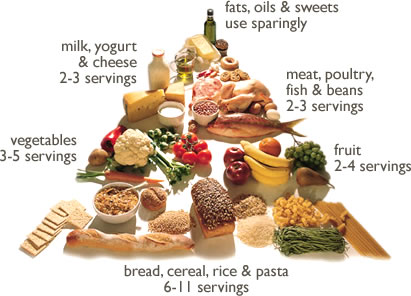
(Perfect for kids, but the bottom level should go on top of the protein shelf for adults)
The good old food pyramid seems to be right after all (In some areas of course).
Speaking of a vegan, plant-based diet, onto my next point about proteins, more specifically, animal proteins:
Proteins are obviously essential for your body; it’s the building block of your entire being, and essential for growth and repair (something young people are doing at a rapid rate) And because proteins from animals such as in eggs, fish, meat, are not only much higher in quantity per serve, they contain readily available essential nutrients such as vitamin B’s, iron, zinc. Unlike plants, they’ve got all the nutrients packed into a small-calorie dense package, which is perfect for young people who needs those essential amino acids at a more pressing rate. Therefore, it’s a good idea for young people to not completely banish animal protein from their diets.
Animal sources of protein contains much more protein per net weight than plant sources
One of the most protein rich plant source is lentils. A cup serving of lentils contains 230 calories and 18 grams of protein (not bad for a plant!)
Meanwhile, a half cup serving (all you really need) of roasted chicken breast contains 138 calories and 21 grams of protein.
As you can see, lentils contain roughly twice as much calories than found in chicken breast, while offering a little less protein but not only that…
Animal sources of protein contains readily available essential nutrients important for growth
Animal protein whether from eggs or red meat contain the bio-available versions vitamins such as vitamin B, and most importantly, do not contain nutrients absorption inhibiting compounds such as phytic acids (abundant in nuts, seeds, grains), tannin, etc. which can interfere with the body’s absorption of iron, vitamin B, calcium, etc. More on my post on phytic acid here: https://obsessivenutritioncompulsive.wordpress.com/2013/10/25/too-much-nuts-legumes-or-soy-products-causing-nutrient-deficiency-in-vegetarianvegans/
Being environmentally and cruelty conscious, what’s my take on animal protein in diets?
1. Moderate addition of animal protein into kids/teens’ diets should be enough to suffice for the amount of protein needed each day, and making sure that you are getting vitamins such as B, minerals such as iron, zinc, magnesium that’s harder to obtain from plants. That way, you won’t ever be overly buying animal products.
The source of animal protein: should idealistically from a cruelty-free source such as organic eggs, free-range farmed animals, game meat e.g. deer, rabbit.
Amount: Just enough to reach the daily recommendations per age group should be the best option for both the animals and your environment.
E.g. 45-50 grams for most teens (higher or lower according to weight and level of physical activity). So they would only need at least two 1/2 cups, modest serving of meat each day along with protein from healthy plant sources i.e. grains, nuts, etc.
The proteins I currently take are from:
– Organic or free-range eggs (twice a day) = around 12 g protein
– Small amounts of organic chicken meat = around 10+ g protein
– Plant sources i.e. whole grains, wheat flour, nuts, tofu, beans = around 18 g protein
(I need to watch the amount of plant proteins I eat, as they contain phytic/nutrients-inhibiting compounds)
Also, nutritional yeast flakes/spreads for vitamin B’s. And some vitamin, essential oil supplements.
2. Realistically, older adults don’t really need animal protein in their diets, they aren’t growing at a fast rate like kids are. Taking vitamin B or other mineral supplements, or plant alternatives such as yeast extract should be enough for the amount of nutrients vegan/vegetarian adults need. The only growing older people will be doing now is through their waistlines so a plant-based diet is the way to go!
Please feel free to make comments about my take and opinions on this matter.
-Iz
Updates
- Over the Chinese New Year holidays in Thailand, which lasted from January 30th until the 2nd of February, our family went on a trip to Huahin. Huahin is a popular vacation destination for Thai people - it is only a 3 hour drive away, the beaches are clean, the city is not busy or overcrowded, and the weather is breezy there. Here are pictures from our second day at the beach district: For brunch, we made a trip to a sea-side restaurant. Between the tables set on the beach where we ate were little chicks and their mother, strolling around for a light morning exercise. What puzzled me was the fact that the chicks varied quite a lot in sizes... the chickens belonged to the restaurant who fed them with some leftover rice placed in a big bowl. Here were the dishes we ordered: Deep fried tilapia in fish sauce. The fish was relatively fresh, and despite having been deep-fried, the inside was not too oily. Unfortunately, I have a thing for the crispy outer skin and crunchy bits, which do hold quite a bit of oil. But Thai deep fried fish is definitely much less fatty than something like kfc, because fish cooks very quickly in hot oil (because of its protein composition, as compared with other meat) and also they cut the fish with big slashes before deep frying. Other than grilled pork and fried chicken, deep fried fish is another 'Thai must-have' at dinner tables. Nearly everytime I go to Thai restaurants with family members, a deep fried fish must also be included in the meal - not the healthiest way to cook and eat fish! The flavours of the tilapia was slightly sweet and salty - the taste of fish sauce. Then we also ordered 'Hormok' - a dish I had introduced in my previous post here: https://obsessivenutritioncompulsive.wordpress.com/2014/01/24/kwan-riam-floating-market-a-brand-new-floating-market-experience-when-contemporary-meets-modern-day-thai-part-1/. The flavour was nothing special: coconut-y, sweet and slightly salty, just hormok. And its creaminess is something I don't totally enjoy. Kind of like eating a cheesy macaroni. Other than those two dishes, we ordered steamed mussels in basil leaves, fried rice with crab meat - another Thai must-have - and deep fried squid. Not pictured above were shrimp with 'sa-tor' stir fry, and oven baked shrimps with vermicelli noodles - my favourite dish as a child (on which I will later elaborate). But first, descriptions of each dish in chronological order. The steamed mussels were definitely very impressive - the flesh was incredibly soft and creamy. Some of the mussels were also tomato red, which was pretty interesting. It has been a while since I've had Thai mussels and I'd say they have more flavour than New Zealand mussels which were slightly tasteless but meatier and therefore full of protein. The flavour of basil definitely seeped into the mussels. The fried rice was just average. In fact, not even properly cooked. Good fried rice is fried with high heat to give a smoky (slightly burnt) taste and texture. This fried rice was just kind of like rice tossed in a bit of oil to warm it up. The deep fried squid was just bad. It was super hard as well as being oily. The oven roasted shrimp with vermicelli noodles were also nothing special. The best shrimp with vermicelli must have that creamy taste of shrimp fat, found mostly in the shrimp's head (the dreaded cholesterol!) mixed in with the sweet soy sauce, a bit of spring onion flavours which has soaked into the vermicelli. At the same time, the vermicelli noodles should not be too wet, but slightly springy. I think kids like this dish (including I as a child) because they like the sweetness of vermicelli with sweet soy sauce, and the fattiness of the dish (they put pig lard in to prevent the noodles from drying out when cooking) undeniably appeals to the human palate The shrimp stir-fry with 'sa-tor' was one of my favourite dishes at this restaurant. The shrimp was stir-fried with Thai 'name-prik kapi' which is Thai's spicy shrimp paste sauce. Because it was stir fried with sauce, the entire dish was not oily. However, I believe they would probably stir fry the shrimps and sa-tor in a bit of oil first, then, add in the 'nam-prik kapi' (but this considerably reduced the amount of oil in the dish) This stir-fry was packed full of flavours from this particular sauce - chunks of garlic, chili, shallots and red onions. Also a bit of sourness from the lime pieces and juice. 'Sa-tor' is a type of bean consumed mainly in Southern Thai dishes. It is quite strong tasting i.e. it has that funny 'greeny' taste, like the type you get from avocado. It also has a slight bitterness like something you might get from raw broccoli. 'Sa-tor' is definitely an acquired taste, which apparently makes your mouth stink incredibly badly. I have not yet had the misfortune to experience the 'sa-tor' breath. Later on that evening, we also went horse riding along the Huahin beach. 'Horse people' would come around on their horses to offer mainly children rides. The fare was not too hefty - 400 baht per half hour ride. But anyway, I went on one, while my cousin took the other which was a larger horse. Then afterwards, my seven year old cousins, and a four year old one all had a ride. The safety requirements in Thailand is pretty chill - basically non existent. No head gear for riders. I am slightly used to that sort of attitude having lived in New Zealand, the adventure capital apparently. For dinner, we went to another sea-side restaurant called "Barn isara" However, this time, we sat on a balcony overlooking the beach. Near the entrance, they had a display of some of their freshest seafood. The huge lobster definitely caught my eye. The greenish, black and orange patterns decorated its shiny shell. Unfortunately, my seven year old cousin was the photographer, and I never had the chance to re-take the shot! For some reason, we also ordered another deep-fried tilapia dish at this restaurant. I know that deep fried fish is a Thai dining meal thing, but the same sort of fish as well? I would say this fish was probably a bit drier than the one we had at lunch. Drier, as in more meaty, which is normally an indication of freshness. Fish should not be soft once cooked. We also ordered another Thai must-have: clear soup or what the Thais call Gang-jeud "Bland soup". Same as the Japanese have their miso soup to go with every meal, Thai people also opt for "bland soup" usually made with chicken ribs, or pork bone. The ingredients would include minced pork balls, white cabbage, seaweed, and whatever veggies you like. This soup was definitely a nice breaker from oily stir-fries, where I can have my veggies unwilted and not completely loaded with oil. This was one of my favourite dishes: Squid stir fry with salted duck egg sauce. The salted duck egg sauce was definitely incredibly rich and full of egg yolks (fat and cholesterol included) - kind of like Thai version of hollandaise sauce. Salty and mellow, the spring onions and red peppers provided refreshing bursts of slight sweetness and veggieness within the creaminess of the dish's sauce. The squid was also very soft, as in easy to bite into, not chewy, but still firm and fresh. Another copy-cat dish from that morning (brunch): steamed mussels in basil leaves. I would say the mussels we had that mid-morning were more impressive than this one. Why? Could be because I prefer soft textured mussels, whilst this one was more rubbery. But also because the flavours of basil leaves and herbs i.e. lemongrass/chili/galangal definitely did not soak in as much, leaving the mussels a bit too "natural" for my Thai palate (I put on a different sort of flavour preferences when I eat different nationalities of foods i.e. salty for Italian (sardines, olives and parmesan), sweet or salty for Chinese (sweet and sour stir-fries)) This was another one of their super delicious dishes (other than the stir-fry with salted duck egg sauce): Spicy "gra-tin" shoots with oyster. This was a "yum" dish which is a Thai way of cooking using mostly fresh herbs, chili and lime. "Yum" dishes are normally served at room temperature, and with lots of side veggies to counteract the fieriness of the dish. I have no idea why this oyster dish was named a "yum" on the menu because it does not really have many characteristics of a yum. The garlic were not fresh but has been fried, and so were the chili and "gra-tin" shoots (a type of vegetable that is slightly chewy). But this dish was nevertheless super yummy! The spicy and sour mix of the sauce was just right, enchanced by the flavours of fried garlic. The creaminess of oyster also went well with the chewy and slight strong flavours of "gra-tin" shoots. Here we have a "nam-prik" or Thai for chili sauce/dip which are most commonly eaten excessively with veggies or rice at most Thai meals. This particular "nam-prik" includes crab meat in it, alongside the typical "nam-prik kapi" or shrimp paste mix which includes shrimp paste, lots of garlic, chili, lime, etc. In my opinion, this "nam-prik" was a bit too sweet. It was like a "nam-prik kapi" with crab meat. After eating a Thai meal, you can just rule out dessert with the amount of sugar in each dishes (I'm only kidding). But a good thing is that a lot of fresh/steamed veggies are normally provided at meals. On to the so-called "star" of the night: the restaurant's signature and recommended dish which 'everyone must order' "hoi-talab" (a type of shellfish) in basil sauce. This dish was kind of lame (I was quite disappointed given all the fuss over this 'top' dish of theirs) The sauce was rather bland, and very oily. It is kind of like some underseasoned pesto with no nuts poured on top of shellfish. In conclusion, both the seafood restaurants we went to in Huahin had their upsides and downsides. There were super delicious dishes that I would love to have scoffed down alongside the "meh" ones and the 'you-are-supposed-to-be-a-restaurant' ones. Overall, I have learned that a cook cannot be perfect with all his dishes. On the last day of our mini-holiday, we had lunch at a "specialized chicken restaurant" called "Kannika Kitchen" (I'm liking this transliterated name - very catchy). All their meat dishes were made using chicken. Personally, I can't stomach chicken, chicken and chicken for an entire meal, but I don't know about other people (I guess Nando's can't be famous if people have the same problem as I, or this restaurant). Just one chicken dish is enough for me (and preferrably organic). Pictured were their signature dishes. We definitely had to order "Thai-style" fried chicken which was both average-tasting and dry. We also ordered the famous "stuffed chicken wings". What they do with the stuffed chicken wings is take off most of the meat on the wings, then stick onto the remaining bones a mix of minced pork and shrimp (which turned out to taste a lot like chicken I did not even realize what the mixture really was) and vermicelli noodles, all seasoned with soysauce, pepper, garlic, (I don't know what else) then battered and deep-fried. It was kind of like Chinese spring rolls, but in the shape of chicken wings and with lots more filling. Not bad at all though. Better than the actual chicken (no wonder people like McNuggets so much) Other non-deep fried dishes (yes!) include: minced chicken stir-fry with basil leaves and green curry with chicken. Chicken tom-yum (lots of veggies i.e. mushrooms, tomato) This is a close-up of the green curry. The chicken "larb". Larb is a kind of Thai dish, characterized by its spicy flavours and characteristic seasoning (dried chili flakes, crunchy ground roasted rice, mint, lime, etc.) Similar to "yum", larb is often served either warm or at room temperature. However, "yum" uses more fresh raw ingredients whilst larb's has been cooked. My cousin being annoying. Just kidding, she's a good kid most of the time. But I know how to deal with the kids anyway. You just have to treat them like they're your age, then they stop bothering you i.e. teasing/whining. As for the tastes of the dishes at this "Kannikar Kitchen" or in Thai "Krua Kannikar": Most of their dishes were quite oily. I suspect it's because they use quite fatty parts of the chicken, and always include the skin parts (the skin (of basically everything) is mostly left on in Asian cuisine anyway) which as a result, traps a lot of fat. Nevertheless, their dishes were very well seasoned (such as the very tasty spring roll chicken wings aka stuffed deep-fried chicken wings). "Krua Kannikar's" spicy dishes did not fail in living up to their titles, and the restaurant's food was thankfully not gearing towards the sweet side (which Thai restaurants tend to do). The minced chicken stir-fry with basil leaves was very well-seasoned. It was not too salty - they relied on garlic for borrowed flavours - nor oily either. The green curry was definitely oily as they are known for being i.e. as being curry. I find most "Western" green curry not as fatty as the traditional Thai ones where a bit more vegetable oil is used in the stir-frying of the chilies, chili paste, meat, etc. before mixing in with the soup and coconut milk. The good thing about this restaurant was that their "sweet green curry" (the transliterated name) was not as sweet as their name. This restaurant definitely instead, emphasized spiciness in their dishes, such as in this green curry. I definitely enjoyed the 'Thai eggplant' and smaller 'Thai eggplant'... ... which cooks much quicker than the typical bright purple "aubergine" and can even be eaten raw. The eggplants were used a lot in the green curry. The abundance of delicious nightshade veggies in Thailand is just overwhelming. I can just eat the "ma-keu-puang", "ma-keu" (eggplant), or "vine-y" plants like gourds, zucchini all day. Plus, these sort of veggies are cheap here in Thailand (compared to leafy veggies i.e. spinach, boychoy, kale). I need to be controlled. The chicken tom-yum was average. Once again with this restaurant, uber spicy. The chicken pieces used were super tender (with lots of skin and collagen on) which many people would enjoy but not me! The chicken "larb" was also well-seasoned, but I didn't like seeing oil floating around the top. It's supposed to be a "salad" (tossed mix of cooked mince, red onions) sort of dish! With so much oil and animal fat, I was glad to see a bit of green (albeit a bit too minimal). Fresh cumin root is great when eating fatty foods as they can greatly help you digest, or release gas, which can often become congested when eating oily food (slows down digestion). We also have some "Laos cilantro" which looks like bolted coriander to me. They are however, much different in flavour from coriander - very distinctive in taste, almost like a cross between very pungent basil leaves and celery. Other than that, they also served fresh basil leaves alongside: a very good digestion aid. The strange-looking veggie near the very front is called 'Pak-pai'. It was like chewing on a flower stem, (which it is - an aquatic plant with yellow flowers. The plant helps increase appetite amongst a few other health benefits) and the taste is quite pungent near the buds at the top. Overall, I would rate "Kannikar Kitchen" or "Krua Kannikar" as average, where the dishes are good tasting, but not totally wholesome and various. The lack of fresh veggies were also a bit disappointing i.e. if you are going to serve that much fried foods or meat, you are going to need more veggie dishes which they lack. This trip to Huahin was definitely filled with fun experiences i.e. riding horses along the beach (watching it pee in front of sunbathing tourists, twice), building sand castles with kids, and enjoying rich seafood and Thai roadtrip snacks i.e. corn cob on sticks or Chinese-style buns, and coffee stops (I probably had a bit too many daily servings of iced coffee during that trip!). I would say my fellow holiday goers most likely indulged themselves much more than I had, in their helpings of... shaved ice, sweetened iced drinks, durian chips, "Kanom Krok" (Thai coconut dessert), sticky rice with mango and coconut milk, and even Western-style doughnuts and McDonalds. My advice for vacationers would be to slow down on the food budget and eating! Try to keep on schedule in terms of activity and also eating, so you end up having done all the sight seeing you wanted to do, and don't get weighed down by feeling bloated or tired (because of improper meal times or having had too much to eat) - Izzy
- Being someone who had for a long time limited my carb (or sugar) intakes, and was on a vegan diet for a while, this post is strongly contradicting to my previous sets of beliefs. But I've had an epiphany about the carbs and proteins in my diet (much like my previous health epiphany here https://obsessivenutritioncompulsive.wordpress.com/about/ , or for a whole loads of other things for that matter! Whether it's vegan, high-protein, low-phytic; new scientific research are always emerging!). Who knows, I could be completely wrong about this, but from the information I've gathered, this theory seems most accurate and sensible right now. (All the carbs and proteins in a typical diet) I know lots of parents these days are more aware of the foods their kids consume; veering them towards whole-grains, plant-based, etc. And then there are vegan families out there who stuff their kids' lunch boxes with veggies, beans, nuts, or a large number of teens (especially girls) who control their carbs intakes. But really, two of the main essential nutrients for growing people is undoubtedly carbohydrates and proteins. Firstly, I will rant about the properties of carbohydrates: Let's start with the obvious. Carbohydrates are an important fuel for both the brain and the body. It supplies energy required to think and be active. Why kids need a moderate-high amount of carbohydrates in their diets Carbohydrates, especially simple carbohydrates are most easily absorbed into the blood stream by our body. So is the most readily form of nutrients for kids and teens who are both active and do a lot of thinking in class (I hope), as a result they will be needing a substantial amount of energy all the time. What happens when kids/teens don’t eat enough carbohydrates? Without that ready source of energy, the body may begin to break down other cell tissues such as muscles or fats, and this leads to a very thin, frail physique (ideal for dieting teenage girls!) but also stunted growth. Young adults can continue to grow , generate new cells in their bodies into their early twenties, and so a balanced nutritional plan is important for both kids, teens and adults in their twenties (as a proper blueprint for their later life). Some consequences of a low/no-carb diet in young people include loss of bone mass leading to osteoporosis and improperly developed brain and body. That's why young people aren't necessarily suited for the low-carb, gluten-free diet advertised by Miley Cyrus, or kids fed on a fully whole-grain diet like Gwyneth Paltrow who would rather die than have her kids eat cup noodles. Carbohydrates is the best brain food so not eating enough can also interfere with kids/teens’ classroom performance. Complex carbohydrates like brown rice or whole wheat bread are ideal, while extremely high-fibre carbohydrates like whole grains may have negative effects on kids' nutrients absorption. What type of carbohydrates is suitable for kids and teens? This doesn’t mean teens and kids should be having their sugar fix from lollies to think better. The best carbs for growing teens and kids are those whose energy can be easily absorbed, and also providing other nutrients like vitamins, minerals, etc. Here in my opinion, are the best carbohydrates for growing people: 1. Medium GI carbs such as long-grain rice, brown rice, rye bread, muesli - ready source of energy while doesn't raise the blood sugar too quickly, contains adequate amount of fibre. 2. Some low GI carbs such as whole grains like quinoa (okay, not a grain but similar!), amaranth, barley, rolled oats, all beans, lentils - These carbohydrates are incredibly nutritious and delicious, but because they're so high in fibre, can quickly fill you up, they can may end up not supplying young people with enough energy they need. Imagine little kids trying to digest all the fibre-rich beans in their lunch box. On the other hand, low GI carbs are great for older people controlling their weight. *Low GI foods are often very hard to digest (Cows need a second stomach for digesting grass for pete's sake) and sometimes doesn't give growing people the quick energy they need. On the other hand, older people are generally not as active, so food that lasts longer in the stomach is most ideal to prevent overeating* 3. A generous amount of fruits! These are a natural, vitamins-rich source of high energy and should be eaten in place of sugar or refined flour products. The fructose absorption is slowed down through the amount of fiber they contain, so 2-3 cups should be ideal for active kids. And lastly, a variety of veggies from carrots, lettuce, peas to spinach. Contrary to popular beliefs, veggies shouldn't completely dominate young kids' plates since they can fill them up with fiber and water (especially raw) while offering little calories or energy. That's why vegan kids need to watch their meal plans out! (Perfect for kids, but the bottom level should go on top of the protein shelf for adults) The good old food pyramid seems to be right after all (In some areas of course). Speaking of a vegan, plant-based diet, onto my next point about proteins, more specifically, animal proteins: Proteins are obviously essential for your body; it's the building block of your entire being, and essential for growth and repair (something young people are doing at a rapid rate) And because proteins from animals such as in eggs, fish, meat, are not only much higher in quantity per serve, they contain readily available essential nutrients such as vitamin B's, iron, zinc. Unlike plants, they've got all the nutrients packed into a small-calorie dense package, which is perfect for young people who needs those essential amino acids at a more pressing rate. Therefore, it's a good idea for young people to not completely banish animal protein from their diets. Animal sources of protein contains much more protein per net weight than plant sources One of the most protein rich plant source is lentils. A cup serving of lentils contains 230 calories and 18 grams of protein (not bad for a plant!) Meanwhile, a half cup serving (all you really need) of roasted chicken breast contains 138 calories and 21 grams of protein. As you can see, lentils contain roughly twice as much calories than found in chicken breast, while offering a little less protein but not only that... Animal sources of protein contains readily available essential nutrients important for growth Animal protein whether from eggs or red meat contain the bio-available versions vitamins such as vitamin B, and most importantly, do not contain nutrients absorption inhibiting compounds such as phytic acids (abundant in nuts, seeds, grains), tannin, etc. which can interfere with the body's absorption of iron, vitamin B, calcium, etc. More on my post on phytic acid here: https://obsessivenutritioncompulsive.wordpress.com/2013/10/25/too-much-nuts-legumes-or-soy-products-causing-nutrient-deficiency-in-vegetarianvegans/ Being environmentally and cruelty conscious, what's my take on animal protein in diets? 1. Moderate addition of animal protein into kids/teens' diets should be enough to suffice for the amount of protein needed each day, and making sure that you are getting vitamins such as B, minerals such as iron, zinc, magnesium that's harder to obtain from plants. That way, you won't ever be overly buying animal products. The source of animal protein: should idealistically from a cruelty-free source such as organic eggs, free-range farmed animals, game meat e.g. deer, rabbit. Amount: Just enough to reach the daily recommendations per age group should be the best option for both the animals and your environment. E.g. 45-50 grams for most teens (higher or lower according to weight and level of physical activity). So they would only need at least two 1/2 cups, modest serving of meat each day along with protein from healthy plant sources i.e. grains, nuts, etc. The proteins I currently take are from: - Organic or free-range eggs (twice a day) = around 12 g protein - Small amounts of organic chicken meat = around 10+ g protein - Plant sources i.e. whole grains, wheat flour, nuts, tofu, beans = around 18 g protein (I need to watch the amount of plant proteins I eat, as they contain phytic/nutrients-inhibiting compounds) Also, nutritional yeast flakes/spreads for vitamin B's. And some vitamin, essential oil supplements. 2. Realistically, older adults don't really need animal protein in their diets, they aren't growing at a fast rate like kids are. Taking vitamin B or other mineral supplements, or plant alternatives such as yeast extract should be enough for the amount of nutrients vegan/vegetarian adults need. The only growing older people will be doing now is through their waistlines so a plant-based diet is the way to go! Please feel free to make comments about my take and opinions on this matter. -Iz


Top Posts & Pages


Blogs I Follow


